If you’ve ever watched a Dario Argento film, you know how important music is to his art.
After collaborating with Ennio Morricone on his first three films, Argento used an Italian progressive rock band for his 1975 film, Deep Red. Argento and Goblin turned out to be a perfect match and the band went on to compose and perform the scores of several other Argento films, most famously for Suspiria.
In this clip from 1975, Goblin performs the main theme for Deep Red on an Italian TV show. (Sorry, I don’t know the name of the show.)
4 Shots From 4 Films is just what it says it is, 4 shots from 4 of our favorite films. As opposed to the reviews and recaps that we usually post, 4 Shots From 4 Films lets the visuals do the talking.
I can’t let this October pass without paying tribute to one of my favorite directors. It’s time for….
I’ve been using this year’s horrorthon as an excuse to watch and review all (well, almost all) of Dario Argento’s films! Today, I take a look at one of Argento’s best — 1975’s Deep Red!
After the successful release of Four Flies on Grey Velvetin 1971, Dario Argento announced his retirement from the giallo genre. His next film was 1973’s The Five Days of Milan, a historical comedy-drama with a political subtext. The Five Days of Milan was a huge box office flop in Italy and, to the best of my knowledge, it was never even released in the United States. To date, it is Argento’s most obscure film and one that is almost impossible to see. In fact, it’s so obscure that, in two of my previous posts, I accidentally called the film The Four Days of Milan and apparently, no one noticed.
Forgotten Argento
After the failure of Five Days, Argento returned to the giallo genre. And while he was undoubtedly stunned by the failure of his previous film, Argento ended up directing one of the greatest Italian films of all time. If The Bird With The Crystal Plumage and Four Flies on Grey Velvet were both great giallo films, Deep Red is a great film period. It is Argento at his over the top best.
Now, before I go any further, I should point out that there are many different versions of Deep Red floating around. For instance, it was released in the United States under the title The Hatchet Murders and with 26 minutes of footage cut from the film. For this review, I watched the original 126-minute Italian version. I’ve always preferred the original to the shorter version that was released in America. Oddly enough, Argento has said that he prefers the shorter version.
Deep Red opens with a blast of music that both announces Argento’s return to the giallo genre and also provides some hints to his future as a filmmaker. Whereas his previous films had all featured an excellent but rather serious score by Ennio Morricone, Deep Red was the first Argento film to be scored by Goblin. There’s a gothic, almost operatic playfulness to Goblin’s work on the film. (If the Phantom of the Opera had ended up working in Hollywood and writing film scores, the end result would have sounded a lot like Goblin.) Goblin’s deafening score works as the perfect sonic companion to Argento’s constantly roving camera and vibrantly colorful images. (The blood spilled in Deep Red is the reddest blood imaginable.)
Deep Red‘s protagonist is Marcus Daly (David Hemmings) and, like so many Argento protagonists, he’s both an artist and a man without a definite home. At one point, he explains that he was born in England, grew up in America, and now lives in Italy. He’s a jazz pianist but he supports himself by giving music lessons. In a scene excised from the American cut, Marcus tells his students that, while classical music should be respected and appreciated, it’s also necessary to be willing to embrace art that some critics would dismiss as being “trashy.” Marcus, of course, is talking about jazz but he could just as easily be Dario Argento, defending his decision to return to the giallo genre.
While Marcus plays piano and tries to help his alcoholic friend, Carlo (Gabriele Lavia), a German psychic named Helga Ulmann (Macha Meril) is giving a lecture when she suddenly announces that someone in the audience is a murderer. Later, Helga is brutally murdered by a gloved, hatchet-wielding attacker.
(Helga’s murder scene is always difficult for me to watch, even if Argento doesn’t — as Kim Newman pointed out in a review written for Monthly Film Bulletin — linger over the carnage in the way that certain other horror directors would have. I have to admit that I also always find it interesting that Helga is played by the same actress who, that same year, would play the evil Lady On The Train in Aldo Lado’s The Night Train Murders. Playing one of the Lady’s victims was Irene Miracle, who later co-starred in Argento’s Inferno.)
The only witness to Helga’s murder? Marcus Daly, of course. He’s standing out in the street, having just talked to Carlos, when he looks up and sees Helga being murdered in her apartment. Marcus runs up to the apartment to help, arriving just too late. And yet, Marcus is convinced that he saw something in the apartment that he can’t quite remember. Deep Red is yet another Argento film that deals with not only the power of memory but the difficulties of perception. Marcus knows that he saw something but what?
Well, I’m not going to spoil it for you! In this case, the mystery and its solution makes a bit more sense than the mysteries in Argento’s first three films. Argento isn’t forced to resort to debunked science, like he did in both Cat o’Nine Tails and Four Flies on Grey Velvet. One reason why Deep Red is so compulsively watchable is because, for perhaps the first time, Argento plays fair with the mystery. After you watch the film the first time, go back and rewatch and you’ll discover that all the clues were there. You just had to know where to look.
That said, the way that Argento tells the story is still far more important than the story itself. Argento’s first three films may have been stylish but Deep Red finds Argento fully unleashed. The camera never stops moving, the visuals are never less than stunning with the screen often bathed in red, and Goblin’s propulsive score ties it all together. This is one of those films from which you can’t look away. It captures you from first scene and continues to hold you through the gory conclusion. Deep Red is an undeniably fun thrill ride and, even today, you can easily see why Argento frequently refers to it as being his personal favorite of his many films. In fact, Argento even owns a store in Rome that is called Profondo Rosso.
But you know why I really love Deep Red?
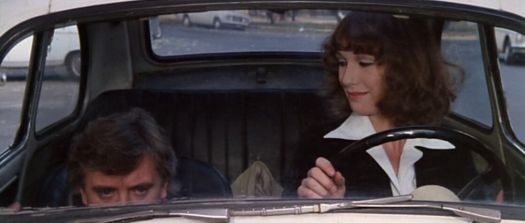
It’s all because of the relationship between David Hemmings and Daria Nicolodi. Daria Nicolodi plays Gianna Brezzi, a reporter who helps Marcus with his investigation. After three films that featured women as either victims or killers, Gianna is the first truly strong and independent woman to show up in an Argento film. I know that some people have criticized the scenes between Hemmings and Nicolodi, feeling that they drag down the pace of the movie. I could not disagree more. Both Hemmings and Nicolodi give wonderful performances and their likable chemistry feels very real.
Gianna and Marcus arm westle. (Gianna wins. Twice.)
To me, that’s what sets Deep Red apart. You care about Marcus and you care about Gianna. Yes, the mystery is intriguing and the murder set pieces are brilliantly choreographed, and Deep Red is definitely Argento at his best. But for me, the heart and soul of the film will always belong to the characters of Marcus and Gianna and the performers who brought them to life.
Deep Red was the start of Dario Argento and Daria Nicolodi’s long and often contentious relationship. (Dario and Daria’s daughter, Asia Argento, was born around the same time that Deep Red was released and has directed two films, Scarlet Divaand Misunderstood, that deal with her often chaotic childhood.) This relationship would play out over the course of six films and, as much as I love those six films, it’s always a little sad to consider that, when watched in order, the provide a portrait of a doomed and dying romance, one that did not particularly end well. (It is possibly not a coincidence that, with the exception of Deep Red and Tenebrae, Daria Nicolodi suffered some type of terrible death in every film she made with Argento.)
But, regardless of what may or may not have been going on behind the scenes, Deep Red remains a triumph for both its director and its stars.
Halloween is less than a week away and for the next few days there’ll be more song of the day choices and this time around it will all be centered on horror. To start things off I chose the theme from George A. Romero’s Dawn of the Dead which was composed by the Italian prog-rock band Goblin.
The theme’s titled “L’alba Dei Morti Viventi” and it definitely creates a dissonant tone which just creeps along and makes one feel more than just a bit uncomfortable. Goblin used a lot of their electronic music background to make this such a signature and iconic horror theme. Anyone who has seen the original Dawn of the Dead will automatically recognize this theme and the feeling it brings up. A feeling of dread and of creeping horror which perfectly describes the zombies from Romero’s grand opus.
Horror fans everywhere have Italian horror maestro Dario Argento for having gotten Goblin to create the score for Romero’s film (Argento was one of the key producers for the film and even re-cut it for the European market). Goblin had already worked with Argento on previous films with their best early work with the filmmaker being the score for ProfondoRosso (known as Deep Red in the US and English market). But no matter how many other Italian horror scores the band has made since Dawn of the Dead (and the ones after have been great in their own right) it will be their score for that film which will indelibly link the band in film music history.
PS: as an added bonus below is the band’s theme for Argento’s Profondo Rosso.




 Through the Shattered Lens