Decade of last.fm scrobbling countdown:
47. Explosions in the Sky (647 plays)
Top track (93 plays): Memorial, from The Earth is Not a Cold Dead Place (2003)
Featured track: Your Hand in Mine, from The Earth is Not a Cold Dead Place (2003)
f#a#oo and Ágætis Byrjun might constitute my first introductions into the diverse world of sound we generalize as post-rock, but Godspeed You! Black Emperor and Sigur Rós both forged unique paths that few if any bands have successfully replicated. When I think of the quintessential sound I associate with the genre, it’s Explosions in the Sky and Mono that first come to mind. (And Isis, for the genre’s metal variant.) I don’t know that any band has so successfully perfected the build-up to explosion formula without ever delving into metal as these guys. (The featured track here accomplishes this in a particularly subtle manner.)
While Memorial is my most played track, I don’t consider it my favorite. That title more rightly belongs to Your Hand in Mine. Their level of quality is so consistent though that nearly any track could have incidentally topped my play chart. Another thing I’ve always found so compelling about these guys is their knack for appropriate titles. This extends beyond a band name that perfectly captures their sound and the most pleasantly optimistic album title I have ever encountered. (The Earth is Not a Cold Dead Place) Their track titles casually reach for the stars, predicting an overload of emotion and imagery that the songs themselves never fail to deliver. It’s amazing how much “A Poor Man’s Memory” and “First Breath After Coma” are enhanced by four simple words. “The Birth and Death of Day” practically names itself. More than any band I have encountered save perhaps Krallice, Explosions in the Sky have mastered the art of employing language as a descriptive subtitle to the thoughts and experiences they directly express through sound. The absurdity of this for Explosions is that they achieve it while remaining an exclusively instrumental band.
This is embarrassing. Here it is 2013, and my 2012 collection consists of only 38 albums, the majority of which I’ve listened to twice at best. I never heard the new Neurosis. I never heard the new High On Fire. Hell, forget metal, I didn’t even listen to the new Shins and Godspeed albums. I can’t offer an experienced, informed opinion now the way I could at the end of 2011. But I’ve been posting up some sort of album of the year list somewhere for over a decade now, and I’ll be damned if I let the fact that I didn’t really listen to any albums in 2012 stand in my way.
Or something like that. Here we go.
10. Dawnbringer – Into the Lair of the Sun God (track: IV)
It’s not often I get into a standard heavy metal album, but Dawnbringer did everything right in 2012. The songs rock along with a bit of an Iron Maiden drive to them, the power and black metal tendencies are tastefully incorporated to enhance the drive without altering the vibe, and the vocals know their limit. If it sounds a bit generic, don’t let that fool you. Not too many bands can pull this off without giving into the temptation to be more “epic” or “extreme” than they really are. Dawnbringer pull it off without the flare–without ever going over the top–and their accessibility places Into the Lair of the Sun God among the best of the year.
9. Korpiklaani – Manala
I wouldn’t say Hittavainen was the heart and soul of Korpiklaani, but he was an essential component. The band would be at a total loss without Jonne Järvelä, and their consistent line-up over the years has contributed enormously to their success, but Juho Kauppinen’s accordion aside, the folk instrumentation was almost all a product of Hittavainen. When he left due to health issues after Ukon Wacka in 2011, I feared it was the end of an era. Korpiklaani never missed a beat recovering from the loss in 2012. In addition to picking up the highly qualified Tuomas Rounakari as their new violinist, Jonne Järvelä stepped up to fill in the void by recording the mandolin, flute, and whistle tracks. I think I can hear some nuance differences between his and Hittavainen’s playing style, but it might just as well be in my head; Manala sounds like a Korpiklaani album through and through. I don’t like it as much as Karkelo and Ukon Wacka–it’s a bit heavier, too much so for my taste in folk metal–but in the greater sphere of Korpiklaani’s discography it is certainly composed and performed to par.
8. Ensiferum – Unsung Heroes
Ensiferum took a lot of slack for this album. I think a lot of people wanted to hear the over-the-top bombast that worked so effectively on Victory Songs, but in my opinion that was already growing stale on From Afar. Unsung Heroes is down to earth in a way they haven’t been since the 2001 self-titled debut, and I love it. They’re heading in exactly the direction I’d hoped for, and with the exception of the ugly mistake that is the album’s 17 minute closing track, Power Proof Passion, Unsung Heroes does not sound at all like a band past their prime. If they continue to push in the direction of tracks like Pohjola, they’re in position to trump Victory Songs and follow up Unsung Heroes with their best album to date.
7. Wodensthrone – Curse
I wish I’d taken the time to review this album earlier in the year, because I haven’t listened to it since the summer, and their flavor of epic black metal isn’t the sort of thing you can fully absorb in a quick last-minute listen. This is an album that can move nowhere but up in my charts over the months to follow, but for the time being I am content to place it somewhere in the middle. While busting out black metal that’s just as grim and unforgiving as the 1990s greats, Wodensthrone manage to infuse a tremendous amount of emotion that speaks of something beautiful hidden beneath the chaos. It’s buried a bit deeper than say, Femundsmarka by Waldgeflüster last year, but the feeling is similar.
6. Vattnet Viskar – Vattnet Viskar EP (song: Weakness)
If someone were to ask me what black metal sounded like in 2012, I might hand them this EP. It’s kind of cool getting to say that, because one of their members is a regular at the music forum where I get most of my recommendations. I wouldn’t have guessed back in March that they would be signed to Century Media by the end of the year, but I’m stoked to hear it. The whole notion of post-black metal has taken on a number of different flavors in these formative years, and Vattnet Viskar expand the genre by incorporating a lot of the all-encompassing guitar tones I associate with post-rock acts like Mono and This Will Destroy You. Top-notch stuff that’s really at the forefront of an emergent genre I’ve been anticipating for years.
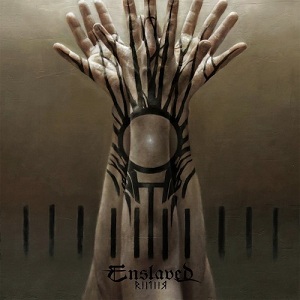
5. Enslaved – RIITIIR
How Enslaved have aged so well is beyond me, but their last three albums have been their best three albums, and 22 years after the formation of this band they remain at the forefront of metal. Their viking-infused progressive black sound of late has done as much to shape the future of the genre as any new-found participant in the current popular trend towards black metal that has been taking shape over the past four years. RIITIIR is another outstanding output by the one classic early 90s black metal band that has managed to weather the ages unscathed.
4. Blut aus Nord – 777: Cosmosophy
The review I wrote of 777: Cosmosophy last month was one of the most thorough I’ve done all year, and there is nothing I care to say about the album that I haven’t said already. It is outstanding in its own right, but it does not feel like an entirely complete finale to their already classic 777 series. The first and third tracks, breathtaking though they may be, don’t seem to sufficiently progress from where the second album in the trilogy, The Desanctification, left off. The second track moreover, Epitome XV, is the weakest link on all three albums. The last two tracks compensate greatly by concluding in proper form, and I certainly think Cosmosophy is excellent. It can only be said to have “shortcomings” in so far as I expected it to be the best album of 2012. Fourth place isn’t too bad.
3. Torche – Harmonicraft (song: Reverse Inverted)
Calling Torche metal at this point is really pushing the limits of the definition. Since their early days writing crushing stoner anthems, they have evolved into a bizarre amalgamation equal parts metal and pop. But it’s not just the uniqueness of the happy, smiley-face hammers Harmonicraft beats you down with that makes it so appealing. Torche have become by all rights the heirs of the 1990s. These guys have more in common with the Smashing Pumpkins than they do with any of their stoner metal contemporaries. This is the sort of thing that 15 years ago we could have just labeled “alternative rock” and gone on enjoying without any need for classifications. While forging an entirely unique, original sound of their own, Torche have managed to capture a song-writing ethos that has been dead for a generation, and Harmonicraft is the cleanest breath of fresh air I’ve inhaled in years.
2. Krallice – Years Past Matter (song: Track 2)
Krallice is my favorite band making music today, and I dare say last year’s Diotoma might be my favorite album by any band ever. Seldom if ever has a band followed up such a masterpiece with something of equal worth, and I was shocked that Krallice had the energy left to release anything at all this year. Years Past Matter is an outstanding post-black metal outing in the vein of Dimensional Bleedthrough. The tracks took longer than usual to grow on me, and usual for Krallice entails dozens of listens, but the payout is always worth the time, and the slow process of appreciation is enjoyable in its own right. Mick Barr and Colin Marston’s dual tremolo is the grand ultimate ear-candy, and so long as they never compromise their commitment to that they will probably remain my favorite band. (Track 3 is my favorite song on Years Past Matter so far, but it was not available on youtube. Track 2 is a worthy substitute.)
1. Panopticon – Kentucky (song: Killing the Giants as They Sleep)
The fact that I didn’t review this album is almost embarrassing, because much like Aesthethica by Liturgy last year, it is an album that absolutely demands a thorough investigation to properly appreciate. I can’t easily tell you why I placed it this high, because frankly I don’t know yet myself. When I first read that a Louisville, Kentucky-based band called Panopticon had released a bluegrass black metal album, all sorts of thoughts ran through my head. Kentucky sounds like none of them. Do ignore the cliche “blackgrass” labels; while Austin Lunn listened to plenty of bluegrass in the process of recording this, he does not actually incorporate the genre as we might think of it. Instead he interweaves traditional Appalachian folk–not bluegrass particularly–as distinct tracks separated from the black metal. What folk does emerge in the bm is more akin to Waylander, and certainly far from “bluegrass”. That’s not a bad thing, just an–I think–important distinction to be made, because otherwise we might be left searching for genre stereotypes which simply aren’t present here. What Kentucky really accomplishes is a merging of a musical themes which perfectly juxtapose a beautiful landscape and a totally destitute human condition. The first half of “Killing the Giants as They Sleep” for instance generates landscape imagery with a degree of effectiveness similar to Femundsmarka by Waldgeflüster. (Have I referenced that album twice now? I think it’s time I paid it another visit.). You take a look around, take a deep breath, and really appreciate the natural beauty that surrounds you. About half way through the dialogue begins, and the explosion around 9:15 serves to draw you fully into the atrocities taking place here, both in the exploitation of workers and the desecration of the environment.
I don’t think Austin Lunn intended to make any sort of political statement here, but in succeeding so comprehensively to depict elements of Appalachia and its outskirts, he effectively did so. At a time when the working class of America is inexplicably becoming staunch supporters of big capital, this album hits a bulls-eye on all of the thoughts that have been forefront on my mind of late. His bleak renditions of union anthems like “Which Side Are You On?”, recently covered with such optimism by the likes of Dropkick Murphys, strike me as a painfully realistic reminder that the entire notion of equality as an American ideal is becoming antiquated.
But that might be seen as secondary. Wherever our ideas may lead us, Kentucky is the sort of album that inclines us to form them. It’s an album that makes me think. Like Aesthethica by Liturgy and Diotima by Krallice last year, it forces me to set aside my mundane daily routines and really engage the human experience. That alone, all other considerations aside, suffices to render it my favorite album of 2012.
You would be hard-pressed to find an album which more reviews have simultaneously labeled generic and beautiful than Les Voyages De L’Âme. It’s an odd situation. Neige has definitely found his sound. I have to imagine that he personally is more satisfied with his work now than ever. The catch is that a lot of people appreciated his music best when he was still searching for something. Les Voyages De L’Âme is beautiful, no doubt about it. It’s a journey through a mysterious, fanciful world that I have taken for 50 minutes frequently this year; it was released in early January, so it’s technically a year old at this point.
Là Où Naissent Les Couleurs Nouvelles
But such descriptions cannot characterize all of his works. Neige’s music has a bit of a narrative in it, told not so much in a single album as in the scope of his career. His first release, Tristesse Hivernale (2001), was a poorly produced sinister ride not particularly unlike the debuts of the Norwegian legends. It also happened to feature an early appearance by Famine, whose Peste Noire took a drastically different and equally admirable path in the years to follow.
Neige didn’t release an Alcest follow-up until 2005, but “Le Secret” revolutionized metal. The two-track EP was an odd consequence of Neige continuing to play black metal while aspiring towards the atmospheric polar opposite. What you got was something beautiful but perpetually fragile; a glimpse at something angelic in music’s darkest corner, which threatened to fade away at any given moment. It’s the sense that what you’re hearing reveals itself in temporary, fleeting form that really places Le Secret above the rest of Neige’s work for me.
Neige was openly bothered by the reviews Le Secret received. A lot of people just didn’t get it, or more likely did get it but felt some bone-headed sense of masculinity in jeopardy should they admit to getting it. Neige regarded the album as a failure. I think the failure was on the part of the listeners who reviewed it, and I was borderline devastated when Neige re-recorded Le Secret last year. But in any case, the fleeting nature of Le Secret’s sound reflected a real fleeting feature of Neige’s style: It wasn’t what he was ultimately aiming for. It was, rather, the last step on the way to getting there. Souvenirs d’un autre monde was the full realization. We might for stylistic purposes label it shoegaze black metal, but it was really post-black metal in the most literal sense.
Souvenirs d’un autre monde was, to me, all about the triumph. It reached for that light buried within Le Secret and made it through to the other side. Neige’s music finally entered that fanciful world of light and beauty that he had envisioned all along. If Le Secret was all about getting there and Souvenirs d’un autre monde was the overwhelming awe he felt when he reached it, Écailles de Lune might be understood as a more orchestrated exploration of what waited on the other side.
Faiseurs De Mondes
This might seem a very peculiar and abstract way to go about describing a discography, but I think it reveals the reason why Les Voyages De L’Âme feels in some sense generic or repetitive. I don’t think Neige planned out any sort of progression from Tristesse Hivernale through to Écailles de Lune. Rather, he is one of those truly great musicians capable of effectively recreating his thoughts in music, and as Neige the man/musician developed his vision over time, his music progressed to reflect it. In the two years that separate Écailles de Lune from Les Voyages De L’Âme not much appears to have changed, and what Les Voyages De L’Âme lacks has absolutely nothing to do with quality. The music is superb. It’s just that we have come over the years to expect perpetual transition, and Les Voyages De L’Âme instead continues to explore the other-worldly landscape Neige first fully entered on Souvenirs d’un autre monde. Les Voyages De L’Âme is in every way Écailles de Lune Part 2.
Given Neige’s past responses to criticism, who knows how he might react to the labels of “generic” being pasted on Les Voyages De L’Âme in otherwise positive reviews. I think the aspect of his sound that is being criticized in this regard isn’t really something he can help, and anyway the context in which the album may be called “generic” is a major stretch from the normal sense of the word. Better to say that it is a continuation of Écailles de Lune, and outstanding as such.
If there are any further doubts, I should inform you that Sophie loved it. She has impeccable taste.
VGM Entry 26: Tim Follin’s noise machine
(Thanks to Tish at FFShrine for the banner)
In most cases it’s fairly reasonable to think of the ZX Spectrum as a secondary system for game music. It didn’t seem to have the capacity of the Commodore 64, and a lot of the game themes that ended up there were toned down takes on C64 originals, attempting to emulate the SID sound as closely as possible. But the ZX Spectrum did have its own unique if seldom exploited flavor, and over the course of three years one ingenious artist in particular would develop that into a brilliant new chiptune style to rival anything produced for the SID.
Some time in 1985, or perhaps a bit earlier, Mike Follin scored a programming job at Insight Software. Mike passed the soundtrack of what would be his first commercially released game, Subterranean Stryker (Insight, March 1985), down to his musically inclined younger brother Tim, who thereby got his first taste of programming. The result was fairly simple–little more than an amateur doodle–but for a 15 year old kid with no prior programming experience it was a pretty sound start. Insight Software were satisfied enough to keep Tim Follin around, and over the next year he familiarized himself with the sounds of the ZX Spectrum.
What he probably didn’t do was familiarize himself with the sounds of Rob Hubbard. What emerged from Tim Follin’s early experimentation on the ZX Spectrum was a sound all of its own. Agent X (Mastertronic, 1986) was heavily influenced by progressive rock, a feature which would characterize Tim’s work across multiple decades and platforms, but its uniqueness rested on his productive employment of the system’s excessively distorted tones. Rather than viewing the distortion as an obstacle blocking the path to quality arrangements, Tim Follin made it an essential and intrinsic feature of the music.
Agent X didn’t appear out of nowhere. Follin’s sound steadily improved during his short stint with Insight Software, such that on Vectron (late 1985) you can definitely hear a rough draft of things to come. His better works also coincided with his first real job. Follin was hired by developers Software Creations in 1986 (they developed all of the Mastertronic games I’ll be featuring here); he was no longer tailing his brother and composing for spare change. The compositional quality understandably improved in turn.
Tim Follin’s ZX Spectrum sound was unlike anything heard on the Commodore 64. It was a sort of post-rock prog shoegaze madness before any such notion formally existed, meant to be blasted at maximum volume, encasing the listener in a wall of sound. Future Games (Mastertronic, June 1986), my personal favorite on the system, was a far more intelligent piece than Agent X. The way the song slowly builds up into a glitch-beat explosion at 2:06 is a tremendous feat given how little Follin had to work with. The song essentially ends unfinished at 2:31, but I think that can be forgiven in light of what all he accomplished here.
I think a lot of this style is the product of Follin’s own originality, and fairly unprecedented in its day. Certainly outside influence on some of the progressive rock elements is self-evident, and in an interview probably dated to 1999 or 2000, the original of which is now lost, Follin acknowledged that he was exposed to a lot of Genesis, Yes, and Rush growing up. But the shoegazey layer of static and especially the glitch beats are features I don’t start to identify in other musical scenes until some time later. It’s not like he was listening to Aphex Twin and Venetian Snares at home.
Agent X II (Mastertronic, 1987) was a good deal more accessible than most of his previous works, featuring a bluesy groove and plenty of rock and roll soloing, but noise was still the glue that held it all together. I think it’s pretty telling that when Tim Follin programmed the Commodore 64 port sound–Agent X II and Scumball (Mastertronic, 1987) were his first attempts at C64 composition–he wrote an entirely new set of songs. Follin based everything he wrote around the instrument with which he wrote it, and however much other artists were trying to make the ZX Spectrum sound like a C64, these were two different animals.
Chronos (Mastertronic, 1987) is probably his most famous ZX Spectrum theme, and understandably so. Technically, or so I gather from the comments I’ve read, it is his most outstanding effort on the system. I don’t know enough to recognize technical skill in chiptune programming when it slaps me in the face. But I think the music speaks for itself. Tim Follin was to the ZX Spectrum what Rob Hubbard was to the Commodore 64, and it was only his first of many legacies.
Just a little under a year ago I had chosen a particular favorite song as the latest “Song of the Day”. This song was Clint Mansell’s “Together We Will Live Forever”which was part of his exceptional film score for Darren Aronofsky’s 2006 scifi love story, The Fountain. I’ve decided to finally bookend that choice by choosing what has to be the best song in that film’s soundtrack and one of the best piece of film score ever composed: Mansell’s “Death Is the Road to Awe”.
While I’ve given Mansell with the final credit for the creation of this epic song (not just in tone and execution but in length), he had help from frequent collaborator Kronos Quartet and Scottish post-rock band Mogwai. “Death Is the Road to Awe” takes the entirety of Mansell’s film scoring for The Fountain and distills them into a mixture of classical, post-rock and ambient dissonance which seems to all work so well together despite their very differing musical styles.
The Fountain was (still is) a film which brings out either love and admiration for it or utter hate for what some think was a pretentious, jumbled mess. Whether one loved or hated the film (rarely is there one who falls in the middle in their reaction to this film) the reaction most have had for the soundtrack has been mostly positive. I, for one, truly believe it to be one of the greatest film scores ever composed for any film. This song is the ultimate culmination of Mansell’s work for this film and just shows that classical, rock and electronic could co-exist side-by-side to create something truly unique and one-of-a-kind.
It’s not really a coincidence that the two genres of music I’ve listened to most over the years are black metal and post-rock. Something about tremolo guitar very consistently inspires me, and these are the two styles that most frequently and effectively utilize it. But post-rock is one of the most diverse styles of music on the market, and if it employs techniques found in black metal to capture its most intense moments, its other reaches are inexhaustible. It’s characterized more by the effect it produces in the listener than by the means it employs towards this end, and tremolo guitar just happens to be the best–certainly not the only–technique suited for it. The effect it produces is, you might say, a general sense of awe.
When we speak of post-black metal we’re suggesting a branching out from something that is much more locked in place. Technically black metal means tremolo guitar and blast beats, plain and simple. Thematically it goes a bit beyond post-rock, exploring and reveling in a very wide array of human emotions which, to conform to a cultural misconception, might be generally described as negative. Sometimes a post-black metal tag suggests bands that break out from tremolo and blast beats but stick to the same “negative” themes, as in say, Agalloch. Sometimes a post-black metal tag suggests something more like “progressive black metal” which finds creative new ways to employ blast beats and tremolo picking, like Ihsahn or Krallice.
Obviously musical classifications are dubious, sometimes illogical, and only really practical as a shorthand for “you might like this band if you like x”. But with a great deal of discretion they may also be employed to track the general evolution of music–the emergence of new methods and themes, the passive and active influences of any of these upon another, etc–and to predict where it is headed next.
Violet
Deafheaven are a brand new band out of San Francisco. They haven’t been releasing demo tapes unnoticed for a decade like a lot of “new” bands; they only just formed in 2010, and Roads to Judah is their debut album. It was the logical next album for me to review, in a sense. I love Krallice, I was told if you like Krallice check out Liturgy, Liturgy’s popularity lead me to reconsider Wolves in the Throne Room, and a broader consideration for “popular” black metal meant the next band to listen to was Deafheaven. (I would imagine I’ll be completing this path by checking out Ash Borer some time next week.)
Now, stylistically none of these four bands have very much in common. Furthermore, I am standing by my opinion that Wolves in the Throne Room are overrated, mediocre, and generic. But Krallice, Liturgy, and Deafheaven all deserve acute attention. Each, in very different ways, is completely redefining black metal. Krallice are doing so by pretty much perfecting everything I’ve ever loved about the style. Liturgy are doing so by embracing a subtle theme within it. Deafheaven, the band I am exploring now, are something of a grand amalgamation of pre-existing genres of music which have often shaken hands but never before so fully embraced each other. As regards my opening observations, they could just as easily be described as “blackened post-rock” as “post-black metal.”
I think the significance of this has been obscured by people calling them shoegaze black metal. Yes, one of their guitarists, Nick Bassett, was in a shoegaze band prior to Deafheaven (Whirr), but you can’t honestly tell me you hear it in this music. Post-rock is greatly in debt to shoegaze in a lot of ways, but it’s not the same thing, and you can’t tell me this sounds more like The Jesus and Mary Chain than Mono. Not that shoegaze black metal isn’t itself a creative new genre, the fact that Alcest already did it (though Neige denies any direct influence) and a lot of bands copies him drastically downplays its significance. But calling Deafheaven shoegaze is like calling it classic rock, because, you know, somewhere down the line The Who influenced metal. No, this is an amalgamation of post-rock and black metal. That is why it’s on the cutting edge. That is why there’s no obvious term with which to describe it.
I’m not sure exactly what all to take from it. Violet doesn’t inspire me in the way that a lot of black metal does, but that’s not to say it falls short. I almost want to say I’d have to see them live to fully appreciate them. I mean, very few post-rock bands deliver on their studio albums. With the exceptions of Explosions in the Sky and Godspeed! You Black Emperor I almost always have to see a post-rock band in concert to appreciate them, and even then no matter how much they blow me away I don’t necessarily enjoy their albums. I get the same vibe from the four opening minutes of Violet that I get from bands like Mono and This Will Destroy You–a pleasant bore through my stereo and a total mindfuck live. You have to feel this sort of music encompassing you and see the musicians creating it to fully take it in.
Language Games
The second track, Language Games, is much more accessible and immediately appealing. What’s more, it progresses into something which feels an awful lot like screamo to me, most notably in the emotionally tortured screams laid over a simple undistorted melody at 3:50 and the drum roll that follows. I wouldn’t be the first to describe Deafheaven as a screamo black metal crossover, and they are, after all, on Converge frontman Jacob Bannon’s record label, Deathwish Inc. Am I then to call this blackened post-screamo? That’s fucking stupid. I think what you can really take from Deafheaven is something a little more inspiring. Like Liturgy, it is a grand realization of hidden trends growing within music in general, and as such it fits no “genre” tags at all until more bands come along that sound like it.
Whatever you want to call Liturgy’s sound, I’ve been pointing out signs of it for a while now, here in an Ulver song, there in an Alcest song, and many other places besides. As regards Deafheaven, black metal and post-rock have always shared a bit in common, and I would argue that screamo is no foreigner either. It’s a word I’ve been hesitantly coughing up to describe more and more black metal recently. Ars Poetica by Drudkh bewildered me with its likeness to Envy, I explicitly noted a post-rock/screamo vibe at the end of The Puritan’s Hand by Primordial, and I pointed out similarities in Altar of Plagues as well, to name a few. Deafheaven took up a growing theme and ran with it.
Unrequited
Deafheaven are definitely at the top of my bands to see live list, and Roads to Judah is an exceptional album, but it’s kind of a downer in so far as none of the tracks deeply move me. I can get into the vibe but I can’t latch on to any particular moment. It’s significance for me is more in what it accomplishes as the most pronounced and maintained example of a combination of stylistic crossovers long in the making.
But let’s end this on a cautionary note. To suggest black metal broke out of its shell in 2011 would be ridiculous. If I turn to Sagas by Equilibrium in 2008, Ballade cuntre lo Anemi francor by Peste Noire in 2009, Luna by Boris in that same year (the Chapter Ahead Being Fake split with Torche), or Blut aus Nord right now, I can find plenty of examples of older bands doing much more progressive (and impressive) things with black metal than what you’re hearing on Roads to Judah. Deafheaven (and Liturgy for that matter) feel pretty immature when competing in the big leagues. The uniqueness of these bands arises from their willingness to shout out something previously only whispered, not from their having perfected anything. (Mind you I am not suggesting they sound remotely similar.)
This act of shouting is only one of many features which have given rise to a lot of derision. With Deafheaven boldy embracing screamo, Liturgy sounding like the Neutral Milk Hotel of black metal, and both bands dressing like trendy assholes, it’s no wonder “hipster” denunciations are flying right and left. “Emo” and “black metal” go together like two gay cowboys at a Texas Republican convention. But really, the more we admit that black metal has always been a little emo the more we detract from the power of subtlety, and there’s some legitimate concern that their appearance is more likely to catch on than their performance. Liturgy and Deafheaven are both great, and some really shitty bands are going to follow in their wake. But it was there all along. This was all bound to happen.
Hands That Pluck is highly erratic black metal cum indie post rock, dubious yet seldom disappointing, as presented by your inconspicuous next door neighbor. Or something like that. The pictures of Andrew Curtis-Brignell scattered across the internet range from creepy skinhead to a guy fully immersed in modern trends, thick frame glasses and all. What he pretty much never looks like is a black metal artist. His music follows a similar trend, full of uncharacteristic oddities, sometimes for the better and sometimes for the worse
Profane Inheritors
The only sustained features you’re going to find on the opening track are a tendency towards constant moody transitions and rather awkward, out-of-place vocals that do not necessarily work. The further details are unique to the track at hand. Given that the album is about 124 minutes long, it would be beyond my means or particular desire to take a close look at each one. At any rate, if you think you have swallowed all Hands That Pluck has to offer in one attentive listen you’re probably not giving it enough credit. Much of it teeters on a narrow pinnacle, ready to fall into an endless brilliant void on one side or a festering trash heap on the other at any moment. There are tracks I have marked off as exceptional on one listen and found entirely meritless on the next, and vice versa. Most, on any given listen, will stand their ground and leave you uncertain.
The opening track, Profane Inheritors, reflects that. The deep, shouted vocals dominate the raw black metal over which they are layered, and before long the music winds down to give them undivided center stage. A dissonant solo here, another vocal solo there, and then suddenly you realize the song has gotten really intense. Encased in the music’s peculiarity, the crushing sort of post-metal ending emerges while you’re still trying to figure out what’s going on, and perhaps just as you give in and start to really enjoy it the song transitions again, into a minimalist ambient outro.
A well-crafted song, or a jumble of random movements masking nonsense in some faux-esoteric mishmash? The truth is I think most of the album is a combination of both, and if you accept that the artist isn’t trying to bullshit you but doesn’t always quite pull off his emotional intentions faultlessly, you might be well on your way to appreciating Hands That Pluck.
The Sea of Grief Has No Shores
Because it’s by no means perfect, but neither is the artist arrogantly throwing out random notes and believing himself to have created a masterpiece. It’s something you should listen to with an ear for what the artist is trying to create, not what he necessarily always does, and sometimes (or if you’re better off than I, every time) the message gets through to create a highly moving song, peculiarly emotional for its style.
Or at least peculiarly emotional for black metal. Stylistically in general terms, the album is an equal mix of black metal, post-rock/metal, and ambient sounds, and never so much an amalgamation of the three as a timeshare. That is, I find it misleading to describe Hands That Pluck as post-black metal. It is post-rock and black metal. Sometimes entire songs divide them, sometimes he jumps back and forth between the two right and left, but both are too dominant in their pure forms to call it post-black.
The post-rock is the more coherent side of his sound, and the more consistently appealing. It furthermore sheds light on a sense of awareness which lends credence to his more spasmodic moments. The Sea of Grief Has No Shores is the sort of song that reminds you, if the other tracks leave you in doubt, that he really has some vision in mind. What you might have liked in Profane Inheritors did not transpire merely by chance.
Ninety-Three
You can listen to Hands That Pluck a dozen times and take an entirely different experience out of it every time, but let whatever strikes you at a given moment be the prize. Don’t dig too deep, or you might end up chasing the wind. There’s more to it than you will be able to take in in one sitting, but not necessarily as much as your initial bewilderment might lead you to believe, nor as little as a skeptic might first assume. The vocals are his biggest stumbling block, and I’m inclined to say they’re downright bad, but they’re not a game ender, and behind them I think he pulls off a good song more often than not.
This will be Andrew Curtis-Brignell’s final full release under the Caïna monicker, though a split with White Medal is still to come. It is his fourth album, the first coming in 2006. It should be interesting to see where his musical inclinations take him from here. It is definitely his less black metal, more post-rock/metal moments, such as the majority of Ninety-Three, that appeal to me most, but if it’s the post-whatever that draws me into Hands That Pluck (and makes the ending of this current track so awesome), it’s the black metal that makes the album stand out as something original. All of the immediate “high” points of Hands That Pluck I can compare to a dozen different bands. The album as a whole stands alone, an entirely unique work. It can phase from immediately accessible and borderline catchy to completely obscure at a whim, and while its finest moments in either form are certainly enjoyable, none of them stand out quite enough to consistently move me. It’s only when taken as a whole, I think, that you’ll be able to get sense of his bigger picture.
I don’t know, I feel no compulsion to listen to this in its entirety a dozen times over, and I think that’s what it would take to really appreciate it. At the same time, the fact that I feel no such compulsion speaks against it; I am not convinced that the payoff would be sufficient. The more work you put into appreciating something, the higher your expectations rise, and I get the feeling Hands That Pluck is ultimately a bit on the average. I definitely recommend listening to the entire thing a few times, because with the right disposition you might find it amazing. Me, I’ll be moving on.
I like to think of Attention Please as Boris’s main release for the year. If the other two are really good, this one’s something closer to brilliant. Typically when Boris release a “normal” album–something composed of distinct tracks, not a concept piece–there’s always a few tracks that fail to do much for me. Even Akuma No Uta and Smile had their down time. Attention Please does not. Every single track is wonderful. It’s also got the least in common of their 2011 works with anything they’ve released before, which, if you know Boris, is a sure sign that you’re in for something good.
Attention Please
The album is a melting pot of laid back songs like the opening track, dreamy shoegaze, and a sort of dirty pop sound that probably finds precedence in genres I’ve never explored. No matter which they’re tapping into at a given moment, they do it well. But it might be kind of pointless for me to just heap endless praise on this. If you’re already a fan of Boris then all you need to know is it’s really good. If you’re unfamiliar with them, then you’re hearing this all in a completely different state of mind than me. Let me give you a little background.
Boris – Track 3 off Vein, 2006
This is also Boris.
Party Boy
So you have to understand, half the fun of the album is hearing what they’re going to do next, and being astonished by how well they pull it off. Maybe this isn’t the best dance electro pop whateverthehell out there, I wouldn’t even know. It’s the fact that Boris is doing it that makes it so remarkable. At least to a point. I mean, a lot of these songs are still excellent by any standard.
Spoon
So enjoy it for its own sake, but also enjoy it because it is Boris. I think that’s all I have to say. Sorry if this isn’t really a “review” of the album. I’m too much of an infatuated fanboy to do much more than drool when I think about it. New Album has its ups and downs, and Heavy Rocks 2011 is somewhat inaccessible, but Attention Please is among their very best. Yeah, I said that about their 4-volume EP series and split with Torche in 2009. Yeah, I said that about Smile in 2008, and pretty much everything dating back to Flood, when I first heard them. But hell, why not. I hope I can keep saying it for years to come.
I’ll leave you with my favorite track off the album, which is kind of an unusual selection you might say, but calms me down in a way no band really has since Sigur Rós released ( ).
We’re now halfway through the week-long horror-themed “Song of the Day” feature and the first three days has been all Italian composers. Two of them were known for working in the grindhouse film scene while the other has been more well-renowned for having worked in spaghetti westerns and more mainstream, albeit very artful, film projects. The fourth selection in this fourth day of the series is the epic song “East Hastings” by the Montreal-based eclectic band Godspeed You! Black Emperor.
“East Hastings” was chosen because of not just its apocalyptic sound and tone, but also how it was used in an excellent way to highlight the desolation in Danny Boyle’s “zombie-faux” film, 28 Days Later.
The song begins after a brief prologue and shows Cilliam Murphy’s character walk the deserted and silent streets of London after waking up from a coma. His lost and dazed travel through the empty streets and by-ways of England’s capital was quite haunting and the song by GY!BE just added to the tension building up on the screen. If there ever was a song that typified the British viewpoint about how the world ends it would be “East Hastings”.






 Through the Shattered Lens