(For those following at home, Lisa is attempting to clean out her DVR by watching and reviewing 38 films by the end of today!!!!! Will she make it? Keep following the site to find out!)
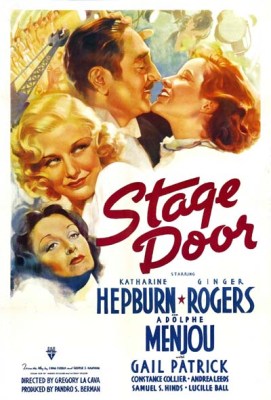
The 1937 film Stage Door is a great example of a unique genre of American film, the Katharine Hepburn Gets Humbled genre.
In the 1930s, Katharine Hepburn went through a period of time where she was considered to be “box office poison.” She was undeniably talented but it was obvious that the studios weren’t sure how to showcase that talent. They put her in high-brow films that often did not have much appeal to audiences. As well, the press hated her. Katharine Hepburn was outspoken, she was confident, she was a nonconformist, and, too many, her refusal to do interviews and sign autographs marked her as a snob. Very few people wanted to see a movie starring Katharine Hepburn and therefore, very few people were willing to make a movie starring Katharine Hepburn.
(Interestingly enough, as I sit here typing this, another KH — Katharine Heigl — is pretty much in the exact same situation, with the main difference being that Hepburn was a far more interesting actress.)
Fortunately, Katharine Hepburn was smart enough to recognize the problem and she started to appear in films like Stage Door. In Stage Door, she essentially played a character who mirrored the public’s perception of her. Terry Randall is a snobbish and pretentious aspiring actress who comes to New York to pursue her career and moves into a theatrical rooming house. At first, her attitude makes her unpopular with the other actresses living in the house. But, as the film progresses, Terry slowly starts to let down her defenses and reveals that she’s just as insecure, neurotic, and vulnerable as everyone else. She also proves herself to be willing to stand up to manipulative producers and condescending directors. When she’s cast in her first Broadway show, it turns out that the show is being financed by her father and his hope is that she’ll do such a bad job and be so humiliated that she’ll give up acting. And, at first, it appears that Terry will be terrible. During rehearsals, she is stiff and mannered. (Hepburn was actually quite brave to portray Terry as being such a believably bad actress.)
Of course, Terry isn’t the only actress at the rooming house who has issues to deal with. For instance, Judy Canfield (Lucille Ball) has to choose between pursuing her career or getting married and starting a family. Kay (Andrea Leeds) is a once successful actress who is now struggling to find roles, can’t pay her bills, and has become suicidal as a result. And then there’s Jean (Ginger Rogers), Terry’s cynical roommate and frequent enemy and occasional friend. Jean is falling in love with Anthony Powell (Adolphe Menjou), the lecherous producer of Terry’s play.
Stage Door is a wonderfully entertaining mix of melodrama and comedy. You’ll laugh, you’ll cry, and you’ll really find yourself hoping that all of the actresses at the rooming house will have their dreams come true. While the film is dominated by Hepburn and Rogers, it truly is an ensemble piece. Not only does the cast include Eve Arden, Lucille Ball and Andrea Leeds (giving the film’s best and most poignant performance) but the great dancer Ann Miller appears as Jean’s equally cynical best friend. Stage Door may be 79 years old but it’s aged wonderfully.
At the box office, Stage Door was a modest success and it directly led to Hepburn being cast in the classic screwball comedy, Bringing Up Baby. Stage Door was nominated for best picture but it lost to The Life of Emile Zola.

 Through the Shattered Lens