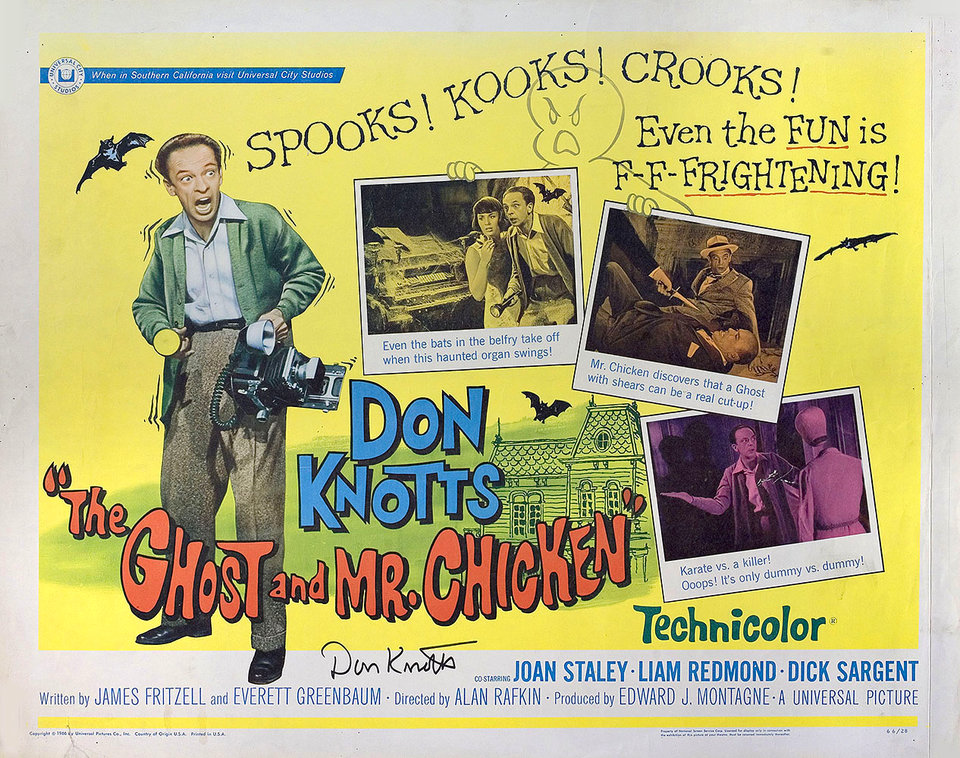
Brad reviews THE GHOST AND MR. CHICKEN (1966), starring Don Knotts.


I love Don Knotts. I’m one of those people who have watched every episode of THE ANDY GRIFFITH SHOW (1960-1968) multiple times. And while it’s true that there are good episodes in the last three seasons, the series was at its best when Sheriff Andy Taylor and his sidekick Barney Fife were serving the townsfolk of Mayberry, North Carolina during the first five seasons. In Barney Fife, Don Knotts created one of the best characters in television history, earning five Emmy Awards in the process. When Don Knotts left the series at the height of its popularity, the first movie he made was THE GHOST AND MR. CHICKEN!  

In THE GHOST AND MR. CHICKEN, Knotts plays Luther Heggs, a meek typesetter at a small-town newspaper in Rachel, Kansas, who dreams of being a serious reporter but is treated like a joke by nearly everyone around him. When the town prepares for the 20-year anniversary of an unsolved murder at the supposedly haunted Simmons Mansion, Luther unexpectedly gets a chance to prove himself. He volunteers to spend the night alone in the mansion to see if it really is haunted. As you might expect, Luther is scared out of his mind as he hears banging on the walls, discovers secret passageways, and observes blood-stained organs playing themselves. The night culminates with Luther seeing a portrait of poor Mrs. Simmons with gardening shears piercing her throat! By surviving the night, and then telling the truth about what he experienced, Luther just may uncover a real crime being committed behind all of this “supernatural” activity!

Since Don Knotts left THE ANDY GRIFFITH SHOW to pursue a movie career, I’m glad to report that his decision to star in THE GHOST AND MR. CHICKEN was a really good choice. His performance is a masterpiece of physical comedy. Sure, Knotts trembles, shakes and delivers his lines in his awkward, nervous way for a lot of laughs, but he also provides a vulnerability that really makes you root for him. Knotts knew how to play lovable losers in a way that shows a quiet decency. He may actually be scared, and he may seem like a real pushover, but he also finds the courage to do the right thing even when it’s not easy. This was true for Barney Fife, and it’s also true for Luther Heggs in THE GHOST AND MR. CHICKEN.

Aside from Don Knotts, THE GHOST AND MR. CHICKEN has a solid supporting cast! Joan Staley is very beautiful as Luther’s love interest, Alma. Staley was a Playboy Playmate in 1958, so I can definitely see why Luther is in love. I like the fact that her Alma is more than just a pretty face. Rather, she’s one of the few people who sees Luther as more than a joke, which makes her even more appealing. Meanwhile, Luther’s newsroom boss (Dick Sargent) and office rival (Skip Homeier) never miss an opportunity to be condescending. The director Alan Rafkin directed 27 episodes of THE ANDY GRIFFITH SHOW, so he definitely knows how to get the best comedy out of Knotts and the rest of his cast. He also keeps the tone light, with the haunted house set pieces playing out like gentle, kid-friendly chills rather than anything truly scary. The blood-stained organ / garden shears sequence in the mansion is especially effective, with Don Knotts perfectly walking the line between raging fear and slapstick comedy. Signaling that there was a big audience for Don Knotts in the movies, THE GHOST AND MR. CHICKEN proved to be a box office hit, taking the number one spot during its first week of release, and grossing about eight times its budget!  

Ultimately, THE GHOST AND MR. CHICKEN endures because it understands the special qualities of its star. Don Knotts is funny, and he’s also human. He may be scared out of his mind, but he also has decency and an ability to find courage when he must. In that way, it’s a comfort movie, a should-be Halloween staple, and finally, a reminder that sometimes the bravest person in the room is the one who can’t quit shaking.  
Lisa Marie Reviews An Oscar Winner: From Here To Eternity (dir by Fred Zinnemann)


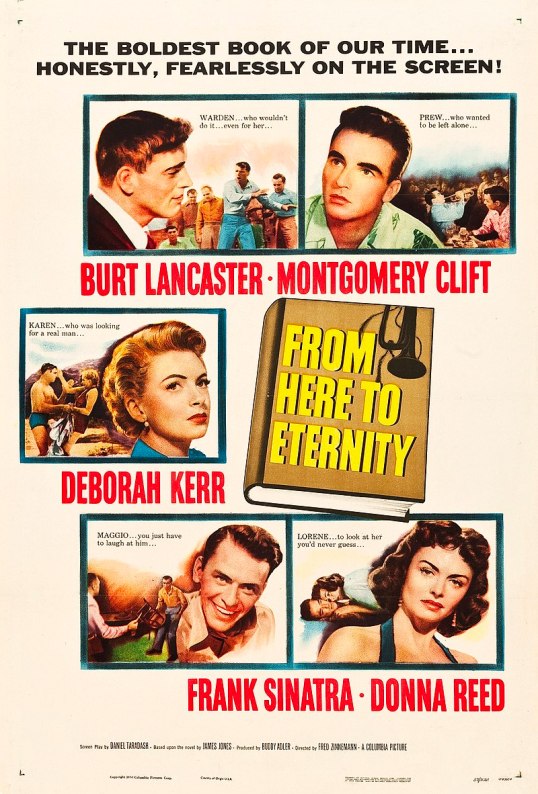
“The boldest book of our time,” shouts the poster art for 1953’s From Here To Eternity, “honestly, fearlessly brought to the screen!”

And indeed, James Jones’s novel was brought to the screen about as boldly as a studio film could be brought in 1953.  The book told the story of several soldiers in the days immediately before the attack on Pearl Harbor.  The Production Code was still in effect and, as a result, a few changes were made to the film’s plot.  Donna Reed played Lorene, a character who is described as being a “hostess” at social club but who, in the book, worked at a brothel that was popular with the soldiers from a nearby army base.  In the book, an unfaithful husband gives his wife a venereal disease that leads to her getting a hysterectomy.  In the movie, Karen’s (Deborah Kerr) hysterectomy was the result of a miscarriage that occurred after she discovered her husband was being unfaithful.  The book was critical of the Army and featured officers who faced no consequences for their actions.  The movie definitely presents the enlisted men as being at the mercy of officers but the worst of the officers is ultimately disciplined.  The movie was made with the cooperation of the U.S. Army and, as a result, the film’s villains — like Captain Holmes (Philip Ober) and the monstrous Fatso Judson (Ernest Borgnine) — were portrayed as being aberrations who did not represent the Army as a whole.  That said, the film version of From Here To Eternity is still a powerful, moving, and daring film.  What couldn’t be shown on screen is still suggested.  One might not see the specifics of what Fatso Judson does to Maggio (Frank Sinatra) in the stockade but it’s not difficult to figure out.

The film follows one company of soldiers as they laugh, fight, and fall in love while stationed in Hawaii.  They spend time training for a war that most of them think will never come.  Captain Holmes is more concerned with his regimental boxing team than the prospect of going to war and is confused when Private Prewitt (Montgomery Clift) refuses to stop back into the ring.  Prewitt, who takes pride in his ability as a bugler, quit boxing after he blinded an opponent in the ring but Holmes doesn’t care.  Holmes wants another trophy for his office.  He orders Sgt. Warden (Burt Lancaster) to make life Hell for Prewitt until Prewitt agrees to box.  Warden, who has seen a lot of officers come and go and who has been tempted to become an non-commissioned officer himself, is having an affair with Holmes’s wife, Karen.  Meanwhile, Prewitt and his friend Maggio spend their time looking forward to the weekends they’re allowed to spend off the base.  Prewitt has fallen in love with Lenore but, as with all the men in From Here To Eternity, Prewitt’s true love is for the army.  Even with Holmes pressuring him to box, Prewitt’s loyalty is to the men with whom he serves.  There’s a lot of drama, a lot of death, and a lot of romance.  This is the film in which Burt Lancaster and Deborah Kerr make out on the beach while the tide rolls in.  But, when Pearl Harbor is attacked, all of the drama and all of the romance is forgotten as America goes to war.

From Here To Eternity is one of the best films of the 1950s and certainly one of the more worthy winners for Best Picture.  Intelligently directed, wonderfully acted, deliriously romantic, and finally rather sad, it’s a film that embraces the melodrama without ever hitting a false note.  Burt Lancaster’s rugged weariness, Montgomery Clift’s method sensitivity, Frank Sinatra’s naturalism, Ernest Borgnine’s crudeness, Deborah Kerr’s classiness, and Donna Reed’s earnestness all come together to create a film in which the characters feel real and alive.  Warden, Prewitt, Lenore, Karen, and Maggio are all interesting, multi-faceted people, trying to find some sort of happiness in the shadow of an inevitable war.  The viewer may sometimes have mixed feelings about their actions (and Borgnine’s Judson is one of the most loathsome roles that the normally likable Borgnine ever played) but you never cease to care about them and their stories.  With all of the characters and the affairs and the secrets, From Here To Eternity can feel like a soap opera but it’s also a portrait of a world that is on the verge of changing forever.

A few years ago, I attended a screening of From Here To Eternity at the Dallas Angelika.  This is a film that definitely deserves to be seen on the big screen.  From the famous scene on the beach to the attack on Pearl Harbor to the tragic final moments, this is a big movie that deals with big emotions and big moments.  It’s one of the best.