Welcome to Late Night Retro Television Reviews, a feature where we review some of our favorite and least favorite shows of the past! On Wednesdays, I will be reviewing Monsters, which aired in syndication from 1988 to 1991. The entire series is streaming on YouTube.
This week, we have the second-to-last episode of Monsters!
Episode 3.23 “The Maker”
(Dir by William Wesley, originally aired on April 18th, 1991)
Mack (Philip Anglim), a suit-wearing vagrant, wanders into what he thinks is an abandoned hotel. Mack just wants a place to spend the night and he’s shocked to discover that the hotel is also occupied by Freddy Fredericks (Eddie Bracken), a former stage magician who is now an alcoholic. When Mack asks how an abandoned building has electricity, Freddy explains that he can create things with his mind. Mack is skeptical so Freddy creates an apple and a banana. Mack asks for money and Freddy creates that. It’s quite a power except there always seems to be some small mistake. For instance, the money has Mack’s picture on it. When Freddy tries to create gold, he creates brass instead. Mack decides that the alcohol is holding Freddy back and he demands that Freddy quit cold turkey.
Bad idea.
When someone can create things just by thinking about them, the last thing you want is for that persons to get the DTs.
This, the second-to-last installment of Monsters, was definitely an effective episode. It wasn’t perfect. It got off to a slow start and Eddie Bracken occasionally went a bit overboard as Freddy. But the idea of Freddy’s alcoholism inhibiting his powers was a good one and the episode took it in a pretty clever direction. The monster — half snake/half-woman — that was created by Freddy’s DTs was genuinely frightening and the episode’s final twist not only made sense but it also worked. All in all, it was a very good episode.
Next week, we’ll finish up Monsters with a Stephen King adaptation starring Tom Noonan.
The 1983 film, Testament, is about death. It’s about the death of a family, the death of a town, the death of a way of life, and the death of hope.
And you may be saying, “Well, gee, Lisa — that sounds like a really happy movie.”
Well, it’s not meant to be a happy movie. Testament is a painfully grim movie about the end of the world.
The movie takes place in the town of Hamelin, California, which we’re told is 90 minutes away from San Francisco. It’s a nice town, the type of place where everyone knows each other. Mike (Mako) runs the local gas station and cares for his disabled son, Hiroshi (Gerry Murillo). Elderly Henry Abhart (Leon Ames) spends his time on his radio, talking to strangers across the world. Fania (Lilia Skala) offers up piano lessons. Father Hollis (Philip Anglim) looks over the spiritual needs of the parish. It’s a normal town.
The town is home to the Weatherlys. Carol (Jane Alexander) is a stay-at-home mom who does volunteer work and who is directing the school play. Tom (William Devane) is a common sight riding his bicycle through town every morning before heading off to work in San Francisco. They have three children. Mary Liz (Roxanna Zal) is a teenager who is taking piano lessons. Brad (Ross Harris) is always trying to impress his father and is looking forward to his 14th birthday. Scottie (Lukas Haas, in his first film) is the youngest and never goes anywhere without his teddy bear. They’re a normal family living a normal life in a normal town.
And then, one day, everything changes. Scottie is watching Sesame Street when the program is suddenly interrupted by a clearly terrified anchorman who announces that New York has been bombed. The president is about to speak but, before he can, there’s a bright flash of light, an distant explosion, and the entire town loses power.
At first, the people of Hamelin try to remain hopeful. Though Tom works in San Francisco and San Francisco is among the many cities that have apparently been bombed (by who, we never learn), he also left a message on the family’s answer machine, telling them that he was on his way home. Even with Tom missing, Carol continues to insist the he’ll be coming home at any minute.
Tom doesn’t come home.
The rest of the film follows the slow death of the town. Even though the town was not damaged by the blast, the fallout soon hits. Cathy (Rebecca De Mornay) and Phil (Kevin Costner) bury their newborn baby after it falls ill from radiation poisoning. Mike, Henry, and Fania all start to grow physically ill and, in some cases, dementia sets in. Father Hollis goes from being hopeful to being tired and withdrawn as he tries to attend to each and every death. Larry (Mico Olmos), a young boy whose parents have disappeared, briefly moves in with the Wetherly family. He disappears about halfway through the movie and we never learn if he left or if he died. All we know is that no one mentions him or seems to notice that he’s gone.
Over the course of the film, Carol buries two of her children. By the end of the film, her remaining child is starting to show signs of being sick, as is she. Testament, which opened with bright scenes of a happy town, ends in darkness, with only a handful of people left among the living. Even those who are alive are clearly dying and can only speak of the importance of remembering all of it, what they had and what they lost.
Sounds like a really happy film, right? Well, it’s meant to be depressing. It was made at a time when nuclear war was viewed as being not just probable but also inevitable. Testament is a film that portrayed what a lot of people at the time were expecting to see in the future and, as a result, it’s not meant to be a particularly hopeful movie. It’s a film that accomplishes what it set out to do, thanks to a great (and Oscar-nominated) performance from Jane Alexander and Lynne Littman’s low-key direction. Unlike a lot of atomic war films, Testament does not feature any scenes of burning buildings or excessive gore. That actually what makes it even more disturbing. Even after the war, Hamelin still looks like it did beforehand, with the exception that many of the houses are now empty and that all of the residents are slowly dying.
(Would I have reacted as strongly to the film if I hadn’t watched it at a time when many people are afraid to go outside? Perhaps not. But this pandemic has brought extra power to a lot of films that may not have had as much of an impact in 2018.)
Testament is a powerful film, though not necessarily one that I ever want to watch again.
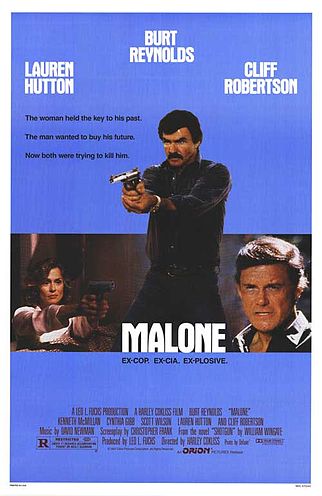
It’s Burt Reynolds vs. Cliff Robertson. Cliff has got the money but Burt’s got the mustache and the toupee.
Robertson plays Charles Delaney, a wealthy businessman who, with the help of a mercenary army, has bought nearly all the land in a small Oregon town. Only the owner of a local gas station, Paul Barlow (Scott Wilson), has refused to sell. Delaney and his men think that they can intimidate Paul into selling but what they do not realize is that Paul has a houseguest. Richard Malone (Burt Reynolds) was driving through town when his car broke down. While waiting for it to get fixed, he has been staying with Paul and his teenage daughter, Jo (Cynthia Gibb). What no one knows is that Malone used to be an assassin for the CIA.
If ever there was a film that demanded the talents of Charles Bronson, it is Malone. The tough and ruthless title character would have been a perfect Bronson role, especially if Malone had been made twenty years earlier. Instead, the role went to Burt Reynolds, who was on the downside of his career as an action hero. Sometimes, Burt tries to play the role as serious and emotionally guarded. Then, in other scenes, Burt will suddenly smile and wink at the camera as he briefly turns back into the Bandit. This is not one of Burt’s better performances. He gets good support from the entire cast, including Lauren Hutton as his CIA handler, but, in most of his scenes, Burt comes across as being tired and his toupee makes him look like The Brady Bunch‘s Robert Reed. Burt was 51 when he made Malone and he looked like he was at least ten years older, making the scenes where Jo comes onto him even more improbable.
Where Malone succeeds is in the action scenes. Along with Burt’s final assault on Delaney’s compound, there is also a classic showdown in a barbershop. Malone had a budget of ten million dollars. How many blood squibs did that buy? Pay close attention to the scene where two hitmen attempt to surprise Malone in his room and find out.
Malone is may not feature Burt at his best but it is still a damn sight better than some of the other films that awaited Burt once his starpower started to diminish. Mad Dog Time, anyone?

 It’s Burt Reynolds vs. Cliff Robertson. Cliff has got the money but Burt’s got the mustache and the toupee.
 Through the Shattered Lens