Made-for-TV Movie Review: Nightmare in Chicago (dir by Robert Altman)


Taking place over the course of one very long day and night in December, this 1964 made-for-television movie opens with the discovery of a murdered woman in Indiana.  She is the latest victim of a killer that the press has nicknamed “Georgie Porgie.”

Georgie Porgie, who has killed five blondes in the Midwest, is actually a nondescript man named Myron Ellis (Philip Abbott).  Myron is middle-aged, short, and fairly normal-looking.  That, along with the fact that he’s always moving, is one reason why he has yet to be captured.  The only thing that really stands out about Myron is that, due to a medical condition, he is extremely sensitive to light and always wears dark glasses, even at night.  When Myron isn’t murdering someone or stealing a car, he’s haunted by the voice of his dead sister.

Because he is a nomadic killer, the authorities in Chicago are worried that Myron is coming to their town next and it turns out that they’re correct.  Myron is already in Chicago and he’s looking for his next victim.  In a rather disturbing scene, he strangles a woman that he meets at a strip club, managing to do so without any of the many people around them even noticing.  Myron wanders up and down the streets of Chicago, looking for his next victim.  With his polite manners and his bland appearance, no one suspects that the polite man on the street corner is actually a murderer.

Police Commissioner Lombardo (Ted Knight) and Detectives McVea (Robert Ridgley) and Brockman (Charles McGraw) decide that the best way to catch the killer would be to set up a dragnet on the highway, stopping cars and shining flashlights at the drivers to see who has the weakest eyes.  The only problem is that there is also a nuclear missile convoy scheduled to move through the city at the same time.  With the highways congested and the killer not above wrecking his own car to throw the police off his trail, Lombardo tries to both capture the killer and make sure nothing happens to the convoy.

Nightmare In Chicago is a short and efficient thriller.  It’s well-acted and rather serious in its approach.  Especially when compared to more recent films with similar plots, Nightmare In Chicago deserves some credit for not trying to turn its serial killer into some sort of diabolical mad genius.  Myron, like all serial killers in real life, is a maladjusted and rather stupid person who has only gotten away with his crimes due to pure luck.  He’s not a Hannibal Lecter-style supergenius.  Instead, he’s just a creep who has many, many issues.  The film also does a good job of capturing the manic energy and eventual exhaustion of pulling an all-nighter.  It’s an effective little film with a memorably sordid story.

For modern audiences, probably the most interesting thing about Nightmare in Chicago is that it was directed by Robert Altman and was, in fact, his second non-documentary film after The Delinquents.  At the time he made this film, Altman was largely working in television.  Nightmare In Chicago was one of the first made-for-TV movies and it was a ratings and critical success.  Seen today, it’s easy to spot Altman’s trademark attention to detail in the film.  While it’s far more straight-forward than the majority of his feature films, Nightmare in Chicago still displays the talent that eventually led to Robert Altman become one of Americas most important filmmakers.
Late Night Retro Television Review: Monsters 2.21 “Refugee”


Welcome to Late Night Retro Television Reviews, a feature where we review some of our favorite and least favorite shows of the past! On Wednesdays, I will be reviewing Monsters, which aired in syndication from 1988 to 1991. The entire series is streaming on YouTube.

This week, Monsters takes a turn into le Carré  territory.

Episode 2.21 “Refugee”

(Dir by Scott Vickrey, originally aired on Mary 13th, 1990)

Paul (Peter White) is an agent of the CIA.  He lives in a run-down apartment, hiding himself from the world and apparently wracked with guilt and regret over some of the things that he did for his country.  In the style of many a John le Carré protagonist, he served his country and has been left thoroughly disillusioned as a result.  His former superior, Oliver (Philip Abbott), comes to Paul with a proposal.  There’s a Russian scientist who is looking to defect.  She has apparently spent years trying to escape from Russia.  If Paul helps her cross the border and stays with her in a safehouse until the CIA can come and get her, Oliver will never ask Paul to do another thing.  Paul’s service as a spy will be terminated.

A reluctant Paul agrees and he is indeed able to get Anna Solenska (Judy Geeson) across the border and into a safehouse.  However, Paul realizes that two men have followed them and now want to enter the safehouse themselves.  Paul assumes that they work for the KGB but actually, they’re agents of Satan!  Apparently, Anna agreed to sell her soul in return for Satan helping her to escape Russia.  And now, Satan has sent his people to collect….

Seriously, if you’ve ever wondered what it was like to live under a communist regime, just consider that someone was willing to sell their soul to escape!  That’s one reason why I’m proud to be an American and to be a capitalist.  No matter what problems we may have in this country, no one is selling their soul to escape.  No one is summoning Satan and saying, “Hey, help me get to Cuba!”  Capitalism for the win!

As for this episode, I liked the idea behind it.  I liked the concept of mixing spy melodrama with supernatural horror.  Peter White actually gave a pretty good performance as the burned-out spy and I enjoyed the opening conversation between him and his former superior.  But once the episode move to the safehouse, the action started to drag.  Monsters is only a 21-minute show so there’s no reason why an episode should have had me checking how much running time was left as often as this one did.  British actress Judy Geeson did a good enough job playing Anna’s desperation but her Russian accent was bad enough that it actually distracted from the story.  Finally, Satan’s agents were never as scary as servants of the devil should be.  This show’s saving grace has usually been its monsters but, in this episode, they were just men with red skin and glowing fingertips.

Sad to say, despite an intriguing premise, this episode was just kind of boring.

Late Night Retro Television Review: Highway to Heaven 2.6 “Birds of a Feather”


Welcome to Late Night Retro Television Reviews, a feature where we review some of our favorite and least favorite shows of the past!  On Thursdays, I will be reviewing Highway to Heaven, which aired on NBC from 1984 to 1989.  The entire show is currently streaming on Freevee and several other services!

This week, Jonathan becomes the Birdman!

Episode 2.6 “Birds of a Feather”

(Dir by Michael Landon, originally aired on November 6th, 1985)

While driving down the highway, Mark is ordered to stop by Jonathan.  Jonathan gets out of the car and walks over to a nearby reservoir, where he discovers a dying bird.  In fact, he discovers several dead birds and he wastes no time in deciding that the nearby chemical plant is to blame.  Despite the fact that they are on a tight schedule and have an assignment waiting for them in another town, Jonathan decides that it’s important that he and Mark first battle against the people who poisoned the reservoir.

How does Jonathan decide to do this?  First, he tells Mark to get a job at the plant.  Mark does so, though it’s never really clear what he was hired to do.  It’s funny how Mark always gets every job that he applies for, despite not having much work experience beyond being a cop.

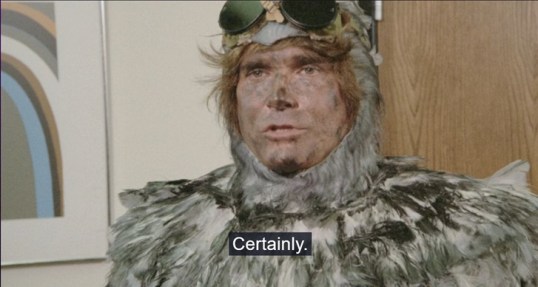
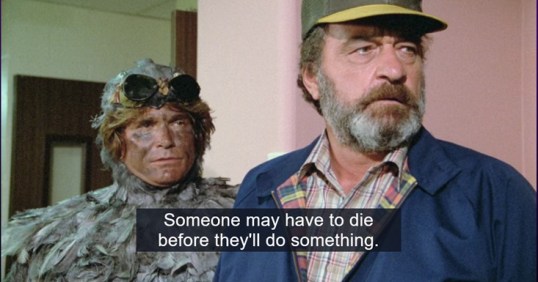
Jonathan then decides that it would be a good idea for him to 1) dress up like a bird, 2) ride a bicycle around town, 3) decorate the bicycle with balloons, and 4) continually shout things like, “Caw!  Caw!”

Now, I’m not really sure what Jonathan thinks this will accomplish.  That said, just two days ago, a bunch of idiots thought they could bring peace to the Middle East by standing on the Golden Gate Bridge and blocking traffic.  And let’s not forget those Extinction Rebellion morons who keep damaging paintings and gluing themselves to floors.  Compared to today’s protestors, Jonathan’s methods seem brilliant.

What’s odd about Jonathan’s bird costume is that he never takes it off.  Even when he’s not protesting, he wears the costume.

Evil businessman Horton Drake (Philip Abbott) doesn’t care about the dead birds because he’s evil.  Even when the children of some of his employees get sick, Drake refuses to clean up the water.  This leads to Jonathan making an ominous declaration.

In a scene that has to be seen to be believed, Jonathan lines up all the dead birds outside of Drake’s corporate headquarters.  And then Jonathan lies down, resting his head on the contaminated birds.  By the time everyone arrives for work, Jonathan’s dead!

Realizing that an autopsy will reveal that Jonathan died due to chemical exposure, Drake sends three of his men to steal Jonathan’s body from the morgue.  However, at the morgue, Jonathan is not only alive but he’s still wearing his bird costume.  “Caw!  Caw!” Jonathan shouts as the men flee.

The next morning, Drake holds a press conference and denies dumping toxic waste in the water.  Moved by Jonathan’s sacrifice, Drake’s former administrative assistant (Marianne McAndrew) reveals the truth about how Drake has been polluting the water and paying off the health inspectors.  Incidentally, the assistant’s son is played by a young Paul Walker.

Mark goes for a walk along the beach.  He looks up to Heaven and tells Jonathan that his plan worked.  Suddenly, Jonathan walks up to Mark and Mark realizes that Jonathan is still alive.  Of course, Jonathan’s an angel so it’s not like he could have really died in the first place.  As Jonathan has pointed out in previous episodes, he already died once.

This episode was about as heavy-handed as anything I’ve ever seen.  One can support a clean environment while also acknowledging that Drake was portrayed as being cartoonishly evil.  Michael Landon’s heart was in the right place but the episode still sometimes verged on unintentional self-parody.  This is the type of thing that AI would come up with if prompted to write a stereotypical episode of Highway to Heaven.

Myself, I’m just wondering where Jonathan found the bird costume.