Cleaning Out The DVR #20: Tom Jones (dir by Tony Richardson)


(For those following at home, Lisa is attempting to clean out her DVR by watching and reviewing 38 films by this Friday.  Will she make it?  Keep following the site to find out!)
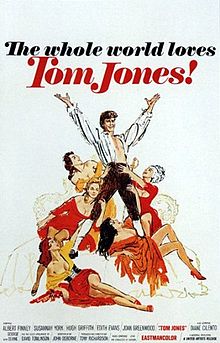
220px-Poster_-_Tom_Jones_01

Oh, how I wanted to love Tom Jones!

http://www.youtube.com/watch?v=NjEE_1U0-8s

No!  Not that Tom Jones.

I’m talking about Tom Jones, the British film from 1963.  Based on a novel by Henry Fielding, Tom Jones was a huge box office success and it was one of the few comedies to ever win the Oscar for best picture.  Whenever you watch a documentary about the British invasion of the early 60s, chances are that you’ll see at least a clip or two from Tom Jones.  The film (or perhaps I should say the film’s box office success) is a part of 60s pop history, right up there with The Beatles on The Ed Sullivan Show and Sean Connery shooting that guy in cold blood in Dr. No.

Up until last night, I had heard about Tom Jones but I had never seen it.

And I really wanted to love it.

The film takes place in 18th century England and it tells the story of young Tom Jones (Albert Finney).  It starts with a lengthy sequence that plays out like a silent film, complete with title cards.  Upright Squire Allworthy (George Devine) comes home and discovers that a baby has been left in his bed.  He assumes that the child was born to two of his servants and declares that he will raise Tom Jones to be a good and worthy man.

Two decades later, Tom Jones has grown up and now he’s being played by Albert Finney (who, it must be said, was quite a handsome man when he was young).  Because Tom is good-looking and kind-hearted, every woman in England lusts after him.  But Tom is in love with innocent Sophie Western (Susannah York).  However, Sophie is a member of the upper class and Tom is a “bastard,” at a time when that actually means something.

Indeed, Sophie’s aunt and uncle (played by Edith Evans and Hugh Griffith) demand that Sophie have nothing to do with Tom Jones.  They decide that she will marry Blifil (David Warner, young but already typecast as a villain).  Through clever lies and manipulations, Blifil convinces Squire Allworthy that Tom has turned bad and must therefore be exiled from his home.  Does Blifil want to get rid of Tom just so he can marry Sophie or is it possible that there’s more to Blifil’s scheming?

Before we get the answer to that question, we spend a while following the exiled Tom as he wanders around England and attempts to prove himself worthy of Sophie.  Along the way, Tom serves briefly in the army, gets into numerous fights, and has several affairs.  One of those affairs is with Mrs. Walters (Joyce Redman), who he briefly thinks might be his mother.  Eventually, Tom ends up as the lover to the decadent Lady Bellaston (Joan Greenwood).  Through Blifil’s scheming, he also ends up framed for attempted murder and facing the gallows…

And, as melodramatic as that may all sound, Tom Jones is definitely a comedy.  It doesn’t take itself seriously and there’s hardly a single scene that isn’t played for laughs.  Director Tony Richardson goes out of his way to make sure that you never forget that you’re watching a movie.  There are freeze frames.  There’s plenty of characters around to supply sarcastic commentary.  There’s even a few cases of fourth wall breaking.

As I watched Tom Jones, it was hard for me not to compare it to Stanley Kubrick’s Barry Lyndon.  After all, both films take place during the same period of time and both deal with a young man making his way through European society.  I would even argue that, in its way, Barry Lyndon is far more satirical than Tom Jones.  The main difference between the two films is that Barry Lyndon is all about subtext whereas everything that happens in Tom Jones happens right on the surface.

As I said, I really wanted to like Tom Jones but, seen today, the entire film seems to be trying a little bit too hard.  Tony Richardson’s direction is so manic that it gets a bit exhausting after a while.  That said, I can understand why the film was such a success when it was first released.  I’m sure in 1963 — after having to deal with decades of pompous costume dramas — viewers probably found Tom Jones to be a breath of fresh air.  Not only was it a British film released at a time when all things British were in style but it was also a film that, by the standards of 1963, dealt frankly with sex.  In short, Tom Jones is definitely a film of its time.  If it doesn’t hold up as well today, that’s because it wasn’t made for 2016.  It was made for 1963.

And obviously, if the judgment of the Academy is to be trusted, Tom Jones was the perfect film for 1963.  That said, I would have given best picture to another British film, From Russia With Love.
Shattered Politics #22: Dr. Strangelove Or How I Learned To Stop Worrying and Love the Bomb (dir by Stanley Kubrick)


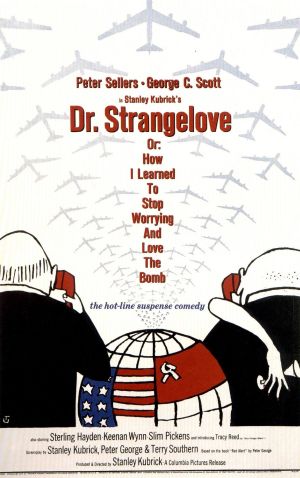
Dr._Strangelove_poster

“Gentlemen!  You can’t fight here!  This is the war room!” — President Merkin Muffley (Peter Sellers) in Dr. Strangelove: Or How I Learned To Stop Worrying And Love the Bomb (1964)

The next time you hear someone bragging about how their favorite politician is an intellectual who always acts calmly and rationally, I would suggest that you remember the example of President Merkin Muffley, one of the many characters who populate the 1964 best picture nominee, Dr. Strangelove or How I Learned To Stop Worrying and Love the Bomb.

As played by Peter Sellers, Merkin Muffley is the epitome of rational political action.  Speaking in a steady (if somewhat muffled) midwestern accent and always struggling to remain calm and dignified, Muffley keeps order in the War Room as the world edges closer and closer to apocalypse.

Just consider, for example, this scene where President Muffley calls the Russian leader (the nicely named Dimitri Kissoff) and explains that a little something silly has happened.

As Muffley explains in the above scene, Gen. Jack D. Ripper (Sterling Hayden) has gone crazy.  Convinced that the Russians have been sapping his precious bodily fluids, Gen. Ripper has ordered a nuclear strike on Russia.  Unfortunately, Russia has built a Doomsday Machine that, should Russia be bombed, will destroy the world.

While Muffley is at fist skeptical about a doomsday machine, his advisor, Dr. Strangelove (also played by Peter Sellers), explains that the doomsday machine not only exists but that it’s actually a pretty good idea.  The wheelchair-bound Dr. Strangelove speaks in a German accent and appears to have lost control over the left side of his body.  At random moments, his left arm shoots up in a Nazi salute.  At other times, his hand tries to strangle him.  Making these surreal moments all the more memorable is the fact that nobody in the War Room seems to notice or question them.

And, while it’s always tempting to dismiss a character like Dr. Strangelove as being an over-the-top caricature, the fact of the matter is that, following the end of World War II, several Nazi scientists ended up working for the U.S. government.  In many ways, the U.S. space program was the creation of a bunch of real-life Dr. Strangeloves.

Of course, President Muffley and Dr. Strangelove aren’t the only roles played by Peter Sellers in this film.  Sellers also plays Lionel Mandrake, a British officer who — as the result of an office exchange program — happens to be at Burpelson Air Force Base at the same time that Gen. Ripper orders the attack on Russia.

As famous as his Sellers’s performances as Dr. Strangelove and President Muffley may be, I actually think Mandrake is his best performance in the film.  In many ways, Mandrake is the audience’s surrogate.  He’s the one who gets to hear Ripper’s rambling explanation for why he launched an attack on Russia.  He’s the one who has to try to convince the hilariously unhelpful Col. Bat Guano (Keenan Wynn) to help him find a quarter so he can call the Pentagon.

(“You’re gonna have to answer to the Coca-Cola company,” Guano says, before shooting open a Coke machine to get change.)

Sellers plays Mandrake as a parody of the traditional, stiff upper lip British army officer.  Not only does that allow some great humor as Mandrake keeps a calm demeanor while listening to Ripper’s increasingly crazed monologue but it also allows Mandrake to be the only sane man in the movie.

(Of course, the whole point of Dr. Strangelove is that the world’s become so insane that one sane man can not make a difference. )

Sellers earned a best actor nomination for playing three different roles and he deserved it but, for me, the two best performances in the film come from Slim Pickens and George C. Scott.

Pickens, of course, is the bomber pilot who ends up riding an atomic bomb like a bull in a rodeo.  As a character, Maj. Kong may be a bit too much of a spot-on stereotype but Pickens brings such sincerity to the role that it doesn’t matter.  Oddly enough, you feel almost happy for him when he rides that bomb to his death.  You know that’s exactly how he would have wanted to go out.

And then there’s George C. Scott, playing the role of Gen. Buck Turgidson.  From the safety of the War Room, Turgidson looks forward to nuclear war and worries when President Muffley invites the Russian ambassador to join them.  (“But he’ll see the big board!” Turgidson exclaims.)  Turgidson is both hilariously stupid and hilariously confident.  Perhaps my favorite Turgidson moment comes when he trips, falls, and stands back up without once losing his paranoid train of thought.

(Though he doesn’t have a big role, James Earl Jones makes his film debut in Dr. Strangelove.  The way he delivers the line “What about Major Kong?” makes me laugh every time.)

50 years after it was first released, Dr. Strangelove remains a comic masterpiece of a nightmare, a film that proves that political points are best made with satire and not sermons.