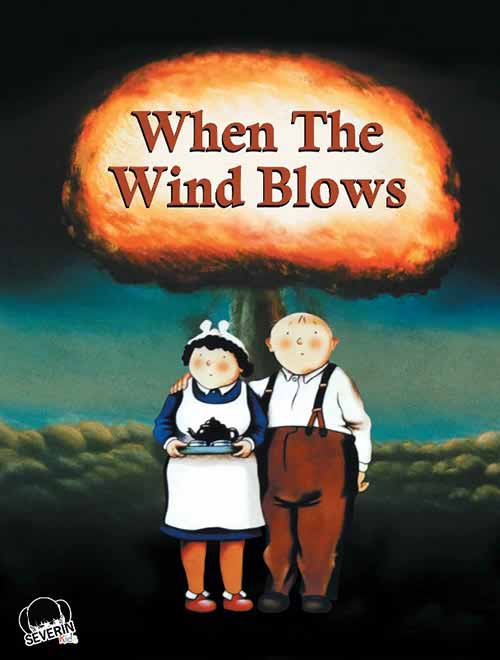
Film Review: When The Wind Blows (dir by Jimmy Murakami)


https://www.youtube.com/watch?v=sb4R8I03C9Y

Over the past few years, I’ve seen some extremely depressing animated films.

I cried during the first fifteen minutes of Up.  I cried during the final ten minutes of Toy Stories 3 and 4.  Actually, now that I think about it, I think I’ve sobbed through every single PIXAR film, with the exception of the movies about the talking cars and the one about the good dinosaur.  My point is that I’m not one of those people who automatically assumes that, just because a film is animated, it’s necessarily going to make me laugh.  I fully understand that not all animated films are for children and that a cartoon can be just as serious and dark as a live action movie.

That said, I don’t think anything could have prepared for the 1986 film, When The Wind Blows.  To say that When The Wind Blows is bleak would be an understatement.  Is When The Wind Blows a depressing film?  Yes, you could say that.  It’s a film about an elderly couple facing the end of the world with optimism and a never-ending faith that things will turn out okay.  This is the most trusting couple in the world and, in the end, they end up crawling into their own separate potato sacks, where they struggle to recite the Lord’s Prayer as they both die a slow and painful death.  It’s not just that When The Wind Blows is depressing.  It’s also that it’s a film that takes place in a world bereft of hope.  It’s a film that has a message but, at the same time, it also seems to be convinced that it’s a message to which no one will bother to listen.

Jim and Hilda Bloggs (voiced by John Mills and Dame Peggy Ashcroft) are a loving couple who own a rather nice cottage in rural England.  They’re very content in their life and more than a bit complacent.  They have faith that both the milk and the paper will be delivered every morning.  Hilda has a nice garden going.  Jim regularly takes the bus down to the library, where he reads the newspapers and picks up pamphlets about what to do in case of a nuclear attack.  When the news comes over the radio that Britain will probably be attacked in 3 days, Jim industrially sets out to make a shelter for himself and Hilda.

It’s not much of a shelter.  In fact, it’s really just two doors leaning against a wall.  However, Jim and Hilda are simply following the instructions that they found in a government-printed pamphlet and both of them have a good deal of faith in the “power that be.”  As they wait for the war to break out, they remember just how much they enjoyed World War II.  Everyone was in it together during World War II!  And Jim has faith that everyone will continue to be in it together during this latest war.

The bomb eventually drops.  The animation, which previously had the feel of an old school Christmas special, becomes dark and ominous as the world around Jim and Hilda’s house erupts into flames.  Jim and Hilda hide in their little shelter.  Though the pamphlets say that they shouldn’t leave the shelter for at least two weeks, Jim and Hilda leave within a few hours.  They walk around outside and look at the charred remains of the garden.  Hilda wonders what fallout looks like.  Jim isn’t sure.

And, at this point, we know they’re both as good as dead.  (Interestingly enough, it does appear that they survived longer than their neighbors, who perhaps did not hide behind a door.)  The rest of the film is essentially watching Jim and Hilda waste away while remaining convinced that someone from the government is going to come and save them.  You find yourself wondering if the two of them are really as naive as they seem or if they’re both in a shared denial about what’s happened.  It’s probably a combination of the two.

It’s an undeniably effective film.  It not only works as an anti-war film but also as an anti-government film.  Both the Left and the Right will find things to appreciate in the film’s story.  But my God is it ever a depressing movie.  It’s a well-made film that I’ll probably never voluntarily watch again.
19

Fast & Furious Hitchcock: THE 39 STEPS (Gaumont-British 1935)


gary loggins's avatarcracked rear viewer

The chase is on – and on – as Robert Donat and Madeleine Carroll are pursued by cops and spies while pursuing a deadly secret in Alfred Hitchcock’s THE 39 STEPS. The “double chase”, first used by Hitch in his silent THE LODGER (1927), playfully keeps the film’s motor running in high gear, and introduces us to two of his soon-to-be famous tropes, the “McGuffin” and the ice blonde. It’s certainly an important film for Hitchcock, as it caught the eye of Hollywood producer David O. Selznick, who would bring Hitch to America’s shores five years later.

Donat, later an Oscar winner for 1939’s GOODBYE MR. CHIPS, plays Richard Hannay, trapped in circumstances beyond his control. The film begins in one of Hitchcock’s favorite places, a crowded public landmark, in this case a music hall (the marquee reminiscent of the shot of Anna Ondry walking past “A New Comedy” in BLACKMAIL ), as Hannay watches…

View original post 622 more words

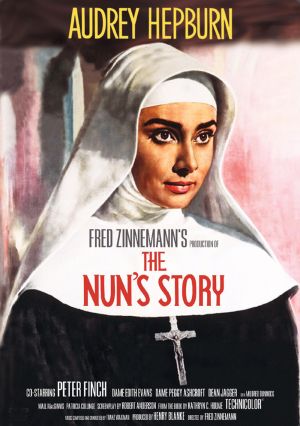
Lisa Watches An Oscar Nominee: The Nun’s Story (dir by Fred Zinnemann)


Nun_story

Happy Ash Wednesday!

So, earlier today, I got off work early so I could go to Noon Mass with my sister and we both got our ashes.  And I’m sure that will take some people by surprise because I’m not exactly the most faithful or devout of Catholics.  But what can I say?  I love the ornate ritual of it all.

And, as a part of my own personal ritual, I washed my forehead before I left the church.  Erin and I had a great vegetarian lunch at Cafe Brazil and then we came home and I turned on the TV and what should be finishing up on TCM but the 1959 best picture nominee, The Nun’s Story.  Fortunately, I had already set the DVR to record The Nun’s Story and so, on this most Catholic of days, I was able to watch this most Catholic of best picture nominees.

The Nun’s Story tells the story of Gaby (Audrey Hepburn), the daughter of a famous Belgian doctor (Dean Jagger).  At the start of the film, Gaby has entered a convent because she wants to become a missionary nursing sister in the Belgian Congo.  However, before Gaby can go to the Congo, she has to learn to give up her own rebellious streak and individual independence.  Taking the name Sister Luke, she excels at her medical training but, because it is felt that she is still too independently minded, she is not sent to the Congo but instead assigned to work in a mental hospital.  It’s there that her independent streak nearly gets her killed when she is fooled by a dangerous patient who claims to be the Archangel Gabriel.  It is only after she takes her final vows that Sister Luke is finally sent to the Congo and it is there that she’s forced to work with the abrasive agnostic Dr. Fortunati (Peter Finch).  Of course, as Sister Luke goes through her own spiritual struggles, the world inches closer and closer to the start of a second world war.  When war does break out, Sister Luke finds herself torn between her vow of obedience (which includes remaining political neutral) and the realities of living in a country that’s been occupied by the Nazis.

1959 was apparently a good year for religious films.  Not only did Ben-Hur win best picture, but The Nun’s Story also received 8 nominations.  Reportedly, The Nun’s Story was the most financially successful film to be released by Warner Bros, up to that point.  If Wikipedia is to be believed, it was also Audrey Hepburn’s personal favorite of the many movies that she made.

When seen today, probably the first thing that people notice about The Nun’s Story is that it’s extremely long and occasionally rather slow.  The film follows Gaby from the minute she enters the convent to the moment that she makes her final choice about whether to be obedient to herself or to her vows and, during that time, it examines every single detail of her life in glorious Technicolor.  A lot of emphasis is put on the rituals that Sister Luke goes through on her way to taking her final vows.  Now, if you’re like me, all of the rituals are fascinating to watch and produce a whole host of conflicting emotions.  Even as I found myself admiring Sister Luke’s dedication and her sacrifice, I still kept wondering — much as she did —  if it was all really worth giving up her independence.  But, I also have to admit that I found myself wondering if someone from a Protestant background would feel the same way.

To a certain extent, I really hate to say that you probably have to come from a Catholic background to truly enjoy any film.  But I certainly think that’s the case with The Nun’s Story.  But, even Protestants and skeptics will appreciate Audrey Hepburn’s wonderful lead performance.  She keeps this film grounded and makes her mostly internal conflict of faith compelling.  In a career that was full of great performance, this is one of Audrey’s best.