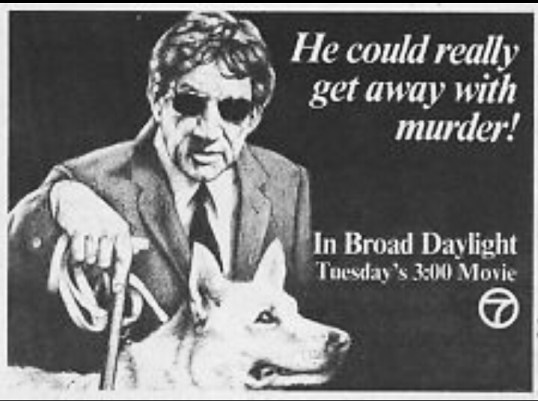
Welcome to Retro Television Reviews, a feature where we review some of our favorite and least favorite shows of the past! On Sundays, I will be reviewing the made-for-television movies that used to be a primetime mainstay. Today’s film is 1971’s In Broad Daylight! It can be viewed on YouTube.
Tony Chappel (Richard Boone) is an actor who has just recently lost his sight as a result of an accident. Released from the hospital, Tony struggles to adjust to living in a world without his vision. When one cab driver says to him, “Didn’t you used to be Tony Chappel?,” he flinches as he realizes that his career as a famous actor is now considered to be over. One day, he comes home early and overhears his wife (Stella Stevens) fooling around with his lawyer and “best friend” (Fred Beir). Tony promptly decides to murder his wife and frame his friend for the crime.
Tony decides to use his acting skills to his advantage. He memorizes the the area around him so that he can make his way through it by memory. He puts on a fake beard, speaks with Greek accent, and makes a point of carrying a camera with him. He starts taking public transportation and going out of his way to be talkative and social Everyone that he meets, he tells them about how he’s been taking pictures of the city and how he can’t wait to see how they come out. When his wife is eventually murdered, the police receive a reports of a mysterious Greek man, one who was definitely not blind, in the area. However, Lt. Bergman (John Marley) has his doubts and comes to suspect that Tony is the killer.
In Broad Daylight was made from an early script written by Larry Cohen, who would later go on to direct films like God Told Me To. It’s a clever script, one that sets up an intriguing premise and which ends on a properly twisty and satisfactory note. The film works because it is as much of a character study as a thriller. Tony’s wife not only cheats on him but also betrays him at the moment when he needs her and his friends the most. Tony has gone from being a movie star to being a man who can barely walk from one room to another. He’s already angry. Discovering that his wife is laughing at him behind his back is the last straw.
Larry Cohen reportedly felt that Richard Boone was miscast as Tony. I felt that Boone did a pretty good job, even if he did overact a bit while Tony was trying to convince everyone that he was a Greek tourist. Stella Stevens is perfectly cast as his wife and Suzanne Pleshette is sympathetic as his nurse. Godfather fans will be happy to see John Marley not having to deal with a horse’s head but instead playing the clever detective who attempts to solve the murder.
In Broad Daylight is a clever and entertaining thriller and character study.
Since it’s currently Spring Break, I figured that I would spend the next two weeks reviewing films about people on vacation. Some of the films will be about good vacations. Some of the films will be about bad vacations. But, in the end, they’ll all be about celebrating those moments that make us yearn for the chance to get away from it all.
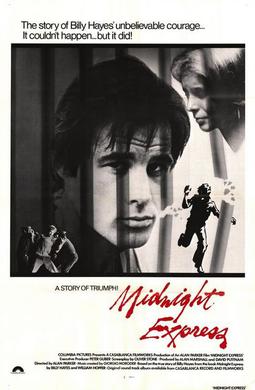
Take Midnight Express, for instance. This 1978 film (which was nominated for six Oscars and won two) tells the story of what happens when a carefree college student named Billy Hayes decides to spend his holiday in Turkey.
When the film begins, Billy Hayes (played by Brad Davis), is at an airport in Turkey. He’s preparing to return home to the United States. His girlfriend, Susan (Irene Miracle), informs him that Janis Joplin has just died. When Billy responds by making a joke, Susan accuses him of not taking anything seriously. What Susan doesn’t realize is that Billy actually has a lot on his mind. For one thing, he’s got several bricks of hashish taped around his waist. He purchased it from a cab driver and he’s planning on selling it to his friends back in the United States. Unfortunately, Billy’s not quite as clever as he thinks he is. Because of recent terrorist bombings, the Turkish police are searching everyone before they board their plane. Billy finds himself standing out in the middle of the runway with his hands up in the air, surrounded by gun-wielding Turkish policemen.
Billy finds himself stranded in a country that he doesn’t understand, being interrogated by men whose language he cannot speak. An enigmatic American (Bo Hopkins) shows up and assures Billy that he’ll be safe, as long as he identifies the taxi driver who sold him to the drugs. Billy does so but then makes the mistake of trying to flee from the police. In the end, it’s the American who captures him and, holding a gun to Billy’s head, tells him not to make another move.
Soon, Billy is an inmate at Sağmalcılar Prison. He’s beaten when he first arrives and it’s only days later that he’s able to walk and think clearly. He befriends some of the other prisoners, including a heroin addict named Max (John Hurt) and an idiot named Jimmy (Randy Quaid). Billy watches as the prisoners are tortured by the fearsome head guard (Paul L. Smith) and listens to the screams of inmates being raped behind closed doors. After being told that his original four-year sentence has been lengthened to a 30-year sentence, Billy starts to degenerate. When Susan visits, Billy end up pathetically masturbating in front of her. When another prisoner taunts Billy, Billy bites out the man’s tongue, an act that we see in both close up and slow motion. If Billy has any hope of regaining his humanity, he has to escape. He has to catch what Jimmy calls the “midnight express…..”
Midnight Express is a brutal and rather crude film. Though it may have been directed by a mainstream director (Alan Parker) and written by a future Oscar-winner (Oliver Stone), Midnight Express is a pure grindhouse film at heart. There’s not a subtle moment to be found in the film. The camera lingers over every act of sadism while Giorgio Moroder’s synth-based score pulsates in the background. When Billy grows more and more feral and brutal in his behavior, it’s hard not to be reminded of Lon Chaney, Jr. turning into The Wolf Man. The film may be incredibly heavy-handed but it’s nightmarishly effective, playing out with the intensity of a fever dream.
As for the cast, Brad Davis wasn’t particularly likable or sympathetic as Billy. On the one hand, he’s a victim of an unjust system, betrayed by his own country and tortured by another. On the other hand, Billy was an idiot who apparently thought no one would notice all that hash wrapped around his chest. That said, Davis’s unlikable screen presence actually worked to the film’s advantage. If you actually liked Billy, the film would be unbearable to watch. Before Davis was cast, Dennis Quaid and Mark Hamill were both considered for the role. If either of those actors has been cast, Midnight Express would be too intense and disturbing to watch. For instance, it would be depressing to watch Dennis Quaid rip a man’s tongue out of his mouth. You would be like, “No, Mr. Quaid, you’ll never recover your humanity!” But when Brad Davis does it, you’re just like, “Eh. It was bound to happen sometime.”
For more effective are John Hurt and Bo Hopkins. Hurt and Hopkins both have small roles but they both make a big impression, if just because they’re the only two characters in the film who aren’t either yelling or crying all of the time. While everyone else is constantly cursing their imprisonment, Hurt is quietly sardonic. As for Hopkins, we’re supposed to dislike him because he’s with the CIA and he sold out Billy. But honestly, no one made Billy tape all that hash to his chest. Finally, you’ve got Randy Quaid and Paul L. Smith, who both glower their way through the film. Smith is wonderfully evil while Randy Quaid is …. well, he’s Randy Quaid, the loudest American in Turkey.
Midnight Express was such a success at the box office that it caused an international incident. There’s not a single positive Turkish character to be found in the entire film and it’s impossible not to feel that the film is not only condemning Turkey’s drug policies but that it’s also condemning the entire country as well. The Turkish prisoners are portrayed as being just as bad as the guards and even Billy’s defense attorney comes across as being greedy and untrustworthy. Watching the film today can be an awkward experience. It’s undeniably effective but it’s impossible not to cringe at the way anyone who isn’t from the west is portrayed. In recent years, everyone from director Alan Parker to screenwriter Oliver Stone to the real-life Billy Hayes has apologized for the way that the Turkish people were portrayed in the film.
Despite the controversy, Midnight Express was a huge box office success and it was nominated for best picture. It lost to another controversial film about people imprisoned in Asia, The Deer Hunter.
The 1987 film Gor opens with a nerdy college professor (played by Urbano Barberini, of Demons and Opera fame) giving perhaps the worst lecture in the history of underwhelming lectures. The professor explains that there is a counter-earth, a place that he claims is known as Gor. Gor shares the same orbit as Earth but it’s linearly opposed to Earth, which apparently makes it impossible to see. However, the professor says that his father gave him a ring which can transport the user to Gor. The only problem is that the professor has not figured out how to use the ring.
The students all look incredibly bored with the lecture and I don’t blame them. Not only does the professor seem to be rambling but he doesn’t even offer up any visual aides. He could have at least utilized a powerpoint presentation or something. Instead, his only teaching aide is a whiteboard on which he’s written “counter-earth.” I have to wonder what their final exam is going to look like. “True or false. Your professor is a freaking loon.”
(I found myself wondering what university would possibly grant tenure to some guy who thinks he owns a magic ring but then I remembered Evergreen College.)
The professor’s name is Tarl Cabot and I think that’s a good deal of his problem right there. When you give a child a name like Tarl Cabot, you’re pretty much guaranteeing that he’s going to grow up believing that he has a magic ring that’ll transport him to another planet.
Of course, in Tarl’s case, it turns out that the ring does just that. After his teaching assistant dumps him so that she can go on a date with another professor, Tarl crashes his car and when he wakes up, he finds himself on Gor. Apparently, the ring only works if you crash your car or something.
As for Gor itself, it turns out to be kind of a dump. It’s a huge desert. Seriously, check out this counter-earth:
If Tarl wanted to see a desert, he could have just driven around Southern California and saved himself a lot of trouble.
Yes, there is trouble in Gor. No sooner has Tarl arrived then he’s being attacked by a bunch of barbarians on horseback. The barbarians are led by the evil Sarm (played by Oliver Reed). Much as with the case of Tarl Cabot, I think that once you name a child Sarm, you’ve pretty much guaranteed the way that his life is going to turn out. Anyway, Tarl somehow survives being attacked by the barbarians. He even manages to kill Sarm’s son, which leads to Sarm declaring that he wants Tarl dead.
Fortunately, Tarl is eventually rescued by another group of barbarians. This group is led by Talena (Rebecca Ferratti) and she wants Tarl to help her rescue her father from Sarm’s fortress. But how can Tarl help when he’s literally useless? Don’t worry! The good barbarians are willing to train Tarl. One montage later, Tarl is now a master swordsman. Now, all Tarl has to do is dress like a barbarian and then track down a little person who can serve as a guide to Sarm’s fortress!
And what a fortress it is! Sarm may be evil but he likes to make sure that both his guests and his slaves have a good time. Sarm welcomes Tarl to the fortress and even tries to recruit him over to his side. (So apparently, Sarm’s over that whole “you killed my son” thing.) Sarm understands that the best way to recruit Tarl is with a dance number! As Sarm laughs lustfully, the slaves put on a show. It’s somewhat out-of-place but at least it distracts from the rest of the film.
Anyway, there’s a lot of problems with Gor but the main one is that the place itself just doesn’t seem like it’s worth all the trouble. After spending years trying to figure out how to get to the planet, Tarl arrives and discovers that it’s basically the same desert that was used in almost every post-apocalyptic film made in the 80s and 90s. (In fact, judging from John Carter, it’s still being used today.) What I always wonder about this type of movie is 1) why is the other planet always full of humans who speak perfect English and 2) why do all of these planets feature a society that resembles that ancient Roman Empire? Apparently, swords and arrows are literally universal weapons because they’re used on every planet in the universe.
When I first saw that this film starred Urbano Barberini, I assumed that it was going to turn out to be an Italian production. (In the late 80s, there were several Italian films that featured barbarians fighting in post-apocalyptic landscapes.) However, it turns out that Gor was a South African production, co-produced by the legendary Harry Alan Towers and directed by an American named Firtz Kiersch. (Kiersch also directed the first film version of Children of the Corn.) That said, the film itself is so ineptly dubbed and the production values are so low-budget that it would still be easy to mistake Gor for a film directed by Bruno Mattei or Claudio Fragasso.
Because he’s so badly dubbed, it’s difficult to really judge Barberini’s performance as Tarl Cabot. At the very least, he looks good with a sword in his hand and he’s cute — if never quite believable — when he plays Tarl as a neurotic physicist. However, Barberini can’t really compete with Oliver Reed, who devours every inch of scenery that he can find. Reed bellows and laughs and appears to be drunk in almost every scene in which he appears but at least he seems to be having a good time. Reed is also required to wear a silly helmet in most of his scenes and I sincerely hope that he got to take it home with him.
Oliver Reed isn’t the only familiar face to pop up in Gor. There’s also Jack Palance. Palance only shows up for about two minutes and he looks rather confused as he discusses his plan to conquer the world. (Apparently, Palance returned in Gor‘s sequel.) For two minutes of screen time, Palance managed to score himself third billing in the opening credits of Gor, above even Oliver Reed! Way to go, Jack!
Anyway, Gor is a pretty stupid movie. I appreciated the random dance number but otherwise, it’s fairly dull and only occasionally enlivened by Oliver Reed’s refusal to go gently into that dark night. I’m going to guess that films like this were popular with filmgoers who saw themselves as real-life Tarl Cabots and who spent their spare time thinking, “Nobody will laugh at me once they see me with a sword!” I caught the film yesterday on Comet TV, which is quickly becoming one of my favorite channels for watching bad movies.


 Through the Shattered Lens