Lisa Reviews An Oscar Winner: The Life of Emile Zola (dir by William Dieterle)


The Life of Emile Zola, the winner of the 1936 Oscar for Best Picture of the Year, opens with two French artists living in a drafty apartment.

Emile Zola (Paul Muni) is destined to become one of France’s most popular and important writers.  Paul Cezanne (Vladimir Sokoloff) will eventually become one of the most important artists of the post-impressionist movement.  But for now, they’re just two struggling artists who have sworn that they will never sell out their principles.  They are poor but they’re happy.  That changes for Zola after he meets a prostitute named Nana (Erin O’Brien-Moore) and he uses her life story as the inspiration for a novel.  The book is controversial and its frank content scandalizes France.  The public censor comes close to banning it.  But it also becomes a best seller.  It’s the book everyone secretly owns but claims to have never read.

Zola writes several more books, all about the conditions of the working class in France.  Eventually, he becomes what he claimed he would never be, a wealthy man living in a mansion and having little contact with the poor and oppressed.  Cezanne sees Zola one last time, calling him out for having sold his talent for money.  Cezanne explains that, on general principle, he can no longer be Zola’s friend.

Meanwhile, a quiet and rather meek family man named Captain Alfred Dreyfus (Joseph Schildkraut) has been arrested and accused of being a spy for Germany.  There’s little evidence that Dreyfus is a spy.  Indeed, most of the evidence seems to point to a Major Walsin-Esterhazy (Robert Barrat).  But, because Dreyfus is considered to be an outsider, he is convicted in a show trial and exiled to Devil’s Island.

(In real life, it’s generally agreed that Dreyfus was a victim of anti-Semitism.  As the only Jewish member of the army’s General Staff, Dreyfus was viewed with suspicion by his colleagues even before anyone knew that there was a German spy.  The Life of Emile Zola doesn’t specifically state that Dreyfus was a victim of anti-Semitism, with the exception of a brief moment when one of his accusers looks at his personnel file and says, “He’s not one of us,” while pointing at the word “Jew.”  Otherwise, the fact that Dreyfuss was Jewish is never mentioned in the film.  It’s as if the film is going out of its way to avoid offending the very people that the movie is criticizing.)

After speaking to Dreyfus’s wife (played by Gale Sondergaard, who would later become the victim of a show trial herself when she was blacklisted as a suspected communist), Zola decides to take up Dreyfus’s case.  He publishes an open letter — J’Accuse — in which he states that Dreyfus was not given a fair trial and that Dreyfus is innocent of the charges against him.  Zola finds himself in court, accused of libel.  Zola uses his trial to give Dreyfus the hearing that he never received.  While the army boos his every utterance, the people of France rally to his side.

The Life of Emile Zola is an early example of the type of prestige production that today is often referred to as being an “Oscar picture.”  It tells a true story.  As a film that condemns the treatment of Alfred Dreyfus but avoids stating the obvious reason why Dreyfus was targeted in the first place, it’s political without being radical.  And it features a performance from the most acclaimed actor of the era, Paul Muni.  Muni gives a powerful performance as Zola, holding the viewer’s attention even during the lengthy trial scenes that take up most the second half of the film.  That said, the true star of the film is Joseph Schildkraut, who plays Dreyfus as being a kind and trusting soul who finds himself caught up in a Kafkaesque nightmare.  At one point, Dreyfus is given a gun and told that there’s one way that he can avoid being put on trial for treason.  Schildkraut played the scene so well that I wanted to cheer when he refused to surrender.

The Life of Emile Zola is a big and, at times, self-consciously important production.  It was clearly designed to win a bunch of Oscars and it certainly managed to do that.  Compared to some of the other films nominated that year — The Awful Truth, Dead End, A Star is Born, Lost Horizon, Stage Door, In Old Chicago — The Life of Emile Zola can seem a bit stodgy.  However,  the performances of Muni and Schildkraut continue to make the film worth watching.
Film Review: The Valiant (dir by William K. Howard)


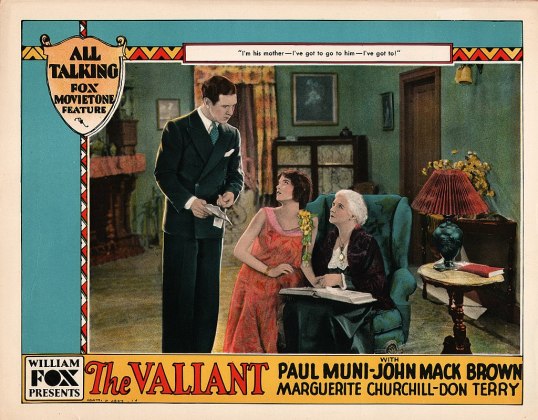
In the days after World War I, a man (Paul Muni) stumbles out of an apartment building and then walks down to the local police station.  He informs the officer on duty that he just shot a man.  He refuses to explain why he shot the man and, when asked for his name, he identifies himself as James Dyke.  The office notices a poster for “Dyke & Co.” on the wall and realizes that the man made up his name.  The man is convicted and sentenced to be executed.

The years pass as the man waits for his execution date.  He is a model prisoner, working hard in the garden and writing editorials for the newspapers in which he warns young readers about pursuing a life of crime.  The money he makes, he puts into Liberty Bonds.  He continues to refuse to tell anyone his first name.

In a small town, an old woman (Edith Yorke) sits in her rocking chair and has visions of all the men who went to war and never returned.  When the woman sees a picture of James Dyke in a newspaper, she thinks that he looks like her son, Joe, who long ago went missing.  The woman’s daughter, Mary (Marguerite Churhill), realizes that her mother is planning to make the trip to the prison to see him before he is executed.  Mary decides to go herself.  She tells her fiancé (John Mack Brown) that she could never get married if it turned out her brother was a murderer.  Meanwhile, the old woman continues to have visions of soldiers marching to war.

At the prison, James Dyke tells Mary that he has no family and he has no past.  But he did serve in World War I and during that time, he met her brother and he saw him die heroically in battle.  Dyke tells her to write to the army for the details of her brother’s death but to be aware that they might not even know whether or not he actually served because the war was such a confusing time that “they don’t know what happened to half the men out there.”  Dyke and Mary continue to talk as the hour of execution draws near….

An adaptation of a one-act play, The Valiant was released in 1929, at a time when America was still coming to terms with the horror of the Great War and Hollywood was still trying to adjust to the arrival of sound.  Though many had assumed that sound films would just be a fad, it turned out that audiences really did like to hear the dialogue as opposed to just reading it.  The Valiant is the type of melodrama that was popular during the silent era and the film does feature title cards that appear between scenes.  “A city street — where laughter and tragedy rub elbows,” one card reads.  Another one announces, “Civilization demands its toll.”  At the same time, it is a sound picture.  The first five minutes of the film are just the Man walking through the city and listening to the sound of cars honking and people talking.  Like many of the early sounds films, it’s obvious that the majority of the cast was not quite sure how they should handle delivering their dialogue.  Some people talk too loudly.  Some talk too softly.  Quite a few deliver their dialogue stiffly and without emotion.  Others use way too much emotion.

The only actor who seems to be fully confident in his ability to perform with sound is Paul Muni, making his screen debut in the lead role.  Muni gives a strong and empathetic performance, one that makes even the most melodramatic of dialogue feel naturalistic.  Muni shows an instinctive knowledge of how to deliver his lines with emotion without going over the top, which was a skill that many of the actors who tried to make the transition to sounds films never learned.  Paul Muni was the first great actor of the sound era, as well as one of the first screen actors to use what would eventually become known as the Method.  Among the actors who were directly inspired by Muni were John Garfield, Montgomery Clift, and Marlon Brando.  Much of modern acting owes a huge debt to the work of Paul Muni.

Seen today, the contrast between Paul Muni’s performance and the film’s staginess can make The Valiant seem like a rather surreal film.  While Muni captures the screen and confidently delivers his lines, everyone else seems hesitant and unsure of how to reply.  The end result is that, to modern audiences, The Valiant can almost seem like a filmed dream.  From the shot of Muni walking down the noisy city street to the sudden appearance of a swing band playing in the prison cafeteria, the film can seem almost Lynchian in its oddness.

The Valiant was a box office success and, according to the notes in the Academy archives, Paul Muni was among the actors considered for the second Best Actor Oscar.  (That year, there were no official nominations and only the winners were announced.)  The Oscar went to Warner Baxter for In Old Arizona but Muni would go on to have an amazing career.

An Offer You Can’t Refuse #2: Scarface (dir by Howard Hawks)


Before there was Tony Montana …. there was Tony Camonte!

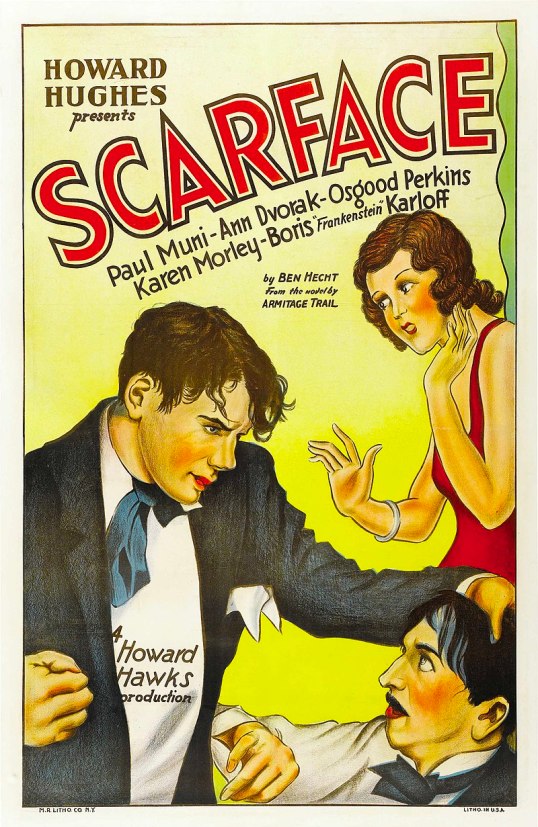
And, of course, before there was Tony Camonte, there was Al Capone.  The 1932 film Scarface was one of the many gangster movies to be based on the life of Al Capone.  Capone and Tony Camonte even share the same nickname, though — unlike Camonte — Capone hated being called Scarface.  On the other hand, as played by the charismatic and cocky Paul Muni, Tony Camonte wears his scar like a badge of honor.  He says that he got his scar serving in the war.  His best friend, Guino (George Raft, a real-life gangster associate who became a star as a result of his performance in this film), says that the scar is the result of a bar fight.

In many ways, that scar tells you almost everything you need to know about Tony Camonte.  If you can look away from the scar, he’s a handsome and charismatic figure.  But when you see the scar, you’re reminded that his life is about violence.  Everything that Tony has is due to his violent nature and it’s somewhat inevitable that his end will also be due to that violence, not to mention his obsession with his sister, Cesca (Ann Dvorak).  It’s not just Tony’s face that’s scarred.  It’s his soul as well.

The film follows Tony, from his early days of working as a gunman for Johnny Lovo (Osgood Perkins) to his eventual usurpation of Lovo’s place as the king of the underworld.  Tony not only takes over Lovo’s rackets but he also goes after Lovo’s girlfriend, the glamorous Poppy (Karen Morley).  The well-bred Poppy may be dismissive of Tony’s ambitions but, as Tony shows her, he lives in the glow of a neon sign that announces, “The World Is Yours.”  That’s something that Tony truly believes and, for a while, the world is his.  He’s done with a gun what other do with lawyer and a clever accountant.  He’s achieved the American dream and he has the money and the beautiful lover to prove it.  Only for a while, though.  You reap what you sow.

The film recreates many scenes from Al Capone’s life.  One of Tony’s rivals is gunned down in a flower shop, much as happened to Dean O’Bannion when he challenged Capone’s power.  At another point, two of Tony’s men dress up like policemen and gun down rival gangsters, just as happened during the St. Valentine’s Day Massacre.  The script was written by Ben Hecht, a Chicago native who had actually met Capone.  When Capone heard that Hecht was writing a film called Scarface, he sent two men to find out what the film was about.  Hecht assured them that the film was not about Capone but was instead a parody of the gangster genre.  Hecht was left alone but the fact that Capone was worried about his public image is quite a contrast to more recent stories about made men studying The Godfather, Goodfellas, and The Sopranos for tips on how to go about their business.  Of course, the film was made before Capone’s anticlimatic downfall so it’s not a combination of tax evasion and syphilis that ends Tony Camonte’s reign of terror.  Camonte goes out in a much more dramatically satisfying manner.

It’s a violent film.  It was a violent film for 1932 and, in some scenes, it’s a violent film for even today.  I’ve read that director Howard Hawks used live ammunition in the scenes that featured guns being fired.  In many of the scenes in which someone is portrayed as running for their lives, the actors in question were literally running and ducking for their lives.  Luckily, the cast survived making the film, though it’s been said that one crew member lost an eye.  Paul Muni went on to have a very distinguished film career, one that inspired future acting greats like John Garfield, Montgomery Clift, and Marlon Brando.  Despite his star-making turn as Muni’s best friend, George Raft’s career was not quite as distinguished, as he ended up turning down a chance to star in Casablanca.  Osgood Perkins’s son, Tony, would become a horror icon when he played Norman Bates.  And Boris Karloff went from portraying a bowling gangster in this film to playing the Monster in Frankenstein.

And, of course, the legacy of Scarface lives on, thanks to the 1983 remake starring Al Pacino.  There’s a third remake on the way, reportedly from Luca Guadagnino, who I guess decided that since he got away with tarnishing the legacy of Suspiria, he might as well go after another classic cult film.  Both versions of Scarface are rightly known as being classics of the gangster genre.  The 1983 version is great but so is the original.

Previous Offers You Can’t Refuse:

  1. The Public Enemy (1931)

Cleaning Out The DVR #34: The Story of Louis Pasteur (dir by William Dieterle)


(For those following at home, Lisa is attempting to clean out her DVR by watching and reviewing 38 films by the end of today!!!!!  Will she make it?  Keep following the site to find out!)

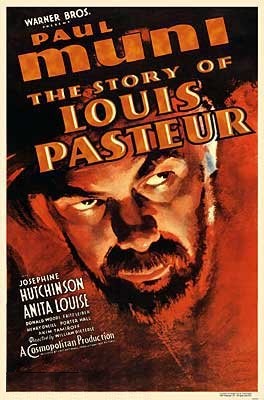
The_Story_of_Louis_Pasteur_poster

OH MY GOD, LOUIS PASTEUR WAS THE DEVIL!

Okay, maybe not but that’s certainly the impression that you might get from looking at the one sheet for the 1936 film, The Story of Louis Pasteur.  Seriously, Louis looks quite sinister!

As the movie starts, that’s certainly the view of the 19th century French medical establishment.  A doctor has been murdered by a grieving husband and it’s believed that the murder was inspired by one of Pasteur’s incendiary flyers.  What does the flyer demand?  That doctors should wash their hands and sterilize their instruments before operating.

That’s right!  Washing your hands before plunging them into a human body was once considered to be a controversial notion.  Pasteur is put on trial, accused of inciting violence with his quackery.  Even though Pasteur is acquitted, he finds himself a pariah.  The autocratic and close-minded Dr. Charbonnet (Fritz Leiber) declares Pasteur to be guilty of great quackery and even the ducks are offended.  That’s how hated Pasteur has become.

But, of course, we the audience know that Pasteur is not a quack.  Not only do we know that he is responsible for discovering the process of pasteurization but he’s also apparently important enough to have his own 1930s Warner Bros. biopic.  And he’s played by Paul Muni, who made a career out of playing great men in 1930s biopics.

The film follows Pasteur as he discovers cures for anthrax and rabies.  Along the way, he yells at a lot of people and he gives a lot of speeches.  This film might as well have been called The Paul Muni Show and … well, his performance is okay.  It’s not great.  If you’ve seen the very first version of Scarface, you know that Paul Muni was capable of giving a far better performance than he gives here.  But then again, as written, all Louis does is bellow against everyone who disagrees with him.  (And cure rabies, we shouldn’t overlook that.)

The Story of Louis Pasteur is one of those old-fashioned biopics that feels a bit creaky and stiff today.  As I watched it, I kept thinking that it felt like something you might across on PBS at three in the morning.  However, 1936 audiences disagreed with me.  The Story of Louis Pasteur did quite well at the box office and was nominated for best picture, though it lost to another biopic, The Great Ziegfeld.

Cleaning Out The DVR #22: The Good Earth (dir by Sidney Franklin)


(For those following at home, Lisa is attempting to clean out her DVR by watching and reviewing 38 films by this Friday.  Will she make it?  Keep following the site to find out!)

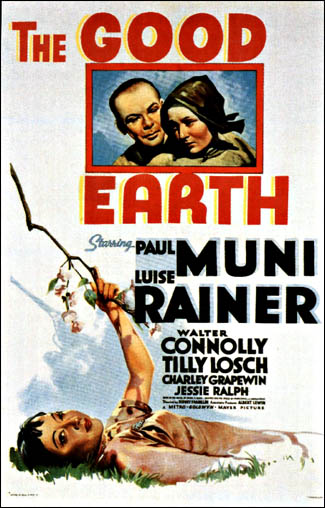
Good_earth_(1937)

The 1937 film The Good Earth is a strange one.

It’s a big, epic film about life in China in the years before World War I.  It opens with a poor farmer named Wang (Paul Muni) marrying a servant girl named O-Lan (Luise Rainer).  O-Lan is quiet but strong and, with her support, Wang eventually starts to prosper.  He buys land and they have children.  Together, Wang and O-Lan manage to survive both famine and a political upheaval.  In fact, it’s China’s volatile politics that occasionally allow the family to survive.  When a revolutionary mob loots a mansion, O-Lan joins in just long enough to come across a bag of diamonds that the Wang uses to eventually buy the biggest house in town.  Once he’s become wealthy and complacent, Wang ends up taking on a younger, second wife (Tilly Losch) and O-Lan finds herself competing for his attention.  Ultimately, it’s only when Wang is again forced to tend to the Earth that he understands what is really important.

So, here’s the weird thing about The Good Earth.  It’s a film about China.  It covers several years of Chinese history and the story itself is rooted in Chinese culture.  All of the characters are meant to be Chinese.  When the movie was filmed, China was at war with Japan so it’s not surprising that the film was shot in California.  But what is interesting (though not really surprising when you consider the history of Hollywood) is that there are very few Chinese people in the cast and none of them play any of the major roles.

Instead, Wang was played by Austria-born, Chicago-raised Paul Muni.  O-Lan was played by German Luise Rainer.  Wang’s comic relief uncle was played by American character actor Walter Connolly while his father was played by a former vaudeville star from Ohio named Charley Grapewin.  All of the actors are heavily made up so that they’ll look Chinese but none of them act or sound Chinese.  It makes for a very strange viewing experience.

And it’s a bit unfortunate because there are some very good scenes in The Good Earth.  Technically, it’s a very strong film.  Towards the end, there’s a locust invasion that is still thrilling to watch.  The sets look great.  The costumes look great.  If you’re a history nerd like me, the story has the potential to be interesting.  But, whenever you start to get sucked into the film’s story, Wang starts to speak and sounds totally like a guy from Chicago and it takes you out of the movie.  The uneven mix of quality and miscast actors makes for a rather disjointed viewing experience.

As a big epic, it’s probably not surprising that The Good Earth was nominated for best picture.  However, it lost to another Paul Muni film, The Life of Emile Zola.

http://www.youtube.com/watch?v=3iEREqQjjzU

6 Reasons To Watch I Am A Fugitive From A Chain Gang


I am so thankful for TCM.  This wonderful network has allowed me to discover so many old films that I might otherwise have never seen.  Among those films, 1932’s I Am A Fugitive From A Chain Gang.

As you might guess from the title, I Am A Fugitive From A Chain Gang was something of a low-budget B-movie.  It’s also one of the few films that can legitimately claim to have changed society.  The fugitive of the title is James Allen (Paul Muni), a veteran of the First World War who, feeling uncomfortable in peace time and unable to find work, finds himself in Georgia where he unintentionally becomes involved in a robbery and then ends up being sentenced to 10 years on a chain gang.  After suffering months of inhumane treatment, Allen finally escapes.  He makes his way up north and, much like Jean Valjean, attempts to start a new life for himself.  However, even as he find success, he knows that he could be exposed and sent back to prison at any moment.

Here’s 6 reasons to watch I Am A Fugitive From A Chain Gang.

1) It’s based on a true story.  I Am A Fugitive From A Chain Gang was based on a book written by a man named Robert Ellis Burns.  Burns actually had served time on and escaped from a Georgia chain gang.  At the time the movie came out, Burns was still a fugitive.  The movie was such a success and was so effective that when Burns was later arrested in New Jersey, the governor refused to extradite him.  Burns was finally pardoned in 1945 and lived the rest of his days as a free man.

2) I Am A Fugitive From A Chain Gang got results.  Alone among the major studios in the 30s, Warner Bros. specialized in making films that dealt with social issues.  While other studios either celebrated wealth or invited audiences to escape the Great Depression through fantasy, Warner Bros. was unashamed to be on the side of the oppressed.  I Am A Fugitive From A Chain Gang is a perfect example of this.  Not only did the film lead to Burns receiving a pardon but it also helped to end the chain gang system.

3) Director Mervyn LeRoy directs the film as if it were a film noir.  By the end of the film, it’s impossible not to empathize with the main character’s growing sense of paranoia.

4) Do you know who Paul Muni is?  You will after watching I Am A Fugitive From A Chain Gang.  Paul Muni is largely forgotten today but, back in the 1930s, he was considered to be one of the best actors around.  Watching him in this film, you can see why.

5) The film’s final scene is a classic.  You can watch it below (and yes, this video does count as a spoiler).

6) I Am A Fugitive From A Chain Gang was nominated for best picture.  It lost to Cavalcade, a celebration of the British upper class.