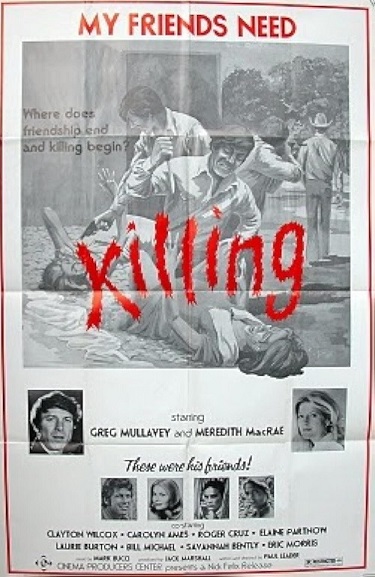
At the start of 1976’s My Friends Need Killing, Gene Kline (Greg Mullavey) and his wife, Laura (Meredith MacRae) lie in bed together. Gene can’t sleep. He’s haunted by the sounds of gunfire and explosions and people barking out orders at him. A Vietnam vet, Gene has been seeing a Dr. MacLaine (Eric Morris) for help with dealing with his wartime PTSD but it hasn’t done him much good. Without telling Laura, Gene has been sending letters to the former members of his platoon, letting them know that he will soon be visiting them in each of their home cities. Gene says that he’s just dropping by for a visit but the reality is that Gene has decided that his friends need killing.
Without telling his wife, Gene leaves home in the morning and heads to San Francisco. While Laura is looking at old pictures of Gene and having flashbacks to their perfect wedding day, Gene is stalking the people with whom he committed an atrocity in Vietnam. Like Gene, the former members of his platoon have struggled to adjust to returning home. One lives in Texas, loves to hunt, and brags about how he never thinks about the war. Another has found work as a trucker. Another has a nice big house and a pregnant wife and still suffers from flashbacks of his own. Perhaps the most tragic of Gene’s friends is Les Drago (Roger Cruz), who is now a performance artist and an anti-war activist and who recites Lady MacBeth’s “out damn spot” speech while discussing his activities during the war.
My Friends Need Killing is a short but intense movie. It may only have a 73-minute running time and a portion of that running time may be taken up with filler but Gene pursues his mission with a relentless and ruthless determination that is ultimately very unsettling to watch. As played by Greg Mullavey, Gene wanders through the film with the thousand-yard stare of a man who has truly snapped. Years after the war, he can’t forgive anyone, including himself. To him, it doesn’t matter that someone like Les returned from Vietnam and decided to dedicate his life to preventing another pointless war. What matters to Gene is getting vengeance on those who he blames for his sins. Even though the film makes clear that Gene’s actions are due to his experiences during the war, Gene himself never becomes a sympathetic figure. He’s too vicious in his murders, even targeting the wife of one of his platoonmates.
Adding to the film’s unsettling and grim atmosphere is the film’s rather ragged editing. Scenes begin and end abruptly, sometimes in mid-conversation. Each murder is followed by a shot of an airplane landing in another city as Gene continues his mission. Scenes of Gene having flashbacks are haphazardly mixed with scenes of Laura and Dr. MacLaine trying to figure out where Gene has disappeared to. One is tempted to smile at the film’s score, which sounds more appropriate for a 70s cop show than a movie about a murderous vet, but even the score ultimately adds to the film’s off-center feel. The score feels as out-of-place as the happiness of his friends does to Gene. My Friends Need Killing ultimately feels like a film about a world that is spiraling out of control. The film ends on a truly odd note, one that suggests that there is hope for the future, even if there’s no place for Gene in it.
Much like Bob Clark’s Deathdream, My Friends Need Killing suggested that mainstream America would never be ready to fully accept what happened in Vietnam.

 Naked women are turning up murdered in Los Angeles. The only clue that the crimes are connected: the baby doll that is left beside each body. Can detectives Louis (Jeff Kober) and Larry (Bobby Di Cicco) solve the case while also dealing with issues in their own private life? Louis’s girlfriend (Melanie Smith) is worried that Louis is becoming obsessed with is work and that he is not willing to commit to their relationship. Larry is upset because he suspects his wife is keeping a secret from him. Their chief (John Saxon) wishes they would just solve the case, especially when the killer targets his own daughter. The problem is that Louis is so driven and prone to violence that he has managed to get himself suspended from the force. Why does that always happen to good cops?
 Through the Shattered Lens