Cleaning Out The DVR: The Comedians (dir by Peter Glenville)


Not to be mistaken for the Taylor Hackford-directed, Robert De Niro-starring disaster from a few years back, The Comedians is a film from 1967 that follows several different people as they attempt to survive day-to-day life in Haiti, back when Haiti was ruled by the dictator, Papa Doc Duvalier.

Richard Burton stars Mr. Brown (Richard Burton), a deeply cynical and world-weary Englishman who owns what passes for a luxury hotel in Haiti.  Though Mr. Brown hopes to be able to sell the hotel and get out of Haiti, he is also having an affair with Martha (Elizabeth Taylor), the German wife of Pineda (Peter Ustinov), the ambassador from Uruguay.  Mr. Brown tries to avoid politics, which it turns out is not easy to do when you’re living under a murderous regime.

Complicating Mr. Brown’s life is Major Jones (Alec Guinness), a retired British army officer who has come to Haiti to do business but who is promptly imprisoned when it’s discovered that he was invited to come to the island by a minister who was subsequently declared to be an enemy of the state.  The fascist Captain Concasseur (Raymond St. Jacques) arrests Major Jones and Mr. Brown takes it upon himself to try to get Jones released.  Unfortunately, Major Jones doesn’t quite understand how serious his situation is and he’s convinced the Haitians that he’s not only a brilliant military leader but that he can also arrange for them to receive a cache of weapons, which he claims he has hidden in a Miami warehouse.

Meanwhile, Mr. and Mrs. Smith (Paul Ford and Lillian Gish) have also arrived on the island, hoping to set up a vegetarian center in Haiti.  (Mr. Smith even once ran for President of the U.S. as the candidate of the Vegetarian Party.)  In many ways, Mr. and Mrs. Smith serve as a stand-in for clueless American activists, obsessing over minor issues while ignoring the larger problems that are right in front of their faces.

From the start, The Comedians establishes Haiti as being a dangerous place, a country where the people live in fear of the brutal police and where the poor struggle to survive day-to-day while their rulers live a life of luxury.  It’s a place where political dissidents regularly disappear, though the police aren’t above murdering people in public as well.  It’s a country where the State rules supreme, controlling the citizens through both fear and a fierce cult of personality.  Rebels like Dr. Magiot (James Earl Jones) only want the country to be free but they know that, as long superpowers like America are supporting the regime, there’s little that the rebels can realistically hope to accomplish.

A major theme running through The Comedians is that the real suffering of the Haitian people is often overshadowed by the strategic concerns of the United States.  Unfortunately, pretty much the same thing happens within the film itself.  While there’s several black actors in supporting roles, the story focuses on the white characters and, as a result, it sometimes feels like the film’s message is less about the people being oppressed and more about how unfortunate it is that people like Brown, Jones, and the Smiths are being inconvenienced by it all.  Like many similarly well-intentioned political films from the late 60s, The Comedians get so bogged down in all of the personal dramas that it loses sight of what’s actually the important part of the story.  The film is often seems more interested in Brown and Martha’s affair than in the conditions that would lead to people like Dr. Magiot risking their lives to bring about change.

For the most part, it’s a well-acted film.  Richard Burton’s natural self-loathing is put to good use and Alec Guinness has a few poignant scenes as a pathological liar who doesn’t realize how much trouble he’s actually in until it’s too late.  (Guinness also has a scene where he wears blackface and pretends to be Burton’s maid.  He does this in order to escape from the secret police and the film doesn’t treat it as being a joke but it’s still rather cringey to watch.)  Elizabeth Taylor is miscast as Martha and her German accent comes and goes but Paul Ford and Lillian Gish do a good job playing clueless Americans.  Perhaps the film’s strongest performance comes from Zakes Mokae, who doesn’t say much as a member of the secret police but who exudes menace every time that he’s on screen.  Still, as well acted at it may be, the film is slowly paced and always seem hesitant about taking any position beyond a general sense that dictatorships are bad.

That said, there’s nothing wrong with reminding people that dictatorships are bad.  That’s especially an important message today.  The past few years have left me convinced that a lot of people secretly yearn for a dictatorship and would be willing to trade their freedoms for a false sense of security.  Though the film may struggle dramatically, it’s still works as a warning about what true authoritarianism actually is.

 

Lisa Reviews An Oscar Nominee: The Russians Are Coming, The Russians Are Coming (dir by Norman Jewison)


russians_are_coming

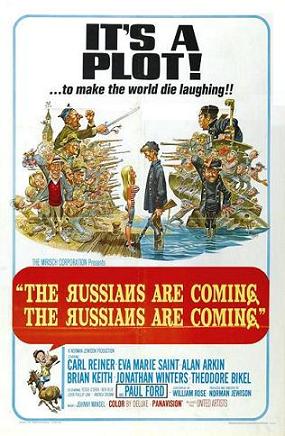
Earlier tonight, I watched a 1966 film called The Russians Are Coming, The Russians Are Coming.  

It’s a cheerful comedy about what happens when the captain (played by Theodore Bikel) of a Russian submarine decides that he wants to take a look at the United States.  Though he was only planning to look at America through a periscope, he accidentally runs the submarine into a sandbar sitting near Gloucester Island, which itself sits off the coast of Massachusetts.  The captain sends a nine man landing party, led by Lt. Yuri Rozanov (a youngish Alan Arkin, making his film debut and receiving an Oscar nomination for his efforts), to the island.  Their orders are simple.  Yuri and his men are too either borrow or steal a boat that can be used to push the submarine off the sandbar.  If they run into any locals, they are to claim to be Norwegian fisherman.

Needless to say, things that don’t quite go as planned.  The first Americans that Yuri and his men meet are the family of Walt Whitaker (Carl Reiner), a vacationing playwright.  Walt’s youngest son immediately identifies the Norwegian fisherman as being “Russians with submachine guns.”  When Walt laughingly asks Yuri if he’s a “Russian with a submachine gun,” Yuri produces a submachine gun and promptly takes Walt, his wife (Eva Marie Saint), and his children hostage.

Yuri may be a Russian.  He may officially be an enemy of America.  But he’s actually a pretty nice guy.  All he wants to do is find a boat, keep his men safe, and leave the island with as little drama as possible.  However, the inhabitants of the island have other plans.  As rumors spread that the Russians have landed, the eccentric and largely elderly population of Gloucester Island prepares for war.  Even as Police Chief Mattocks (Brian Keith) and his bumbling assistant, Norman Jonas (Jonathan Winters), attempt to keep everyone calm, Fendall Hawkins (Paul Ford) is organizing a militia and trying to contact the U.S. Air Force.

Meanwhile, Walt’s babysitter, Allison (Andrea Dromm) finds herself falling in love with one of the Russians, the gentle Alexei Kolchin (John Phillip Law).

As I said at the start of this review, The Russians Are Coming, The Russians Are Coming is a cheerful comedy, one with a rather gentle political subtext, suggesting that the majority of international conflicts could be avoided if people got to know each other as people as opposed to judging them based on nationality or ideology.  There’s a rather old-fashioned liberalism to it that probably seemed quite daring in 1966 but which feels rather quaint today.  Sometimes, the comedy gets a bit broad and there were a few times that I found myself surprised that the film didn’t come with a laugh track.  But overall, this is a well-acted and likable little movie.

As I watched The Russians Are Coming, The Russians Are Coming (and, as someone who is contractually obligated to use a certain number of words per review, allow me to say how much I enjoyed the length of that title), I found myself considering that the film would have seemed dated in 2013 but, with all the talk of Russian hacking in the election and everything else, it now feels a little bit more relevant.  Not a day goes by when I don’t see someone on twitter announcing that the Russians are coming.  Of course, if the film were released today, its optimistic ending would probably be denounced as an unacceptable compromise.  Peaceful co-existence is no longer as trendy as it once was.

Another interesting thing to note about The Russians Are Coming, The Russians are Coming: though the film was written by William Rose (who also wrote another example of mild 1960s feelgood liberalism, Guess Who’s Coming To Dinner), it was based on a novel by Nathaniel Benchley.  Benchley was the father of Peter Benchley, the author of Jaws.  It’s easy to see the eccentrics of Gloucester Island as distant cousins of the inhabitants of Amity Island.

As previously stated, The Russians Are Coming, The Russians Are Coming was nominated for best picture but it lost to the far more weighty A Man For All Seasons.

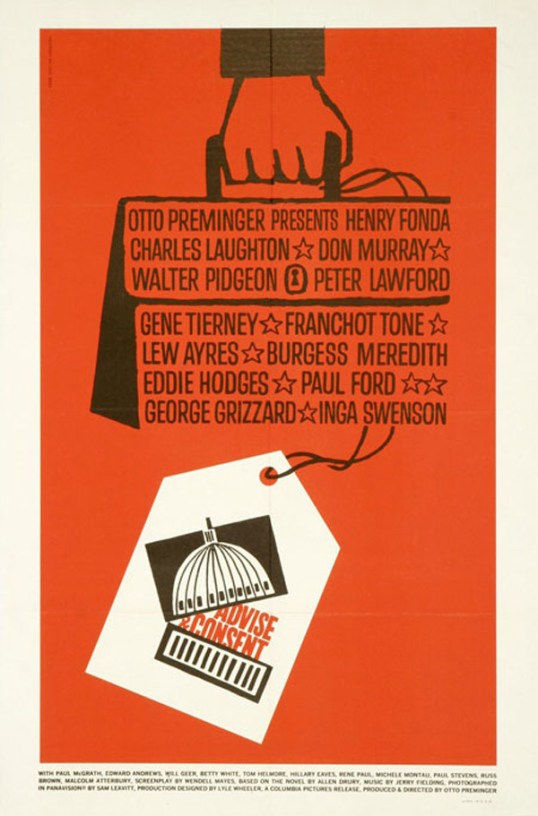
Shattered Politics #17: Advise & Consent (dir by Otto Preminger)


Advise-&-Consent-(1)

In case you hadn’t heard, U.S. Sen. Barbara Boxer has recently announced that she’s retiring in 2016.  For the first time in decades, there’s going to be an open senate seat in California.  There’s been a lot of speculation about who might run for the seat and, for the most part, it’s all been the usual political suspects.  The state’s attorney general is running.  A few congresspeople might run.  Token billionaire Tom Steyer is thinking of getting into the race.

What disappoints me is that, as of right now, it doesn’t look like any celebrities are planning on running.  You know what would have made the Golden Globes perfect?  If George Clooney had announced his candidacy while accepting his Cecil B. DeMille award.  (At the very least, it might have given Amal something to smile about, as opposed to just sitting there with a condescending smirk on her face.  Seriously, what’s up with that?)  But even beyond George Clooney, there’s all sorts of celebrities who could run.  Charlie Sheen lives in California, after all.  Jeff Bridges might not be able to run in Montana but what about California?

I was discussing this with a friend of mine who suggested that Betty White should run because who could vote against Betty White?  Speaking for myself, I could easily vote against Betty White but I do think there would be something appropriate about Betty White serving in the U.S. Senate.  After all, in 1962, she played a senator in Otto Preminger’s political epic, Advice & Consent.

White played Sen. Bessie Adams of Kansas and was only given a few minutes of screen time.  She’s one of many performers to show up in Advise & Consent‘s version of the U.S. Senate.

For instance, Walter Pidgeon plays Sen. Bob Munson, who is the Senate majority leader and, as a result, the closest thing that this sprawling film has to a central character.  His job is to make sure the President’s agenda is pushed through Congress.

And then there’s Peter Lawford, as Sen. Lafe Smith, who always has a different girl leaving his hotel room.  When Advise & Consent was made, Lawford was President Kennedy’s brother-in-law.  Interestingly enough, one of Kennedy’s former girlfriends — actress Gene Tierney — shows up in the film as well, playing Bob Munson’s lover.

George Grizzard plays Sen. Fred Van Ackerman, who is about as evil as you would expect someone named Fred Van Ackerman to be.  Grizzard gives one of the better performances in the film, which just goes to prove that it’s more fun to play an evil character than a good one.

Don Murray is Sen. Brigham Anderson, a senator who is being blackmailed by Van Ackerman’s lackeys.  Despite being happily married to Mabel (Inga Swenson), Anderson is leading a secret life as a gay man.  The scene where Anderson steps into a gay bar may seem incredibly tame today but it was reportedly very controversial back in 1962.

And finally, there’s Sen. Seabright Cooley.  You may be able to guess, just from his overly prosaic name, that Cooley is meant to be a southerner.  That, of course, means that he wears a white suit, is constantly fanning himself, and speaks in lengthy metaphors.  Sen. Cooley is played by Charles Laughton, who overacts to such a degree that I’m surprised that there was any oxygen left over for anyone else.

All of these senators have been tasked with deciding whether or not Robert Leffingwell (Henry Fonda) will be the next secretary of state.  Fonda, not surprisingly, is the epitome of urbane liberalness in the role of Leffingwell.  However, Leffingwell has a secret.  Back in the 1930s, Leffingwell was a communist.  When Sen. Cooley introduces a witness (Burgess Meredith) who can confirm this fact, Leffingwell offers to withdraw as the nominee.  However, the President (Franchot Tone) refuses to allow Leffingwell to do so.  Instead, with the help of Van Ackerman, he tries to pressure Anderson into supporting Leffingwell’s nomination.

This, of course, leads to melodrama and tragedy.

As far as literary adaptations directed by Otto Preminger are concerned, Advise & Consent is better than Hurry Sundown while being nowhere to close to being as good as Anatomy of a Murder.  It’s a film that is occasionally entertaining, often draggy, and, if just because of all the different acting styles to be found in the cast, always interesting to watch.

And, for what it’s worth, Betty White makes for a convincing senator.  So, perhaps the people of California should watch Advise & Consent before voting for Tom Steyer…