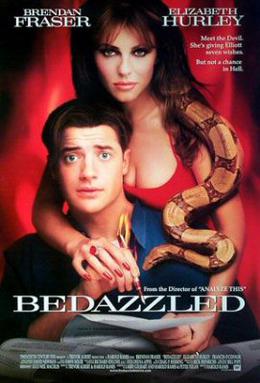
 Elliot (Brendan Fraser) has a go-nowhere job at a computer company and an unrequited crush on Alison (Frances O’Connor), a co-worker who doesn’t even know who he is. One night, at a bar afterwork, he’s approached by the Devil (Elizabeth Hurley), who offers Elliot seven wishes in return for his soul. Elliot agrees but then he discovers that the Devil is tricky and his wishes always have an complication. Elliot wants to be powerful so the Devil turns him into a Columbian drug lord. Elliot wants to be sensitive and the Devil turns him into a whiny crybaby. Elliot wants to be president and suddenly, he’s Abraham Lincoln being told to get ready for the theater. Whenever things start to get too dangerous, the Devil brings Elliot back to reality so that she can continue to taunt him.
An Americanized remake of a British comedy that starred Dudley Moore and Peter Cook, Bedazzled was unfairly savaged by the critics when it was first released. While it can’t match the wit and heart of the original and not all of the wishes are equally effective, the remake has its charms. When Bedazzled first came out, most people talked about Elizabeth Hurley’s sexy performance of the Devil. When she appears as a school teacher, it’s not a surprise that every student brings her an apple at the start of the day. Hurley is so sexy that it’s easy to miss that she’s also giving a really good performance. Hurley’s Devil is a prankster. She likes to steal souls but mostly, she’s just having fun ruining all of Fraser’s wishes. Brendan Fraser is likable as Elliot and the way he responds to each wish gives him a chance to show off his comedic skills. Finally, the movie has a good ending, with Elliot growing up and realizing the truth about his crush on Alison.
Bedazzled may not be up to the level of some of director Harold Ramis’s other films but it’s still better than its reputation.
 Through the Shattered Lens