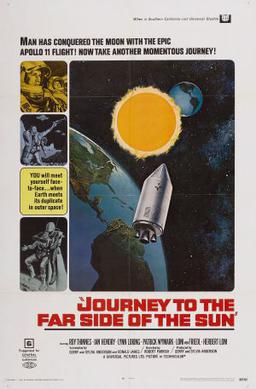
Journey to the Far Side of the Sun (1969, directed by Robert Parrish)


In the year 2069, the European Space Exploration Council discovers that there is a planet on the other side of the Sun, one that orbits the same path as the Earth.  Unfortunately, a spy transmits this information to the communists so America and Europe team up to make sure that they reach the planet before the Russians!

(Remember, production started on this movie in 1967, when America and Soviet Union were still competing to see who would be the first to land on the moon.  Of course, by the time Journey to the Far Side of the Sun was released in 1969, America had already landed on the moon and the Russian space program was no longer taken seriously.)

Two astronauts are assigned to a manned mission to explore the new planet.  Glenn Ross (Roy Thinnes) is American.  John Kane (Ian Hendry) is British.  After spending three weeks in suspended animation, Ross and Kane awaken to discover themselves orbiting a planet that appears to have much the same atmosphere as Earth.  When their ship crashes into the planet, Kane is fatally injured and Ross is retrieved by a human rescue team!  He’s told that the ship crashed in Mongolia.  Kane and Ross were orbiting Earth all along!

Or were they?  Even though Ross is reunited with his wife and debriefed by Jason Webb (Patrick Wymark), the head of the mission, he soon discovers that things are different.  People who were once right-handed are now left-handed and text is now written from right-to-left instead of left-to-right.  People drive on the wrong side of the road and, after Ross makes love to his wife, she feels like something was different about him.  Ross realizes that he’s on a counter-Earth!

It’s an intriguing premise but, unfortunately, Journey to the Far Side of the Sun doesn’t do much with it.  It’s not as if Ross has landed on the Bizarro world, where people say, “Bad Bye” and root for the bad guys at the movies.  Instead, it’s just a world where right-handed people are now left-handed and everyone drives on the opposite side of the road.  Ross theorizes that everything that happens on Earth also happens on Counter-Earth, which means that the other Ross is on Earth, realizing the exact same thing that the first Ross is realizing but who cares because there’s not really any major differences between the two Earths.  Maybe if Counter-Earth had an alternate history where Rome never fell or the Germans won World War II, the movie would be more interesting or at least more like an old episode of Star Trek.  Instead, the movie is all about Ross trying to convince the people on Counter-Earth that he didn’t intentionally abort the mission and that he should be given a chance to return to his Earth.   It’s the driest possible way to approach an interesting premise.

I will say that Journey to the Far Side of the Sun also has one of the strangest endings that I’ve ever seen.  I won’t spoil it here, other than to say that I wonder if the ending was written before or after 2001 made confusing conclusions cool again.

Action in the Alps: WHERE EAGLES DARE (MGM 1969)


gary loggins's avatarcracked rear viewer

Alistair MacLean’s adventure novels, filled with muscular action and suspenseful plot twists, thrilled moviegoers of the 60’s and 70’s in such big budget hits as THE GUNS OF NAVARONE and ICE STATION ZEBRA. In his first foray into screenwriting, 1969’s WHERE EAGLES DARE,  he adapted his own work to the silver screen, resulting in one of the year’s biggest hits, aided by the box office clout of Richard Burton and Clint Eastwood . The film’s a bit long, running over two and a half hours, but action fans won’t mind. There’s enough derring-do, ace stunt work, explosions, and cliffhanging (literally!) to keep you riveted to the screen!

A lot of the credit goes to veteran stunt coordinator Yakima Canutt, in charge of all the action scenes as second unit director. Canutt staged some of the most exciting scenes in film history, from John Ford’s STAGECOACH to William Wyler’s BEN HUR, and certainly keeps things busy…

View original post 617 more words

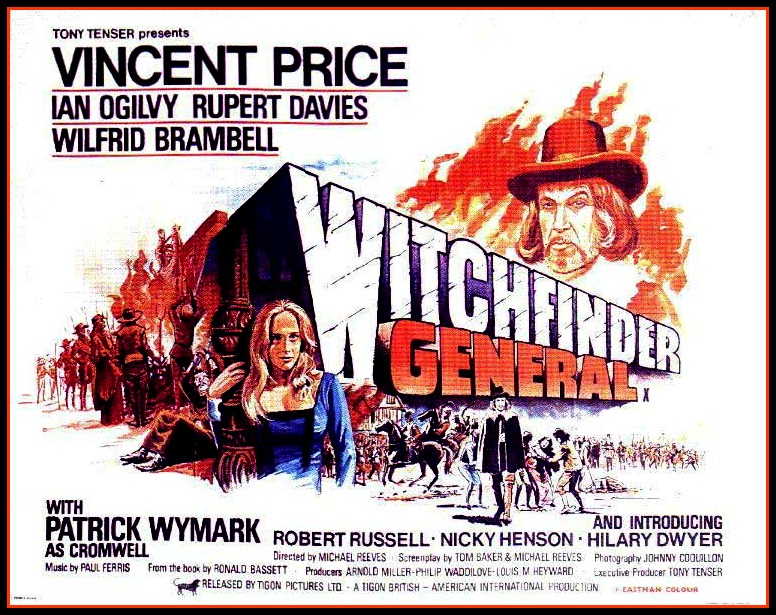
Quickie Review: Witchfinder General (dir. by Michael Reeves)


The late 1960’s saw a major shift in horror films. There have always been horror films which had an inordinate amount of gore and violence, but were always relegated to the niche cinemas which catered to horror exploitation films. In 1968 it all changed with the release of George A. Romero’s Night of the Living Dead. Not only did this film graphically show gore and violence on the screen it also paired it with a well-told story. Another film which became infamous the very same year for it’s portrayal of torture, rape and sadism on the screen was British filmmaker Michael Reeves’ horror film, Witchfinder General.

Witchfinder General starred horror icon Vincent Price in the title role as Matthew Hopkins who was tasked as the Witchfinder General by the Cromwell government during the English Civil War of the 17th-century. His Hopkins would travel the region of East Anglia (Cromwell-controlled territory) rooting out witchcraft and sorcery wherever they might be found. Assisting him in this task is the thuggish, brute Stearne (played by Robert Russell) who relished in torturing suspected witches in towns the two visit. It’s during one such visit to the town of Brandeston, Suffolk that Hopkins and Stearne begin a sequence of events which would pit them against the soldier Richard Marshall (who also happens to fight on the same side as Hopkins and Stearne) whose fiancee and her uncle became the latest victims of the Witchfinder General’s sadistic methods of rooting out confessions.

The film as a horror has less to do with the supernatural, but more of the hypocritical horror which begets a political environment where powerful men contest for more power and uses fear and the superstitious ignorance of a populace to cement their power. In this amoral vacuum comes in the opportunistic Matthew Hopkins who uses the power given to him by his government to not just do his duty to eradicate witchcraft but also abuse it for his own personal (and as seen in the film a way to sate his own personal lusts) gain. It’s this hypocritical nature of who was suppose to be a Puritanical and righteous agent of God which emphasizes the true historical horror of religion and politics becoming one and the same.

Vincent Price as Matthew Hopkins was at the top of his game in Witchfinder General. He gives his role not just an air of superiority over everyone he meets and deals with, but he also makes Hopkins’ truly an amoral character who sees nothing wrong in taking advantage of his position and actually feels like he deserves the desperate attentions of those willing to do anything to save their loved ones from his machinations. Robert Russell as his licentious and sadistic assistant Stearne also does a great job in portraying an individual who might seem brutish and thuggish, but who was also more honest with is situation than his master. It makes for an interesting pair despite their roles being the film’s prime antagonists.

The film more than truly earned the outcry it received upon it’s release in 1968 as scenes of torture and sadism was extreme for a British horror film industry so used to the Gothic sensibilities of the Hammer Films of the era. Graphic depictions of burnings, torture and drowning were done not to seem gratuitious or to cater to the burgeoning gorehound crowd of the era, but done so matter-of-factly that they seem even more horrific.

The Witchfinder General really helped usher in the death of gothic horror which dominated the genre with the Hammer Films in the UK and the Edgar Allan Poe films of Roger Corman in the US. The film continues to impress new generations of horror fans and is still considered by older fans of the genre as one of the best horror films ever made. For some the film might look dated due to the acting (most of the actors of the era were stage actors first and film ones second) and the effects work, but they also fail to look at the film in context of the era and how even by today’s standard it would still shock those not well-versed in the genre of horror. They definitely don’t make horror films like this anymore and that’s a shame on many levels.