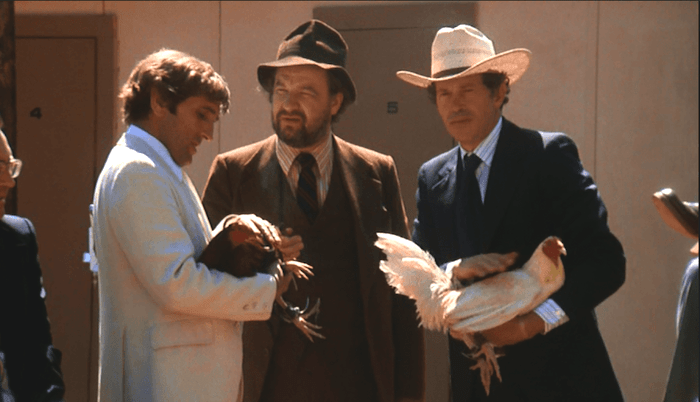
Brad reviews COCKFIGHTER (1974), starring Warren Oates!


I read about the movie COCKFIGHTER many years ago, and I remember the review being very positive. I had never watched the film before, but with today being Warren Oates’ birthday and it being available on Amazon Prime, I decided I’d finally watch it. 

Directed by Monte Hellman and based on Charles Willeford’s 1962 novel, COCKFIGHTER introduces us to Frank Mansfield (Warren Oates), a man completely obsessed with the southern “sport” of cockfighting. As we meet him, he’s in the process of losing a bet and a cockfight with Jack Burke (Harry Dean Stanton). The loss isn’t just a setback, it costs him all of his cash, his truck, his trailer, and his current girlfriend Dody White (Laurie Bird). We also notice in these early scenes that Frank only communicates through sign language and writing notes. It seems that he’s been living under a self-imposed vow of silence. Two years earlier, on the eve of the big, season-ending cockfighting grand finale, Frank’s big-mouthed braggadocio caused him to lose his prized cock, and the prestigious “Cockfighter of the Year” medal in a meaningless hotel bet, also against Jack Burke. Frank vows not to speak again until he wins that medal. Coming up with cash in the only way he can by selling his family’s home, Frank buys a new cock named White Lightning from Ed Middleton, played here by the film’s writer Charles Willeford. Armed with new fowl and a new, capital rich partner named Omar Baradansky (Richard B. Shull), Frank will not let anything stop him, including the love of his life Mary Elizabeth (Patricia Pearcy) or an axe wielding competitor (Ed Begley, Jr.), from being named “Cockfighter of the Year” and finally regaining his voice and the respect he desires!

COCKFIGHTER definitely has some things going for it. First and foremost, Warren Oates is so good in the lead role as the obsessed man who puts success in cockfighting above anything else in his life, including every other person. He literally sells the family home out from under his alcoholic brother Randall (Troy Donahue) in order to fund his next cock purchase after he’s gone bust. This sets up quite the sight gag for such a gritty and realistic film as a large truck and trailer drives away the family home taking up the entire state highway. When his long time fiancé asks him to give up cockfighting, he just gets up, leaves her shirtless and heads back out on the circuit. He writes her a letter from the road and tells her he loves her, but he also makes it clear that life without cockfighting is a life that he’s unwilling to live. Oates’ Frank Mansfield is not the kind of person you’d ever want to depend on in life, but he’s also an uncompromising individual who is determined to live life wholly on his own terms, accepting of the successes and failures that come with it. I watched the film because it features Warren Oates, and after having done so, I can say that his performance is truly special. 

COCKFIGHTER is one of those movies that makes us feel like we’re watching real people, and that’s kind of fascinating even if they reside in a world that we don’t really want to live in. The primary credit for that has to go to director Monte Hellman and Oscar winning cinematographer Nestor Almendros (DAYS OF HEAVEN). The restraint that is shown in the storytelling, as well as the sweaty, ramshackle authenticity of the Georgia locations, brings the story to life. The supporting cast also does its part to create the world of COCKFIGHTER. Harry Dean Stanton as Jack Burke, Frank’s primary rival in the cockfighting game, is excellent as you might expect, and he seems a lot like a regular guy. I really like Richard B. Schull, who plays Frank’s outgoing and talkative partner Omar. His friendly and gregarious personality seems a little untrustworthy at first, but he turns out to be the most likable person in the film. And finally, I want to shoutout Charles Willeford. Not only did he write the source novel and screenplay for COCKFIGHTER, he also gives a solid performance as Ed Middleton, an old-timer in the game who treats Frank with honesty and decency when he’s hit rock bottom. 

With all the positive things I’ve said above, I have to address the graphic depiction of cockfighting in COCKFIGHTER. This was the 70’s, and the scenes shown here are real and were very difficult for me to watch. It’s not fun to see animals fight and kill each other, and this is coming from a person who loves fried chicken and is not particularly an animal lover. The scenes are presented as matter of fact and in service of the story, but that still doesn’t make them easy to watch. Director Monte Hellman has gone on record to express his personal disgust at even filming these scenes. While a movie made in the 1970’s probably couldn’t have been made without these sequences, I just wanted to make it clear that this film is probably unwatchable for a lot of people.

Overall, COCKFIGHTER is a relic of the 1970’s. It’s a gritty and realistic film, featuring a great central performance from Warren Oates. It’s also an ethically troubling film that features real animal on animal violence. Based on that I don’t necessarily recommend the film. Rather, I just want to share my own thoughts, and you can determine if you want to watch it or not. That’s what I’ve tried to do above. 
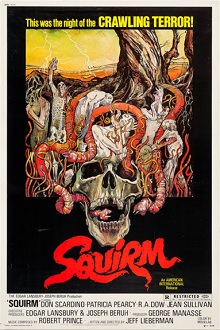
Horror Film Review: Squirm (dir by Jeff Lieberman)


Worms are creepy and you don’t want to get them in your hair.

I think that, more than anything, explains the continuing appeal of this lightly satirical Southern shocker from 1976.  The film’s plot is a simple one, as the plots of the best horror films often are.  There’s a storm.  The power lines over Fly Creek, Georgia get knocked down.  The power line lands in the mud and soon, you’ve got thousands of electrified worms crawling all over the place.  These worms are angry and noisy and they like to eat people’s faces and take control of their bodies.  Of course, since the power lines are all down, you’re can/t exactly call for help and even worse, you’re thrown into darkness once the sun goes down.  Squirm gets at some very basic fears.

Squirm has a welcome sense of humor, as any film about killer worms should.  It’s obvious that Lieberman knew that the audience would be demanding that the worms get revenge on at least a few fisherman and those scenes are tossed in there.  The film’s nominal hero is Mick (Don Scardino), a visitor from New York City, and he’s so out-of-place in rural Georgia that it becomes funny watching him try to do simple things like order food or have a simple conversation.  Even when he tries to warn people about the worms, you can tell they’re thinking, “He might be right but do I want to listen to a yankee?”  As we say down here in Texas, you can always spot the yankee because they’re the ones sweating profusely and talking about killer worms.  The scenes of Mick trying to order something at the local diner reminded me of the great “We don’t got no goddamn trout” scene from Hell or High Water.

Mick is in Georgia to visit his girlfriend, Geri (Patricia Pearcy).  Almost everyone who Mick meets seems like they could have come out of an overheated first draft of a Tennessee Williams play.  Once the worm attack starts in earnest, Geri’s mother sinks into a state of denial that would have impressed Blanche DuBois.  Meanwhile, Squirm has its own wannaba Stanley Kowalski in the form of Roger (R.A. Dow), who obviously can’t understand why Geri would want a boyfriend from New York when she could have him.  Roger is a creep but he’s a familiar creep.  Anyone who has ever lived in the country will immediately recognize Roger and know everything that they need to know about him.

That said, the worms are the real stars of Squirm and they certainly do manage to get everywhere.  On the one hand, it’s funny to see the worms emerging from a shower head but, on the other hand, it’s actually really terrifying because, when you’re standing naked in a shower, the last thing you want is to get about a thousand worms dumped on your head.  Seriously, that would freak me out even more than threat of getting killed by Norman Bates’s mother.  The film is also full of close-ups of the worms and, to be honest, worms are really freaky to look at.  The opening and closing of that little mouth is like pure nightmare fuel.

Squirm is a classic of Southern horror.  You’ll never look at a worm the same way again.


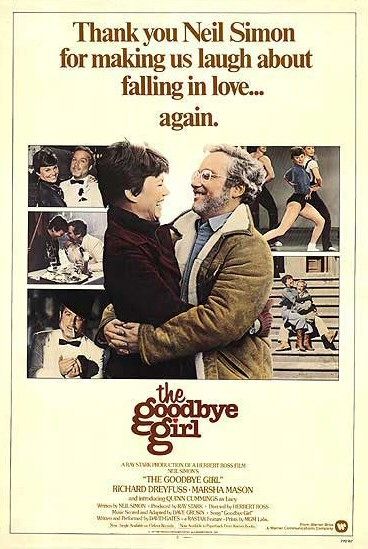
Lisa Watches An Oscar Nominee: The Goodbye Girl (dir by Herbert Ross)


Goodbye_Girl_movie_poster

After I watched San Francisco, I decided to watch yet another film that I had DVRed during TCM’s 31 Days of Oscar.  I had several films to choose from and I ultimately decided to watch the 1977 best picture nominee The Goodbye Girl because, in general, I like movies from the 70s.  Add to that, the film was described as being a comedy and who am I to turn down the chance to laugh?

The Goodbye Girl asks the question, “What would happen if two of the most annoying people on Earth were forced to live together and then ended up falling in love with each other as a result?”  Paula (Marsha Mason) is recently divorced and is trying to raise her 10 year-old daughter, Lucy (Quinn Cumming), while also trying to relaunch the dance career that she put on hold when she got married.  As played by Marsha Mason, Paula is probably one of the most humorless characters to ever be at the center of a romantic comedy.  It’s not just that Paula is written to be a very angry character.  (For the most part, Paula has every right to be angry).  Instead, it’s that Mason gives such a totally sour performance that you get the feeling that Paula has probably never smiled once over the course of her entire life.  When, later on in the film, she does smile, it feels forced and unnatural.  You worry that her face is going to split in half.

In the course of one very bad week, she is abandoned by her actor boyfriend (he’s going to Italy to shoot a film) and she discovers that, before he left, her ex also sublet their apartment to another actor.  That actor is Elliott Garfield (Richard Dreyfuss), who is hyperactive, immature, self-centered, and very, very talkative.  He does things like play guitar in the nude and meditate in the morning.

Once Elliott shows up and barges his way into the apartment, a familiar pattern is established.  Elliott does something eccentric.  Paula yells at him.  Elliott yells back.  Paula yells in reply.  Elliott yells some more.  Even if you never quite buy the idea that the two of them would ever fall in love, you’re glad when they do because at least it gives them something to do other than yell.

(Of course, The Goodbye Girl was written by Neil Simon, which means that not only are Elliott and Paula yellers but they’re also very quippy yellers.  And while I guess we should be happy that Elliott tells the occasional joke, the constant barrage one liners is ultimately rather alienating.  Every time you think that the film is about to make an interesting point about human relationships, Elliott says something quippy and ruins the mood.)

Which is not to say that The Goodbye Girl is a terrible movie.  The scenes where Elliott rehearses and then appears in a terrible production of Richard III are brilliantly done and wonderfully satirize theatrical pretension.  As well, during its second hour, the film settles down a little bit.  Or, I should say, Richard Dreyfuss settles down and actually starts to give a performance that’s more than just a collection of nervous tics.  It helps that once Elliott and Paula are in love, they don’t yell at each other quite as much.  There’s even a rooftop dinner scene where the two actors finally show a hint of chemistry.

Ultimately, The Goodbye Girl is an uneven film that feels a lot like a sitcom.  It’s one of those films that you watch and, even though it’s not terrible, you still find yourself thinking, “This was nominated for best picture?”