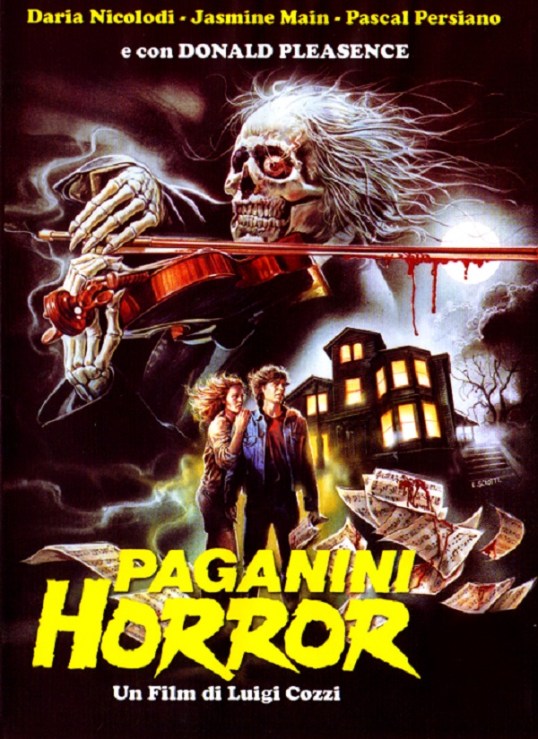
International Horror Film Review: Paganini Horror (dir by Luigi Cozzi)


https://www.youtube.com/watch?v=bv9t2mJRl_g

Yes, this 1989 Italian horror film does deal with the legend that violinist and composer Niccolò Paganini sold his soul the devil in return for his talent.

And yes, it does feature Paganini coming back to life and murdering people.

Listen, there’s a lot of critical things that you can say about this film but you have to love the idea of a slasher film that feature an actual historical figure coming to life and doing the slashing.  I mean, this is no ordinary, masked murderer!  No, this is a murderer whose compositions are still played in concert to this day!

Paganini Horror was written by Daria Nicolodi (who also co-starred) and directed by Luigi Cozzi, two Italian horror figures who — fairly or not — will always be associated with Dario Argento.  Nicolodi co-starred in several of Argento’s films and was his longtime girlfriend.  She’s the mother of Asia Argento.  She also provided Dario Argento with the story that would eventually become Suspiria.  Argento and Nicolodi had a notably bad breakup and, though they continue to occasionally work together, it’s rare that you ever read an interview with Nicolodi where she doesn’t have something negative to say about Argento and his later films.  Luigi Cozzi, meanwhile, is often considered to be a protégé of Argento’s.  Argento produced several of Cozzi’s films and Cozzi has directed multiple documentaries about Argento.  For several years, Cozzi was also the co-owner and manager of Argento’s movie memorabilia store, Profondo Rosso.

Considering Nicolodi and Cozzi’s well-documented relationships with him, it’s interesting that Paganini Horror features a character who appears to be, at the very least, slightly based on Dario Argento.  Mark Singer (Pietro Genuardi) is an arrogant director of bloody horror films who is hired to shoot a music video for a band.  The band, which is in desperate need of a hit, is recording a song that is based on a never before recorded (or heard) composition by Paganini himself.  The band’s drummer, Daniel (Pascal Persiano), purchased the composition from a mysterious man named Mr. Pickett (Donald Pleasence).  We later see Mr. Pickett standing on the roof of a church, grinning maniacally as he throws away Daniel’s money.  Hmmm….I wonder what that’s all about.

Though Pleasence isn’t in much of the film, his performance is definitely one of the highlights of Paganini Horror.  That he’s playing an evil character is obvious from the minute he shows but Pleasence seems to be having so much fun with the role that you can’t help but like him.  There’s something especially charming about the way he smiles while throwing away that money.

The other highpoint of the movie is Paganini himself.  As played by Roberto Giannini, Paganani wanders about wearing a mask and a black coat.  He carries a violin that has a very sharp blade sticking out of the bottom of it.  Yes, it’s totally ludicrous but that’s kind of the point of it.  Paganini was known for two things: 1) being a great musician and 2) the rumors that he sold his soul to the devil.  Paganini Horror may emphasize the rumors about the devil but it doesn’t let us forget that Paganini was a damn good violinist….

Anyway, Paganini Horror is a frequently incoherent film, where characters don’t act logically and the rules of Paganini’s curse seems to change from scene to scene.  Once you get passed the novelty of Paganini being the murderer, this really is a standard slasher film, albeit one that’s a bit more graphic than its American and British counterparts.  That said, I don’t think that it’s quite the disaster that Luigi Cozzi has described it as being.  (Cozzi has consistently cited it as one of his least favorite of the films that he’s directed.)  Donald Pleasence appears to have had a blast playing his role and there are a few memorable shots of Venice.  (Of course, it’s pretty much impossible to find an unmemorable shot of Venice.)  The scenes of the band pretending to perform are also enjoyably silly.  Paganini Horror may not be great but it’s certainly not boring.  If you appreciate Italian horror, you get it.

I watched Paganini Horror on Tubi.  It was an enjoyable 90 minutes.  I have no regrets.
 

The TSL’s Daily Horror Grindhouse: The Sweet House of Horrors (dir by Lucio Fulci)


Mary and Roberto Vivaldi (played by Lubka Lenzi and Pascal Persiano) would appear to have a perfect life, perhaps because they do.  They’re young.  They’re attractive.  They’re in love.  They’re rich.  They have a really nice house and they have two children, a boy and a girl.  What could go wrong, right?

Well, they could come home from a party and discover that their house is being burglarized.  And the burglar could then proceed to graphically and viscously murder them, smashing in Robert’s head and, since this is a Lucio Fulci film, popping out Mary’s eye.  In fact, the opening murder is so graphic and so disturbing that it’s somewhat surprising to learn that this movie was made for television.

Of course, what’s even stranger is that the rest of the film is oddly tame, particularly for a Fulci film.  Perhaps they only had enough money in the budget for one graphic gore scene.

Anyway, the parents are now dead and the children are now orphans.  At the funeral, the children shock everyone by playing and laughing.  However, a few seconds later, they’re standing over the grave and crying.  Some people would call this an inconsistency but I think it’s the most realistic part of the film.  When you lose someone who you love, you do strange things.  There is no one proper way to grieve.  As someone who suffered through his share of personal tragedy, this was something that Fulci probably understood.

The parents may be dead but they’re not gone!  Instead, they’re haunting the house.  The children are overjoyed but their new guardian, Aunt Marcia (Cinzia Monreale, who was Emily in Fulci’s The Beyond) is not.  Marcia freaks out upon realizing that the house is haunted and it certainly doesn’t help that she’s attacked by a gigantic fly in the attic.  Her husband, the incredibly dense Carlo (Jean Christophe Bretigniere), doesn’t think anything strange is happening.  Still, Carlo does agree that it would be a good idea to sell the house and move the children elsewhere.

Nope!  The parents have no intention of letting that happen!  Of course, the dead parents main concern to kill the man who killed them but, once he’s dead (it doesn’t take that long), they’re free to spend their time pushing a real estate agent down a flight of stairs, harassing Marcia and Carlo and eventually causing an exorcist’s hand to melt.

If you’re getting the feeling that both the dead parents and the living children are pretty obnoxious, that’s because they are.  I mean, it’s one thing to not want to be separated.  That’s something we can all relate to.  It’s another thing to melt a man’s hand and then laugh about it.  Add to that, neither Marcia nor Carlo come across as being particularly villainous.  It’s not like they’re planning on murdering the kids for their inheritance or sending them to a Dickensian orphanage or anything like that.  They just want the kids to stop conducting black magic ceremonies and they want to live in a house that isn’t haunted.  No matter how much sympathy you may have for the parents or the kids, it’s hard to deny that Marcia and Carlo aren’t being all that unreasonable.

(It also doesn’t help that the film ends with the suggestion that the dead parents can stay with the kids regardless of whether the house is sold or not.)

And yet, I can’t help but like The Sweet House of Horrors.  Even though it doesn’t make much sense and it’s hampered by a low-budget (just check out the floating flames that represent the dead parents), there’s a sincerity to The Sweet House of Horrors.  The parents really do seem to love their obnoxious children and the film actually does provide some insight regarding the way that children use imagination to deal with grief.  Like many of his later film, The Sweet House of Horrors is hit-and-miss but Lucio Fulci still comes up with a few good visuals, suggesting that his heart may have been in this film in a way that it wasn’t in some of the other films he made during the final years of his storied career.  Just the fact that The Sweet House of Horrors tells such an openly sentimental story makes it unique in Fulci’s filmography.

The Sweet House of Horrors cannot be compared to such Fulci classics as The Beyond, The House By The Cemetery, The Black Cat, or Zombi 2.  But still, it’s an interesting little film and provides a hint that, even during his decline, Fulci still possessed some of the talent that made his earlier films so iconic.

the-sweet-house-of-horror-1989-movie-1

The TSL’s Daily Horror Grindhouse: Demons 2 (dir by Lamberto Bava)


demons-2-2

1985’s Demons was such a success that it only took one year for it to be followed by a sequel.  Like the first film, Demons 2 was directed by Lamberto Bava and produced by Dario Argento.  (Once again, Argento is also credited with co-writing the script.)  Bobby Rhodes appears in both films, though he plays two different characters.  And again, it’s the same basic plot: watching a movie leads to an outbreak of a plague that transforms a group of people into a pack of murderous demons.

And yet, despite all the similarities, Demons 2 is a hundred times better than the first Demons.  And I say that as someone who really likes the first film.  There simply is no comparison between the two.  If Demons was a nonstop thrill ride, Demons 2 is a filmed nightmare.

Demons 2 takes place in a high-rise apartment building.  In the style of any good disaster movie, the first part of the film introduces us to the tenants and gives us just enough information so that we’ll be able to remember who is who.

For instance, in one apartment, we have George (David Knight) and his pregnant wife, Hannah (Nancy Brilli).  In another, we have a woman (Anita Bartolucci) who obsessively dotes on her dog.  Down the hall, ten year-old Ingrid Haller (Asia Argento, making her film debut) watches TV while her parents eat dinner.  In the basement, a gym instructor named Hank (Bobby Rhodes) shouts encouragement at a group of body builders.

And finally, in another apartment, a teenage girl named Sally (Coralina Cataldi Tassoni) sits in her bedroom and cries.  It’s her birthday but her parents are out for the night.  Meanwhile, her friends are gathered in the living room and wondering if Sally is ever going to come out of her room.  Sally is upset because her boyfriend didn’t come to the party.  Poor Sally.

In her sadness, Sally has turned on her TV but she’s barely watching.  And what’s on TV that night?  A horror movie, one that tells the same story as the one we saw in the first Demons and the one that we will eventually see again in Demons 2 (and also in Michele Soavi’s The Church).  A group of teenagers come across a dead demon.  When one of them accidentally gets splashed by the demon’s blood, he is transformed into a demon himself…

(If this sound familiar, that’s perhaps because the same idea was later used in 28 Days Later, a film that owns a not insignificant debt to both of the Demons films and Umberto Lenzi’s Nightmare City.)

Suddenly, the movie demon stops and seems to be staring straight at the unseen camera.  He starts to approach it, until his twisted face fills the entire TV screen…

Suddenly, the demon bursts out of the TV and infects Sally.  Sally finally leaves her bedroom and proceeds to attack everyone at her party, spreading the infection.  Meanwhile, acidic demon bile eats through the floor and drips into the apartments below, infecting everyone that it touches…

demons-2

And I do mean everyone!  If there’s anything that truly separates the Demons films from so many other horror films, it’s that literally anyone can be infected.  It doesn’t matter if you’re likable or if you’re funny or if you’re played by a familiar actor.  If you get infected, you’re going to turn into a demon.  Usually, when you watch a horror film, you can sure that children and pregnant women will automatically be safe.  Demons 2 wastes little time in letting you know that this isn’t the case as far as this film is concerned.

Demons was pretty much distinguished by nonstop action.  In Demons 2, director Lamberto Bava devoted more time to atmosphere and characterization.  As a result, Demons 2 features characters that we actually care about and  some truly haunting images, everything from Sally’s friends moving, in slow motion, down a dark hallway to Asia Argento watching as her parents are literally ripped into pieces in front of her.  If Demons was defined by its relentless heavy metal soundtrack, Demons 2 is defined by the ambient but haunting new wave music that plays through the majority of the film.  Demons was an action-horror film.  Demons 2 is a nightmare from which you cannot awake.

If you have the opportunity, I would say to watch both of the Demons films.  But if you have to choose only one to watch, go with Demons 2.