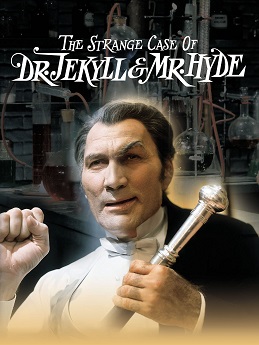
Horror Film Review: The Strange Case of Dr. Jekyll and Mr. Hyde (dir by Charles Jarrott)


First released in 1968, The Strange Case of Dr. Jekyll and Mr. Hyde is a somewhat loose adaptation of the famous novella by Robert Louis Stevenson.

Jack Palance stars as Dr. Henry Jekyll, a mild-mannered and respected doctor who lives in Victorian-era London and who is convinced that there is a good and dark side lurking in every single person.  The dark side is what forces people to break the law and fight with each other.  Jekyll feels that his experiments will allow people to get closer to their dark side and, in doing so, defeat it.  When Dr. Jekyll explains his theories to a medical association, he is violently jeered and booed.  Jekyll returns to his home, enters his laboratory, and takes a drink of the serum that he’s been developing.

The next morning, Dr. Jekyll wakes up with a hangover and no memory of how he spent the previous night.  Trying to retrace his steps, Jekyll finds himself in a dance hall where everyone is talking about a well-dressed but ugly man named Edward Hyde.  Hyde showed up the previous night, spent a lot of money on a woman named Gwyn (Billie Whitelaw), and then got into a fight with two men.  Hyde broke a window to make his escape.  Jekyll, sensing what must have happened, pays for the window on behalf of his “friend,” Edward Hyde.

Jekyll continues to drink the serum and he continues to indulge in all of the forbidden vices as Edward Hyde.  Eventually, we get to see Palance as Hyde.  Unlike a lot of other actors who have played the role, Palance uses a minimum of makeup to suggest his transformation.  Instead, he hunches over, scrunches up his face, and he has a unibrow.  One of the stranger things about this production is that we are continually told that Hyde looks nothing like Jekyll but we know that’s not true.  Instead, Hyde looks exactly like Jekyll making a funny face.

Palance gives one of his more eccentric performances as Jekyll and Hyde.  Somewhat surprisingly, he’s far more convincing as the kindly and troubled Dr. Jekyll than as the villainous Mr. Hyde.  (As Hyde, Palance is often trying to so hard to maintain his facial paralysis that it’s hard to understand exactly what it is that he’s saying.)  With each drink of the serum, Jekyll becomes a bit more confident in himself.  However, he also finds himself losing the ability to control the transformations.  One morning, he wakes up in his bed and is shocked to discover that he is still Hyde.  That same morning, he learns that Hyde is suspected of committing a senseless and brutal murder.  Jekyll has no memory of it but he knows that Hyde is guilty.  And if Hyde is guilty, so is Jekyll.  (Those who make the argument that Dr. Jekyll and Mr. Hyde is ultimately about drug addiction will find plenty to back up that argument in this production,)  Jekyll’s anguish as he realizes what he has become is rather poignant to watch.

Produced by horror impresario Dan Curtis, The Strange Case of Dr. Jekyll and Mr. Hyde can seem a bit creaky today.  It was apparently highly acclaimed when it first aired but, seen today, it can feel rather stagey and talky.  That said, the film has a strong supporting cast, with Denholm Elliott especially giving a good performance as Jekyll’s best friend.  Jack Palance’s performance is so bizarre that it transcends the usual standards used to determine good and bad.    It’s definitely a film worth watching.

Horror Film Review: Mr. Sardonicus (dir by William Castle)


The next time that someone gives me a hard time for not being compassionate enough (and believe it or not, it does occasionally happen now that 90% of twitter has gone down the woke rabbit hole), I’m going to point out that I voted to show mercy to Mr. Sardonicus.

Played in villainous fashion by Guy Rolfe, Mr. Sardonicus was the title character of a 1961 film that was produced and directed by William Castle.  Castle was known for being the king of the gimmick.  His gimmick for Mr. Sardonicus was that, upon entering the theater, members of the audience were given two cards.  One card had a thumbs up.  One card had a thumbs down.  Towards the end of the film, the avuncular Mr. Castle appeared onscreen and announced that it was time for the audience to vote.  Should Mr. Sardonicus be punished for his sins or should he be shown mercy?  Thumbs up for mercy.  Thumbs down for punishment.  After taking the vote, Castle said, “Projectionist, play the reel.”

Now, of course, Castle only shot one ending and that was the ending where Mr. Sardonicus was punished.  To make sure the audience would vote the right way, Castle made Sardonicus into one of the most loathsome villains around.  Mr. Sardonicus — or Baron Sardonicus, as he preferred to be called — lived in a castle in the 1880s.  Not only did he torture his servants with leeches but he was also responsible for death of several dogs, all of which were killed as a part of his dastardly experiments.  To make it even worse, he wasn’t even a member of the nobility!  He stole his title!  It turned out that Mr. Sardonicus has once been a simple farmer who allowed his greed to get the better of him.  When his father was buried with a lottery ticket, Mr. Sardonicus dug up the old man to retrieve the ticket.  The shock of seeing his father’s skull caused Mr. Sardonicus’s face to freeze into a twisted grimace.  When the film begins, Mr. Sardonicus wears a mask and desperately wants to be cured of his affliction.

To try to convince Sir Robert Cargrave (Ronald Lewis) to cure his condition, Mr. Sardonicus is holding the woman that Sir Robert loves, Maude (Audrey Dalton), prisoner in a loveless marriage.  With the help of his evil servant, Krull (Oskar Homolka), Mr. Sardonicus torments the villagers and anyone else unlucky enough to come near the castle.

And yet, when I watched this movie last night with the Late Night Movie Gang, I voted to show compassion to Mr. Sardonicus because I’m a firm believer both in criminal justice reform and that almost anyone can be rehabilitated.  Perhaps Mr. Sardonicus just needed someone to say that they believed he could be a better man.  I was willing to do that.  However, the rest of the Late Night Movie Gang voted to punish him.  I think it was the dead dogs that sealed the deal.  So, sorry, Mr. Sardonicus.  I tried.

Even before William Castle tells everyone to vote, Mr. Sardonicus is enjoyably over-the-top and silly horror film.  It plays out like an extended episode of Twilight Zone, with every action that Mr. Sardonicus takes bringing him closer to karma’s judgment.  Guy Rolfe is properly evil and arrogant Sardonicus and Oskar Homolka gets many of the best lines as the servant who may not be as loyal as he seems.

Mr. Sardonicus is currently on YouTube.  Watch and vote for yourself!