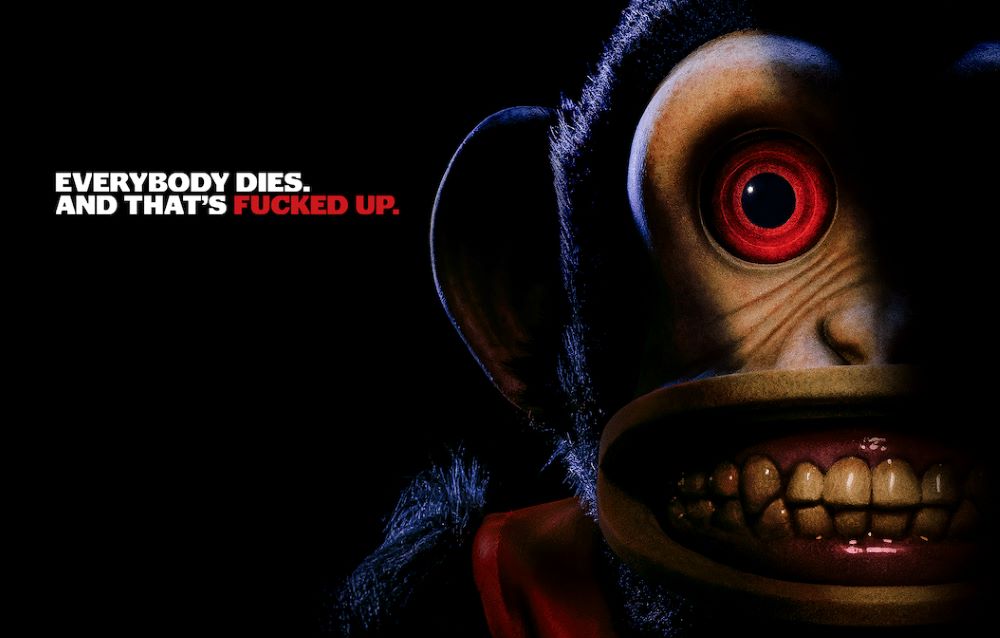
Yes, dying is quite fucked up and Osgood Perkins follow-up to his 2024 horror cult-hit Longlegs points and shows this to the audience in spades (and buckets of blood).
The Monkey, based on the Stephen King short story of the same name, tells the story of a drum-playing toy monkey which happens to cause the the deaths of random individuals when it stops playing the drums. Right from the start we see that The Monkey veers away from Perkins usual moody and atmospheric horror language and goes for the absurdist take on the genre.
Anyone who has seen the supernatural horror series Final Destination will recognize the Rube Goldberg-esque ways each kills in that series has become its signature will appreciate how truly absurd some of the kills in The Monkey turns out. To say more would be too much of a spoiler and should be experience by anyone willing to watch this film.
Osgood Perkins still brings to the table his own brand of horror comedy by exploring the ideas and themes of death’s inevitability and randomness, but also childhood trauma and how it impacts the lives of those children even to their adulthood. Where some films would be more subtle in exploring these themes, Perkins decides on drumming it on thickly which, at time, does come off as cringe.
Yet, despite the heavy-handedness of Perkins’ screenplay (he also wrote the screenplay adaptation of King’s tale), The Monkey still succeeds in delivering an early horror hit for 2025 that should be seen with a crowd. this is a film that is actually better when seen as part of a collective experience rather than with a small group.
Before there was Tony Montana …. there was Tony Camonte!
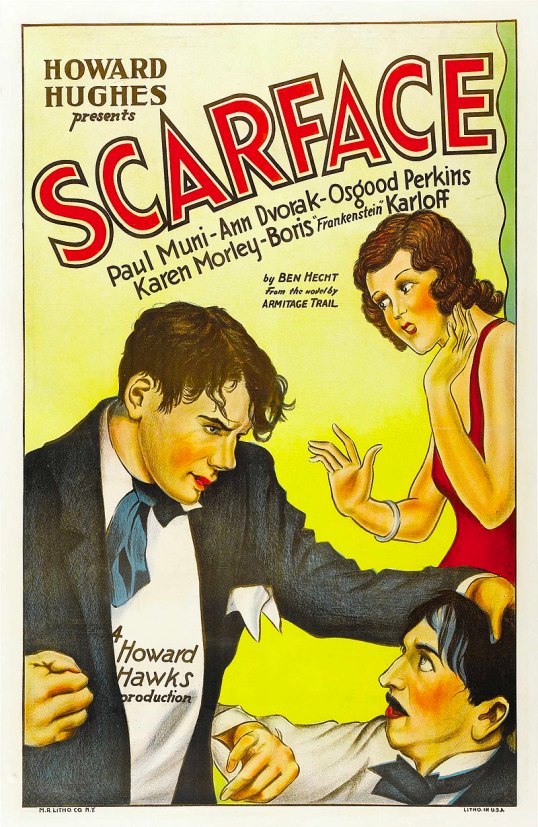
And, of course, before there was Tony Camonte, there was Al Capone. The 1932 film Scarface was one of the many gangster movies to be based on the life of Al Capone. Capone and Tony Camonte even share the same nickname, though — unlike Camonte — Capone hated being called Scarface. On the other hand, as played by the charismatic and cocky Paul Muni, Tony Camonte wears his scar like a badge of honor. He says that he got his scar serving in the war. His best friend, Guino (George Raft, a real-life gangster associate who became a star as a result of his performance in this film), says that the scar is the result of a bar fight.
In many ways, that scar tells you almost everything you need to know about Tony Camonte. If you can look away from the scar, he’s a handsome and charismatic figure. But when you see the scar, you’re reminded that his life is about violence. Everything that Tony has is due to his violent nature and it’s somewhat inevitable that his end will also be due to that violence, not to mention his obsession with his sister, Cesca (Ann Dvorak). It’s not just Tony’s face that’s scarred. It’s his soul as well.
The film follows Tony, from his early days of working as a gunman for Johnny Lovo (Osgood Perkins) to his eventual usurpation of Lovo’s place as the king of the underworld. Tony not only takes over Lovo’s rackets but he also goes after Lovo’s girlfriend, the glamorous Poppy (Karen Morley). The well-bred Poppy may be dismissive of Tony’s ambitions but, as Tony shows her, he lives in the glow of a neon sign that announces, “The World Is Yours.” That’s something that Tony truly believes and, for a while, the world is his. He’s done with a gun what other do with lawyer and a clever accountant. He’s achieved the American dream and he has the money and the beautiful lover to prove it. Only for a while, though. You reap what you sow.
The film recreates many scenes from Al Capone’s life. One of Tony’s rivals is gunned down in a flower shop, much as happened to Dean O’Bannion when he challenged Capone’s power. At another point, two of Tony’s men dress up like policemen and gun down rival gangsters, just as happened during the St. Valentine’s Day Massacre. The script was written by Ben Hecht, a Chicago native who had actually met Capone. When Capone heard that Hecht was writing a film called Scarface, he sent two men to find out what the film was about. Hecht assured them that the film was not about Capone but was instead a parody of the gangster genre. Hecht was left alone but the fact that Capone was worried about his public image is quite a contrast to more recent stories about made men studying The Godfather, Goodfellas, and The Sopranos for tips on how to go about their business. Of course, the film was made before Capone’s anticlimatic downfall so it’s not a combination of tax evasion and syphilis that ends Tony Camonte’s reign of terror. Camonte goes out in a much more dramatically satisfying manner.
It’s a violent film. It was a violent film for 1932 and, in some scenes, it’s a violent film for even today. I’ve read that director Howard Hawks used live ammunition in the scenes that featured guns being fired. In many of the scenes in which someone is portrayed as running for their lives, the actors in question were literally running and ducking for their lives. Luckily, the cast survived making the film, though it’s been said that one crew member lost an eye. Paul Muni went on to have a very distinguished film career, one that inspired future acting greats like John Garfield, Montgomery Clift, and Marlon Brando. Despite his star-making turn as Muni’s best friend, George Raft’s career was not quite as distinguished, as he ended up turning down a chance to star in Casablanca. Osgood Perkins’s son, Tony, would become a horror icon when he played Norman Bates. And Boris Karloff went from portraying a bowling gangster in this film to playing the Monster in Frankenstein.
And, of course, the legacy of Scarface lives on, thanks to the 1983 remake starring Al Pacino. There’s a third remake on the way, reportedly from Luca Guadagnino, who I guess decided that since he got away with tarnishing the legacy of Suspiria, he might as well go after another classic cult film. Both versions of Scarface are rightly known as being classics of the gangster genre. The 1983 version is great but so is the original.
 Through the Shattered Lens