6 Times The Academy Got It Right: The 1960s


The 1960s were a time of turmoil for both America and the Academy.  The decade started with optimism and it ended with chaos.  In order to keep up with the films coming in from Europe, Hollywood finally abandoned the Production Code but Hollywood also tried to keep alive the old fashioned spectacle that proved profitable in the 40s and the 50s.  The Academy often found itself torn between honoring the new wave of filmmakers and acknowledging some of the most overdone productions to ever come out of the major studios.

It was a crazy decade and it’s one that continues to fascinate cultural historians.  Here are 6 things that Hollywood got right in the 60s.

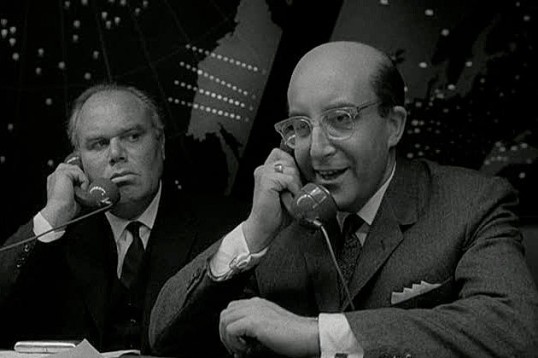
  1. Dr. Strangelove: Or How I Learned To Stop Worrying And Love The Bomb is nominated for Best Picture

In the 40s and the 50s, it would have been unthinkable to nominate a film like Dr. Strangelove.  And, even in 1964, it was a controversial nomination.  That said, Dr. Strangelove had held up in a way that many other films released that year have not.  It’s the dark satire by which all other dark satires are judged.  That it lost to My Fair Lady is a disappointing fact but that it was nominated at all is a bit of a miracle.

2. Mike Nichols wins Best Director for 1967’s The Graduate

It’s kind of amazing to think that The Graduate competed for Best Picture with Dr. Doolittle.  Of course, they both lost to the well-intentioned In The Heat of the Night.  Still, Mike Nichols changed the face of American cinema with his direction of The Graduate.  The Academy made the right decision when they honored him.

3. Julie Christie wins Best Actress for 1965’s Darling

For many, the 1960s were defined by the British invasion and that was true when it came to the movies as well.  Julie Christie was the forefront of that invasion and she certainly deserved her Oscar for her amazing lead performance in Darling.  In Darling, Christie was everything that was chic about Britain during the first half of the 60s.  Reportedly, Christie was also considered for a role in Thunderball, which was itself a part of the British invasion.  When she either turned down or was turned down for the latest Bond film (the specifics depend on who you ask), she did Darling and won her Oscar.

4. Michael Caine Is Nominated For Best Actor For 1966’s Alfie

While Julie Christie represented everything chic about the UK, Caine represented the working class.  He became a star with Alfie and he also earned the first of his many Oscar nominations for his performance in that film.  His nominated heralded the arrival of a new type of star.
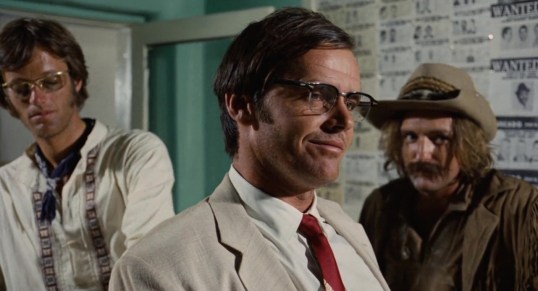
5. Jack Nicholson Is Nominated For Best Supporting Actor in 1969’s Easy Rider

After spending a decade toiling in Hollywood and getting nowhere, Nicholson was on the verge of retiring from acting when agreed, at the last minute, to replace Rip Torn in Easy Rider.  Nicholson not only became a star but he also received his first Oscar nomination.  Much as with Caine, Nicholson’s nomination heralded the arrival of a new cinematic age.

6. Midnight Cowboy Wins Best Picture Of 1969

You can debate whether or not Midnight Cowboy was truly the best film of the year but, by honoring it, the Academy finally choose a side in the culture war that it had spent a decade trying to avoid.

Up Next: The 70s!

Midnight Cowboy (1969; D; John Schlesinger)
6 Times The Academy Got It Right: 1950s


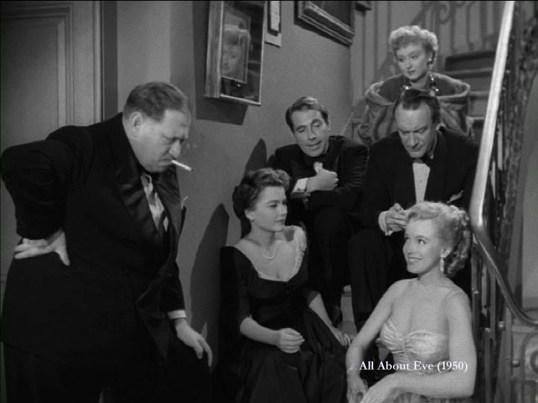
My favorite scene from All About Eve

The 1950s don’t get much respect from film historians.  The decade is often written off as being an age of conformity, when Hollywood reacted to the treat of television by producing empty spectacle.  In some instance, that may have been the case but I think it can also be argued that the 50s saw its share of good films and good performances and some of them were even honored by the Academy.

Here are six times that the Academy got it right in the 50s.

  1. All About Eve and Sunset Boulevard are nominated for Best Picture of 1950

The decade got off to a good start with the Academy two of the best films ever for Best Picture.  Personally, I think All About Eve was the correct winner but I don’t think anyone, even all these years later, would have complained if the Oscar had gone to Sunset Boulevard instead.  Somehow, neither Bette Davis nor Gloria Swanson won Best Actress that year.

2. Gloria Grahame wins Best Supporting Actress For The Bad and the Beautiful

Grahame’s role was a small one and she didn’t even appear in the film until it was close to over but she more than deserved to win her Oscar for 1952’s The Bad and The Beautiful.  The often-underrated Grahame gave a wonderful performance as the writer’s wife, who is tragically seduced by Hollywood.  Along with her nominated performance in Crossfire and her unnominated work in It’s A Wonderful Life, The Bad and the Beautiful features the underrated Grahame at her best.

Oscar, in happier times

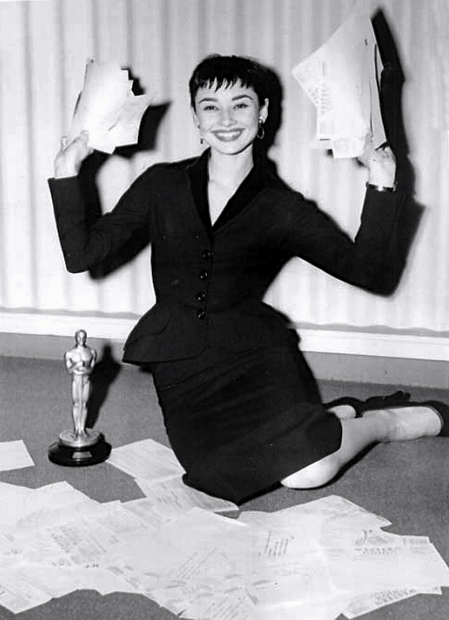
3. Audrey Hepburn wins Best Actress for Roman Holiday

The great Audrey Hepburn’s performance in 1953’s Roman Holiday is one of my favorite Oscar-winning performances of all time.

4. James Dean Is Nominated For East of Eden and Giant

It’s tempting to speculate about what type of career James Dean would have had if not for his tragic and early death.  Would he have gone on to become a Brando-style eccentric or would he have become a more conventional leading man?  Would he still be as powerful an actor once he was no longer a young rebel but instead a middle-aged suburbanite?  One likes to think that Dean would have continued to be an icon but it’s easy to imagine him getting lost in the Hollywood counter culture like Dennis Hopper did for most of the 60s.

All that’s just speculation though.  What we do know is that James Dean received two posthumous Oscar nominations after his death, one for 1955’s East of Eden and one for 1956’s Giant.  The Academy, long-derided as being out of touch, obviously understood that Dean was a phenomena.

5. Peyton Place Is Nominated For Best Picture of 1957

Yes, it’s incredibly trashy and a little dumb but I don’t care.  I love it.  It’s exactly the type of overproduced, overheated, but fun film that deserves to be nominated but which doesn’t necessarily deserve to win.

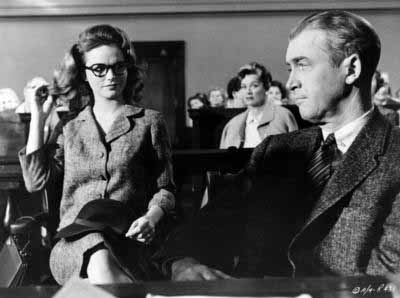
6. The Academy Nominates 1959’s Anatomy of a Murder

Personally, I wish it had won but you know what?  I’ll be happy with the nomination.  Jimmy Stewart received his final Oscar nomination for his role in Anatomy of a Murder.  Again, I wish he had won but, at the same time, I’m also happy that it at least got a nomination.

Up next: The 60s!

6 Times The Academy Got In Right: 1940s Edition


The 1940s began with America going to war and it ended with the world entering the Atomic age.  It was an interesting decade for the movies, as visions of optimistic patriotism and downbeat noir often went head to head at the box office and at the Oscars.

Here are 6 times that the Academy got it right in the 1940s!

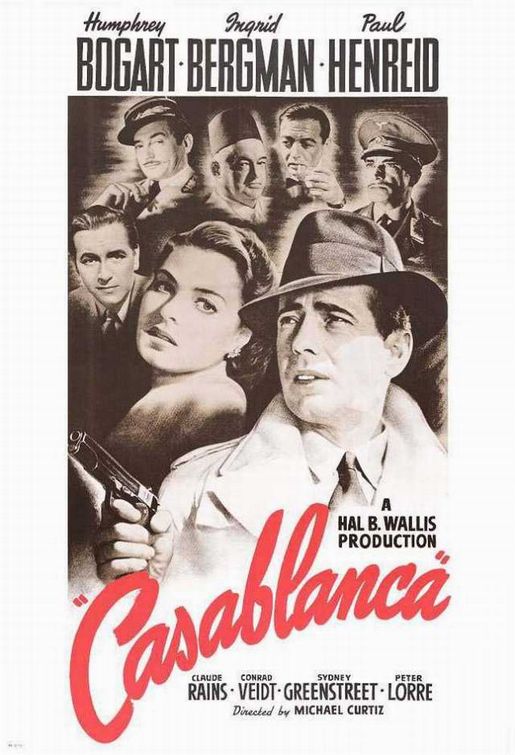
  1. Casablanca Wins Best Picture

You knew that this was going to be the first thing that I was going to list.  In 1943, Casablanca won the Academy Award for Best Picture.  Though the film’s victory obviously had a lot to do with its anti-Nazi theme, it’s also one of the best acted and most quotable films ever made.  Humphrey Bogart and Ingrid Bergman were never better.  Claude Rains was never more charming.  And Conrad Veidt perfectly embodied everything that the Allies were fighting against in Europe.  This one of the rare Oscar victories that no one can complain about.

2. James Stewart wins Best Actor For The Philadelphia Story

He deserved it for the scene where he sings Somewhere Over The Rainbow.  This is award is usually cited as the first instance of the Academy giving someone an award to make up for an earlier snub, in this case Stewart not winning for Mr. Smith Goes To Washington.  That’s probably true but still, it’s a charming performance and how can you not be happy about Jimmy Stewart receiving an Oscar?

3. Edmund Gwenn wins Best Supporting Actor For 1947’s Miracle on 34th Street

He is Santa Claus!

4. Orson Welles Wins Best Original Screenplay for Citizen Kane

Yes, I realize he had to share it with Herman Mankiewicz and I realize that there’s a lot of people who think that they’re an expert on what happened because they sat through Mank.  The fact of the matter is that Citizen Kane is an Orson Welles film.  To give all of the credit to Mankiewicz is to ignore all of the talent and vision that Welles brought to shaping the film.  Even if we accept Mank‘s dubious claim that the majority of the script was Mankiewicz’s, Welles was the one who made the film into a portrait of America at its best and worst as opposed to just the bitter ramblings of an old alcoholic.  Citizen Kane and Welles deserved more than one Oscar but considering just how many powerful people in Hollywood tried to stop Citizen Kane, I’m a little amazed that the Academy even gave Welles one Oscar.

5. Crossfire Is Nominated For Best Picture

Even though 1947’s Crossfire lost the award to Gentleman’s Agreement, it still made history as the first “B” movie to receive a nomination for Best Picture.  Crossfire holds up quite well today as a portrait of the evil that comes with prejudice.

6. The Best Years of Our Lives and It’s A Wonderful Life Are Nominated For Best Picture

In 1946, two of the best films made about postwar America were nominated for Best Picture.  The Best Years Of Our Lives won, while It’s A Wonderful Life went on to become a holiday perennial and a cultural touchdown.  Both of them are powerful portraits of Americans trying to find themselves in the years directly after the end of World War II.  Both deserved their nominations.  It’s a shame that both couldn’t win.

Up next: The 1950s!

6 Times The Academy Got It Right: 1930s Edition


During the 1930s, American suffered through the Great Depression and the rest of the world first tried to prevent and then fearfully prepared for another world war.  It was a dark time and it’s not surprising that movies became an escape for many.  With so many people going the movies, it’s also not a surprise that the Oscars themselves became a far bigger deal than anyone had initially expected.  Today, it can be easy to forget that the awards were almost an afterthought, something that was added to the Academy’s original charter at the last minute.  In the 1930s, they went from being a quiet industry dinner to being a major cultural event.

Here are 6 times the Academy got it right in the 1930s.

  1. 1939

1939 was one of the first truly great years in American cinema and, for once, the Academy honored that greatness.  The slate of nominated films, which included everything from Gone With The Wind to Mr. Smith Goes to Washington to The Wizard of Oz to Stagecoach, and performances was the best that Academy had presented so far.  All of the nominees were impressive and deserved to be there.  One can perhaps disagree with some of the eventual winners but 1939 was one of the few years when no one can disagree with who and what the Academy chose to nominate.

2. It Happened One Night Win Best Picture

In 1934, the Academy honored It Happened One Night with the award for Best Picture.  Not only was it entirely deserved but it was also the first comedy to win the big prize.

3. The Thin Man Is Nominated For Best Picture

The same year that It’s Happened One Night won Best Picture, The Thin Man was nominated.  1934 was a great year for comedy.

4. Grand Illusion is Nominated For Best Picture

Jean Renior’s anti-war classic was nominated for Best Picture in 1937.  Not only was the nomination deserved but it also became the first film in a language other than English to receive a best picture nomination.

5. Fredric March Wins Best Actor for Dr. Jekyll and Mr. Hyde

At the 5th Academy Awards ceremony, March became the first actor to win an Oscar for a horror role and Dr. Jekyll and Mr. Hyde became the first horror film to win anything.  Of course, Wallace Beery also won Best Actor for The Champ.  This was one of the few years in which there was a tie.

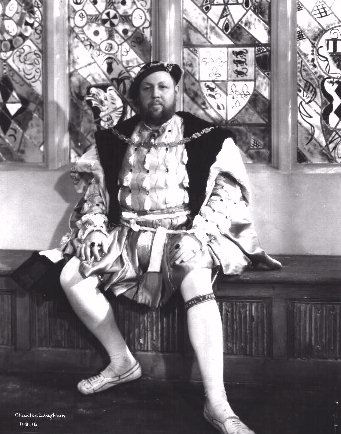
6. Charles Laughton Wins Best Actor For The Private Life of Henry VIII

At the 6th Academy Awards ceremony, Laughton won an award for his lusty performance as Henry VIII.  While one could argue that Paul Muni technically gave a better performance in I Am A Fugitive From A Chain Gang, no one can deny that Laughton’s lusty and comedic performance set the template by which all future Henry VIII’s would be judged.  Add to that, Laughton became the first of many actors to win for their performance in a British-made film.

Up next: the 1940s!

4 Times The Academy Got It Right: 1920s


In previous years, I’ve used Oscar Sunday as a chance to write about what the Academy has gotten wrong over the years, the snubbed classics and the unworthy winners.  This year, though, I want to do something a little different.

I want to take a look at the time that the Academy made the right decision, either by picking the best film for Best Picture or even just by giving a nomination to someone who actually deserved it.  Consider this to be my attempt to add some positivity to what has otherwise been a pretty negative awards season!  We all love to criticize the Academy and goodness knows that much of that criticism has been deserved over the years but occasionally, they do get it right!

Here are 4 times the Academy got it right during the 1920s!

(Before anyone thinks that I’m condemning the Academy with faint praise, the first Oscars were handed out in 1928 so, for this decades, there are really only a handful of winners and nominees to choose from.)

  1. All Quiet On The Western Front Wins Best Picture

All Quiet On The Western Front was the third film to win the Oscar for Best Picture and it was the first truly great film to win the award.  If Wings and Broadway Melody were rewarded largely because of internal politics, All Quiet On The Western Front won because it truly deserved it.

2. Sunrise Wins The Academy Award For Unique And Artistic Picture

At the first Oscar ceremony, two awards for Best Picture were given out.  Best Picture went to Wings, which is good but not great.  The award for Unique and Artistic Picture, however, went to F.W. Munrau’s sublime Sunrise.

3. The Racket Is Nominated For Best Picture

The Racket was one of the three films to be nominated for the very first Best Picture Oscar in 1928.  It’s nearly forgotten today but it still remains significant because it was the first gangster film to be nominated for Best Picture and it was also the first genre film.  The Racket started a long tradition of American movies about organized crime, one that includes The Godfather, Goodfellas, The Irishman, and so many other films.  As well, The Racket was long considered to be a lost film until someone stumbled across the last remaining copy in the 70s.  Never stop searching for those lost films!

4. Warner Baxter Win Best Actor For In Old Arizona

The 2nd Academy Awards ceremony was a strange one, largely because only the winners were announced and no one is quite sure how the Academy settled on those winners.  That said, Warner Baxter’s award for starring in In Old Arizona does feel historically significant.  He was the first actor to win for appearing in a western and he won for playing not a lawman but an outlaw.  In fact, his amoral character served as a template for many of the characters who would populate the Spaghetti westerns of the 60s and the 70s.

Up next: the 1930s!

The Shattered Lens Live Tweets Oscar Sunday


Welcome to Oscar Sunday!

Music Video of the Day: Shallow, performed by Lady Gaga and Bradley Cooper (2019, dir by whoever directed the Oscars that year)


Who knows what tonight’s Oscar telecast will be like but I’m pretty sure it won’t come anywhere close to providing a moment as powerful as this.

Enjoy!

It Is Oscar Sunday


It’s Oscar Sunday. Again.

Can you tell how excited I am?

Yes, cats don’t really care about the Oscars or the movies. But some humans do! Actually, according to the flame-haired once, less humans care about the Oscars this year than ever before. It sounds like the Oscar humans really messed things up and now everyone is mad at them. As long as I get fed, I don’t get mad at anyone. Humans should be more like me. If you’re one of the few remaining humans who cares about the Oscars, the Shattered Lens has you covered today!

Happy Oscar Sunday to those who observe. If you watch the ceremony, don’t forget that the cat needs some attention too!

As for who I think is going to win this year …. meh. I haven’t seen any of the nominees but I’m sure they needed more scenes featuring hunting, stalking, and napping. Lots and lots of napping.

My Oscar Predictions


Well, since the big show is tomorrow, I guess it’s time for me to try to predict what I think will win. Up until four weeks ago, I would thought Power of the Dog would be the obvious front runner but CODA seems to be the film that people are responding too. The same is true of Penelope Cruz, who went from being an also-ran to the new front runner in just a matter of days.

In short, this Oscar race is up in the air. Almost anything could happen. It should be exciting, though I think most people will be tuning in not to see who wins but to see how bad the show is.

Anyway, here are my predictions! We’ll see how right I am (or how wrong I am) tomorrow night!

Best Picture — CODA

Best Director — Jane Campion, The Power of the Dog

Best Actor — Will Smith, King Richard

Best Actress — Penelope Cruz, Parallel Mothers

Best Supporting Actor — Troy Kostur, CODA

Best Supporting Actress — Ariana DeBose, West Side Story

Best Original Screenplay — The Worst Person In The World

Best Adapted Screenplay — CODA

Best Animated Feature Film — Encanto

Best International Film — Drive My Car

Best Documentary Feature — Attica

Best Documentary Short Subject — Audible

Best Live Action Short Film — The Long Goodbye

Best Animated Short Film — Affairs of the Art

Best Original Score — Dune

Best Original Song — Dos Origuitas from Encanto

Best Sound — West Side Story

Best Production Design — Dune

Best Cinematography — The Power of the Dog

Best Costume Design — Nightmare Alley

Best Makeup and Hairstyling — The Eyes of Tammy Faye

Best Film Editing — Don’t Look Up

Best Visual Effects — Spider-Man: No Way Home


The PGA Names CODA The Best of 2021


I’m a little late in reporting this but last night, the Producers Guild of America announced their picks for the best of 2021 and they promptly threw the Oscar race into chaos by selecting CODA, instead of the Power of the Dog.  Today, there’s a lot of people talking about the possibility of DGA winner Jane Campion taking Best Director while CODA, which also won the SAG Ensemble Award, takes Best Picture.

It could happen.  We’ll find out for sure next Sunday!

The Award for Outstanding Producer of a Feature Theatrical Motion Picture
Being The Ricardos
Belfast
CODA
Don’t Look Up
Dune
King Richard
Licorice Pizza
The Power Of The Dog
Tick, Tick…Boom!
West Side Story

The Award for Outstanding Producer of Animated Theatrical Motion Pictures
Encanto
Luca
The Mitchells vs. The Machines
Raya And The Last Dragon
Sing 2
 
The Award for Outstanding Producer of Documentary Motion Pictures 
Ascension
The First Wave
Flee
In The Same Breath
The Rescue
Simple As Water
Summer Of Soul (…Or, When The Revolution Could Not Be Televised)
Writing With Fire