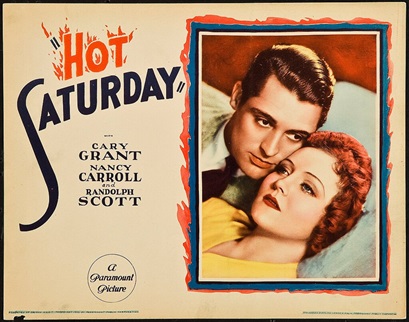
Love On The Shattered Lens: Hot Saturday (dir by William A. Seiter)


First released in 1932 and featuring Cary Grant in his first leading role, Hot Saturday is a film about gossip and love.

Ruth Brock (Nancy Carroll) is a young bank teller living in a small town.  It’s the type of town where everyone knows everyone else.  For instance, everyone knows that every man in town wants to date Ruth but that Ruth, for her part, is not in any hurry to settle down and get married.  She’s having too much fun going to dances, drinking with her friends, and enjoying life.  Everyone knows that playboy Romer Sheffield (Cary Grant) is interested in Ruth but then again, Romer appears to be interested in everyone.  Romer has scandalized the town by allowing a woman named Camille (Rita LaRoy) to live at his mansion.

Ruth has a date with one of her coworkers, Conny Billop (Edward Woods), but, when Conny refuses to take no for an answer, she gets away from him and ends up at Romer’s estate.  Ruth and Romer spend the night together, just talking.  Still, thanks to Conny and Eva (Lillian Bond), the daughter of Ruth’s boss, the whole town is soon convinced that Ruth is Romer’s lover.  The town is so scandalized that Ruth even loses her job.

Fortunately, Bill Fadden (Randolph Scott) has returned to town.  Bill is a geologist.  He grew up in town, with Ruth.  He’s spent the last seven years on a surveying expedition but now he’s back and he wants to marry Ruth.  How lucky is Ruth?  She not only has two good men in love with her but one of them looks like Cary Grant and the other one looks like Randolph Scott!  However, when Bill hears the rumors, will he continue to love her or will he be yet another person who gives in to the curse of small town gossip?

Hot Saturday is a film that truly took me by surprise.  It’s a pre-code film and it’s one that has all of the usual tropes that one usually associates with the pre-code era.  Everyone’s obsessed with sex.  There’s a lot of kissing.  There’s a lot of drinking.  There’s an emphasis on legs and lingerie.  There’s even a scene where Ruth gets into a wrestling match with her younger sister when she discovers that her sister has taken her new panties.  I’m one of four sisters so I could certainly relate but it’s still not the sort of thing that one necessarily expects to find in a film from the 1930s.  But that’s one reason why I love the Pre-Code era.  Allowed to police itself, pre-code Hollywood made films that were more realistic and open about their subject matter than the films made under the production code but which also still had their own unique innocence to them.  Hot Saturday has an ending that would have never been allowed during the Code era, one that is, dare I say it, rather empowering.

But, beyond all that, Hot Saturday is an intelligently written film that strikes a good balance between drama and character-driven comedy.  Nancy Carroll is beautiful and likable in the lead role.  Cary Grant and Randolph Scott are both as handsome and charming as can be.  Hot Saturday is both a look at the reality and dangers of small town gossip and a touching love story.  I enjoyed it.

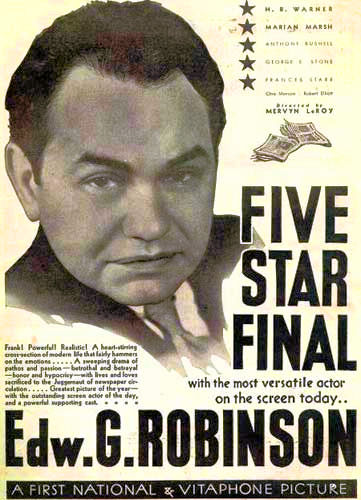
Lisa Reviews An Oscar Nominee: Five Star Final (dir by Mervyn LeRoy)


Five_Star_Final_1931_poster

In 1911, a pregnant secretary named Nancy Voorhees (Frances Starr) shot and killed her boss and lover.  It was quite a scandal at the time but, twenty years later, it has largely been forgotten.  Nancy has married a successful businessman named Michael Townsend (H.B. Warner) and is a respected member of society.  Her daughter, Jenny (Marian Marsh), has no idea about Nancy’s past and believes Michael to be her father.  Jenny is now engaged to marry the handsome and rich Phillip Weeks (Anthony Bushnell).

Everything seems to be perfect but you know what they say about perfection.

Bernard Hincliffe (Oscar Apfel) is the publisher of a struggling tabloid newspaper.  He is frustrated by city editor Joseph Randall (Edward G. Robinson) and Randall’s refusal to do whatever it takes to boost circulation.  “Why, he won’t even print pictures of women in their underwear!” one of Hincliffe’s assistants exclaims.  Finally, Hincliffe orders Randall to publish a series of articles that will take a retrospective look at both the scandal and what has happened to those involved in the years since.  At first, the cynical Randall refuses but eventually, he gives in.

He assigns two reporters to crack the story.  One of them, Kitty Carmody (Ona Munson) is first introduced showing off her legs and bragging about how there’s no way that she won’t be hired to work at the newspaper.  (By the way, if anyone ever remakes Five Star Final and needs someone to play Kitty, I am ready and available.)  The other is the incredibly creepy T. Vernon Isopod (Boris Karloff).  Isopod was a divinity student until he was arrested on a “morals charge.”  Now, he pretends to be a minister as a way to fool people into revealing their deepest secrets to him.  Kitty and Isopod dig into the life of Nancy and Michael.  The stories appear on the front page.  Suicide and melodrama follow and Randall is forced to finally take a stand.

Released in 1931, Five Star Final was nominated for best picture but lost to Grand Hotel.  Seen today, Five Star Final is undeniably stagey (it was based on a play) but it’s still a compulsively watchable melodrama, featuring good performances and a lot of memorably snappy 30s dialogue. Five Star Final is one of several films about journalism to have been nominated for best picture.  Most of these films — like All The Presidents Men, The Front Page, and this year’s front-runner, Spotlight — have featured journalists as heroic seekers of the truth.  Five Star Final, on the other hand, plays more like a pre-Code version of Network set at a newspaper.  It’s a deeply angry film and, when Randall finally tells off Hincliffe, it feels like the 30s equivalent of Peter Finch shouting that he’s mad as hell and not going to take it anymore.

Finally, the best part of the film, for me, was Boris Karloff as the sleazy Isopod.  Karloff made Five Star Final right before he played the creature in Frankenstein and it’s interesting to see him play a totally different type of monster here.  If I had to choose which character is scarier, I’m going with T. Vernon Isopod.

http://www.youtube.com/watch?v=a0qL1fs1c6k

The First Annual Academy Awards: 1914


Hi there! The blogger known as Jedadiah Leland and I have launched a TSL side project. We are taking Oscar history, re-imagining it, and turning it into something much better, one year at a time! I, of course, will be handling the even years while he handles the odd years. (Why? Because Lisa doesn’t do odd numbers, that’s why!) Here’s our report on the First Annual Academy Awards, honoring the best of 1914.

(You read that right…)

Lisa Marie Bowman's avatarThrough the Shattered Lens Presents The Oscars

Mack Sennett, the 1st President of the Academy Of Motion Picture Arts and Sciences Mack Sennett, the 1st President of the Academy Of Motion Picture Arts and Sciences

Ironically, considering its current prominence in American culture, the origins of the Academy of Motion Picture Arts and Sciences are shrouded in mystery.

Reportedly, in February of 1914, a meeting was held in New York City that led to the founding of the Academy.  While all exact records appear to be lost, it is generally agreed that the meeting was attended by Mack Sennett,Thomas H. Ince, William Randolph Hearst, Charles O. Baumann, John R. Freuler, Samuel S. Hutchinson, Jesse Lasky, William Fox, Adolph Zukor,D.W. Griffith, Cecil B. DeMille, William Kennedy Dickson, Mary Pickford,J. Stuart Blackton, Albert E. Smith, Carl Laemmle, and L. Frank Baum.  By the end of the meeting, not only had the Academy of Motion Picture Arts and Sciences…

View original post 584 more words

Shattered Politics #1: Abraham Lincoln (dir by D.W. Griffith)


Unlike just about everyone else that I know, I am about as apolitical as you can get.

Oh, don’t get me wrong.  I always vote.  I believe in …. stuff.  Occasionally, I get angry about the state of the world. Why I’ll have you know that when I first registered to vote, I was really, really excited and I even sat down and researched every single person who was running for President.  (And, of course, I decided I would support John Edwards because he had good hair.  But then I changed my mind and ended up voting for Charles Jay, the candidate of the Personal Choice Party.)  But, for whatever reason, current events have never become the obsession for me that they are for some people.  You’ll never catch me posting a political meme or sagely agreeing with an activist on Facebook.  It’s just not for me.

(On the plus side, this has allowed me to have friends with many diverse viewpoints and generally lead a happy life.)

At the same time, I’m also fascinated by history and history is often the story of politics and politicians.  As a result, I’m far more interested in past affairs than I am in current affairs.  I can spend hours talking about the election of 1876 but I could hardly care less who is elected in 2016.  I know my political history well enough not to worry about the political present.

Perhaps that explains why, despite my indifference to politics, I tend to enjoy political movies.  And that leads us to my latest review series here at the Shattered Lens.  Over the next two weeks, I will be reviewing, in chronological order, 94 films about politics and politicians.  It’s a little something I call Shattered Politics.

(For some previous examples of what I mean by review series, check out Lisa’s Homestate Reviews, Lisa Goes Back To College, Netflix Noir, 44 Days of Paranoia, Embracing the MelodramaBack To School, and, of course, Lisa’s Marie’s Favorite Grindhouse and Exploitation Film Trailers!)
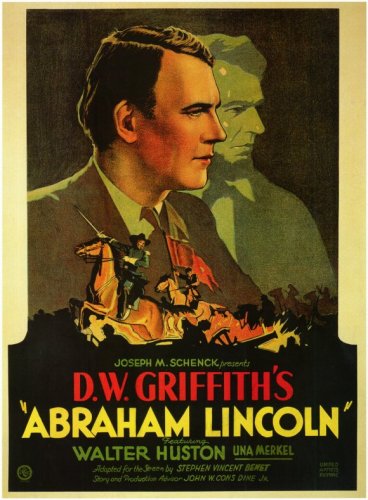
abraham-lincoln-movie-poster-1930-1020198617


We start things off with a film from 1930.  One of only two sounds films to be directed by cinematic pioneer D.W. Griffith, Abraham Lincoln is — as you might guess from the title — a 90 minute biopic about the 16th President of the United States.  It tells the same basic story as Lincoln, just in a lot less time and with Walter Huston playing the title role.  The film opens in 1809 with his birth then speeds forward to detail his tragic love affair with Ann Rutledge (played by Una Merkel) and his subsequent marriage to Mary Todd (Kay Hammond).  We get a snippet of the Lincoln-Douglas debates and then, just as quickly, Abe is President, the country plunges into civil war, and an alcoholic actor named John Wilkes Booth (Ian Keith) is meeting with disreputable looking men in a shadowy bar and making shadowy plans.

Any honest review of this version of Lincoln’s life needs to deal with the obvious.  Abraham Lincoln was released 84 years ago, at a time when the film industry was still struggling to make the transition from silent to sound film.  In other words, the film is stiff, stagey, and full of actors who alternate between shouting their dialogue and delivering their lines through nervously clinched teeth.  This is essentially a silent film — complete with overdramatic title cards and heavy-handed symbolism — that just happens to feature some very awkwardly delivered dialogue.  Walter Huston is occasionally effective as Lincoln but, just as often, he’s not.

However, Abraham Lincoln is fascinating to watch from a historical point of view.  It helps if you know a little something about director D.W. Griffith.  Almost all of the narrative techniques that we now take for granted were originally introduced to cinema by D.W. Griffith and many of them were introduced in his controversial 1915 epic, The Birth of a Nation.  

Of course, Griffith’s legacy is problematic precisely because of The Birth of a Nation.  An epic look at the Civil War, Birth not only featured white actors in black face menacing Lillian Gish but also ended with the Ku Klux Klan heroically riding to the rescue.  That even viewers in 1915 were critical of the film’s racism and overly pro-Confederate sentiments should tell you something about just how extreme the film truly was.

(That said, one huge fan of the film was U.S. President and aspiring dictator Woodrow Wilson.)

By most accounts, Griffith was stunned by the negative reaction to The Birth of a Nation and several of his subsequent films (most famously, Intolerance) were meant to answer his critics.

That’s what makes the opening scenes of Abraham Lincoln all the more interesting.  The film opens in 1809 with a shot of a ship on the ocean.  We catch a glimpse of the Africans chained in the lower decks.  Two white slave traders are seen carrying a dead body to the side of the ship and tossing it overboard.

We cut to Virginia, where we see a group of slave owners complaining about how the North is harming them financially by trying to end the slave trade.  One of the men says that the only man who could have kept the north and south united is dead.  The camera pans up to a picture of George Washington.

Then, the scene cuts to Boston.  A group of northerners sit around a table and talk about how slavery is harming the north economically and therefore, it has to end.  One of the northerners says that the only man who could have kept north and south united is dead.  Again, the camera pans up to a picture of George Washington.

And, it’s a wonderfully effective sequence, one that not only reveals the economic reasons behind most wars but one which also reveals the cruelty, inhumanity, and pure evil of slavery.  (That said, when the film later shows us a glimpse of life in the Confederacy, Griffith does include a couple of slaves cheerfully dancing in the background.)

And, as awkward as the scenes involving dialogue are (the less said about the scenes between Walter Huston and Una Merkel, the better), Griffith does occasionally show the visual flair that was his trademark.  One excellent sequence involves soldier after soldier lining up, one after the other and each of them staring straight into the camera as they prepare to go to war.  When the film concentrates on scenes of men marching across the countryside, it actually works.

Then again, you may just want to see the film for the chance to hear one extra, when asked the identity of a man giving a fiery speech, awkwardly explain, “That’s the actor, John Wilkes Booth.  Not much of an actor but he’s got a way with the ladies!”

It’s really up to you.
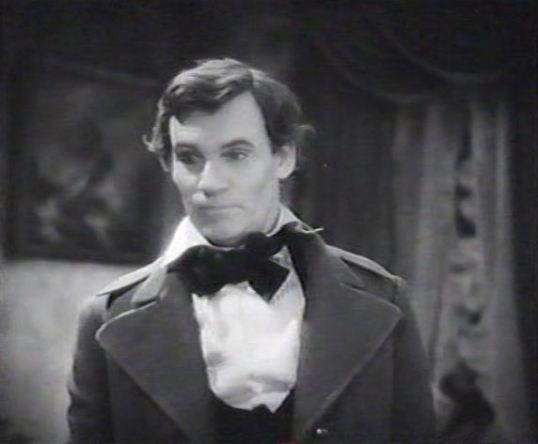
Walter Huston as Abraham Lincoln
Walter Huston as Abraham Lincoln