If there’s one thing that will draw me back out of obscurity no matter how much work I’m bogged down with, it’s Horror season here on Shattered Lens. As a de facto film blog’s one author who pretty much never watches movies, I like to do my part by digging out a mix of tunes appropriate for the season.
This is always the time of year when I stop focusing on new releases and revisit a lot of my metal and folk favorites of old. From b-side Satanic cheese to authentic pagan anthems to the truly deranged, all the music I love most seems to find a home when that oppressive summer sun gives way to pleasant temperatures and dimming lights. It’s my favorite time of year, and my music collection rises to the occasion.
Opeth is pretty common fair in the textbooks of heavy metal these days, but Mikael Akerfeldt’s finest works came before the fame, in my opinion. Their 1995 debut, Orchid, ranks highest for me. While Akerfeldt’s trademark progressive rock experimentation was present from the get-go, those early albums had a sort of hollow, natural tone to them that lent the band a distinctly folk vibe. Orchid (and Morningrise) seem to drift through the crisp, foggy air surrounding a lake on the edge of a forest, the sun just beginning to rise over the horizon. I don’t wake up early when I can help it, but if a morning commute is necessary, Opeth always sees a spike in my play count. The vision that songs like “The Twilight is My Robe” paint is stunningly vivid, and surprisingly peaceful in contrast to Akerfeldt’s harsh vocals.
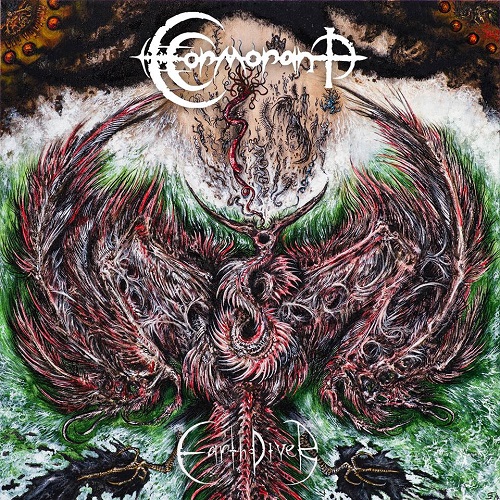
Cormorant are a 4-piece San Francisco Bay band formed in 2007. They released their third studio album, Earth Diver, back in April of this year. Lacking major ties to any other band I have heard of, it’s probably no surprise that they stayed off my radar until now, but this is a band that definitely deserves some attention. Their well-crafted mix of folk, progressive rock, post-rock, and black metal sets a high standard at the cutting edge of metal today. While Earth Diver may possess a fatal flaw, it offers a world of potential that few bands can hope to realize.
Cormorant – Daughter of Void, from Earth Diver
Earth Diver opens with “Eris”, a two and a half minute instrumental folk guitar track with a bit of a Spanish flare. As nice as the song sounds in and of itself, I am not convinced that it was the ideal choice for their opener. The second track, “Daughter of Void”, kicks off acoustic as well, and with the two tracks combined, the intro just seems a bit overdrawn. Don’t worry though; that’s the last time I’ll be complaining about the album’s structure. The acoustic portion of “Daughter of Void” sets the stage nicely and gets us straight to the point without much delay, kicking the metal side of the song off theatrically. We start with a nice metal groove lacking any of the repetitiveness you might expect from a band with the “black” tag, and at two minutes their prog tendencies start to show. Black metal vocals give way to something reminiscent of Opeth or Mastodon, and the song shifts through a variety of genre norms without really breaking from the overall feel. The song hits a peak at 4:05 with an Amorphis-esque vocal melody and a really catchy rhythmic hook. The bending tremolo behind the vocals starting at 5:35 is sick, and they build on it further at 6:25. The song is just packed with little standout moments that never last long enough to seem like overkill. (The youtube video ends early, but you’re only missing eight seconds.)
This is the sort of track you could easily remember from start to finish, if you could get in to it enough to care. If. The down side to “Daughter of Void” is a fairly mediocre production job that fails to really pull me in. I can hear everything clearly enough, but I can’t really feel it. They are going for classic low-key grit over big, booming sounds, and I get that, but it feels pretty washed out. The sort of sound Agalloch accomplished with Ronn Chick on Pale Folklore could have pushed this song from above average to outstanding.
Funny fact I didn’t realize until I wrote this: Cormorant actually do share some production history with Agalloch. They work with Justin Weis, who did a notoriously shitty job on Marrow of the Spirit. Go figure.
Cormorant – Sold as a Crow, from Earth Diver
“Sold as a Crow” has a very different feel about it. We kick off with some delicious post-black metal. A pretty tremolo melody warps into a desperate cry as the distortion and blast beats kick into gear. The snare does not always feel quite on point with the guitar, but Lev Weinstein might just have me spoiled in that department. This is the kind of black metal I live for. I love the single-beat stop at 1:46 and 2:00. I love the harmony at 1:50 and 2:05. I love the octave shift at 1:52. I love the three seconds of guitar flare at 1:55. This constant barrage of subtle nuances tends to distinguish post-black metal from its ancestor, and it’s the reason I can recall every note of a 15-minute Krallice composition while an Immortal track might fade into the back of my mind in seconds.
At 2:36 the main melody returns with a sort of flowing, jazzy feel, and then the majority of the song repeats. We get some new variation at 4:03 as build-up to a minute of soloing to close out the track. Maybe because the ending doesn’t appeal to me quite as readily, the production of the album starts to eat at me again. It still feels a bit of a wash, lacking depth or crispness without a good reason. I can appreciate “Sold as a Crow”. I can love listening attentively to every note from every instrument, especially in the first two and a half minutes. But I’m left without that desire to hear it again, right goddamn now. I can never listen to a whole Krallice album at once, because I always get stuck on a track and set it to repeat ad nauseam. “Sold as a Crow” could have been a song like that, but its beautiful structure is not matched by compelling tonal quality.
Cormorant – Broken Circle, from Earth Diver
What you’re not going to hear on Earth Diver is more of the same. This isn’t the sort of album where I can describe two or three tracks and feel like I’ve summed the collective up well. Every song is a masterfully complex beast unto its own. With Opeth always on the tip of my tongue, peppered by Amorphis, Agalloch, and Krallice, Cormorant manage to remind me of a lot of the most unique bands in metal without ever paralleling any of them for long or losing its own unique flavor. “Broken Circle” has jazzy acoustic guitar a la My Arms Your Hearse Opeth, straight-up in-your-face black metal, a break to a distinct Orchid-era Opeth sound at 3:29, brief allusions to math rock, and a world in between. When the singer isn’t barking in classic black metal fashion, he might be pulling off his best Pasi Koskinen or Mikael Åkerfeldt impression, letting out a bellowing roar, or even shouting at the top of his lungs (2:04). You can often catch the bass running wild, sounding especially like Johan De Farfalla during the Orchid moment (why oh why did Mikael fire that man?). But as many band references as I can throw out there, the majority of “Broken Circle” sounds like Cormorant’s own unique creation.
And yet. And yet I can’t pull this album in and hold it close for long. What struck me as mediocre production from the start begins to feel like a travesty in the face of such absolutely brilliant compositions. This album was robbed of its well-deserved glory by a quality of sound that totally ostracizes me. I keep cranking the volume up louder and louder, hoping that I am just not experiencing it immersively enough to feel the pull. But it’s never there. Oh, it doesn’t sound half as bad as the transcoded garbage you’re hearing in these youtube samples. It would be fine for an average, run-of-the-mill album. But Earth Diver is not that. It deserved above-average attentiveness–something carefully crafted to showcase their sound in all of its uniqueness. I can’t help but think that if Colin Marston had gotten his hands on this raw potential it would have been molded into the best album of 2014.
Decade of last.fm scrobbling countdown:
48. Opeth (640 plays)
Top track (26 plays): The Devil’s Orchard, from Heritage (2011)
When I saw Opeth was coming up next, I got pretty excited about what the top track would be. Would my really oldschool Opeth credentials shine with a song like The Twilight is My Robe or Advent topping the charts, or could nothing hope to match Demon of the Fall? A Heritage track was the last thing I ever expected. It’s easy to forget, in the onslaught of relatively poor reviews, how much I actually enjoyed that album when it came out. Oh, it wasn’t love at first listen, but for me it was a breath of fresh air after years of diminishing faith in Akerfeldt’s song-writing ability. Opeth was one of the first metal bands I ever listened to, and, nostalgia aside, I really do think their first three albums were by far their best. A void, beginning subtly with Still Life and expanding more drastically after Blackwater Park, had grown between my personal tastes and the direction Akerfeldt was steering the band. This coupled with what I perceived as an overinflated ego to completely erode my interest in the band for a long time. Ghost Reveries and Watershed only managed four and three listens respectively before I yawned and moved on.
I am not much of a progressive rock fan, but with Heritage I did start to feel like Akerfeldt was coming back to earth and keeping it real again. I don’t know about his whole “I’m done with metal” mentality; it seems to me like he’s exactly where he needs to be to start composing the sort of metal I can enjoy again. But even if prog rock is all that’s going to appear under the Opeth moniker for a long time to come, his decision to tone things down has successfully resurrected my interest. The Devil’s Orchard is my most played Opeth song because these charts do not begin until 2003; a few years earlier and the statistics would reflect something quite different. But suffice to say I do think this is the best Opeth album since Blackwater Park.
I’ll leave you with a classic Opeth track of the sort that made these guys, for a pre-last.fm period of four years or so, my favorite band in the world:
October has always been my favorite month. It marks the beginning of a seasonal reclamation of man by the world, in which civilization’s mask of sensibility begins to slip away. Tasteless architectural symbols of control over nature digress to their more appropriate forms, as frail refuge against forces beyond our control or comprehension. It is, to misappropriate Agalloch, “a celebration for the death of man… …and the great cold death of the Earth.”
Last year I posted a six part series on some of my favorite black metal, folk metal, and related genres for the season. I had intended to do something similar this year, but time just did not allow for it. I never got around to coming up with a central concept on which to focus. Perhaps it is no coincidence that the two bands I have listened to the most this month, Opeth and Summoning, both defy all standards of classification.
I would like to showcase both, but I can’t imagine doing so properly without embarking on a project way beyond the scope of my time and desire to write at the moment. So I will keep this short and sweet, featuring only Opeth’s Orchid (1995) and Summoning’s Let Mortal Heroes Sing Your Fame (2001), and perhaps in the process still introduce you to some amazing music you had not heard before.
Opeth – The Apostle in Triumph
Everyone has heard Opeth, right? Their fame is fairly unprecedented among metal bands that are actually worth a damn. Yet, out of touch with what is and is not popular today as I am, I still get the impression that what I think of as Opeth is just as relatively obscure as it had been when I first heard them well over a decade ago.
Opeth as a popular band, in fact, is entirely foreign to me. Their first album to make the US charts, Damnation, came out right around the time I stopped listening to them altogether, and long after my interest had begun to wane. I was introduced to Opeth, like everyone around the turn of the century, via Demon of the Fall. My Arms Your Hearse was one of the most emotionally charged and breathtaking albums I’d ever heard. At the time, if you wanted to hear more, you had to look backwards, to Orchid and Morningrise, both of which were very different beasts. With them, if no one reminded you of the distortion and growled vocals, you might forget, amidst Akerfeldt’s soft, subtle lamentations, that you were listening to metal at all.
It took both a long time to grow on me. It’s not that they were inaccessible, but that peculiar teenage ability to focus in on a single masterpiece with no appreciation whatsoever for its surroundings had hold of me. There I was covering My Arms Your Hearse from start to finish on my new guitar (sure wish I could still do so now), and I’d listened to Morningrise maybe five times. Orchid never broke through the cellophane. I finally turned to them just barely in time to soak them up before history left them in the dust, a last minute love affair I was conscious of at the time. They ended up becoming my two favorite Opeth albums, and still are.
Even though My Arms Your Hearse was, alongside Blind Guardian’s Nightfall in Middle-Earth, easily the most influential album in my life, Orchid and Morningrise are the two I look back on most nostalgically, and their melancholy beauty always reverberates the sensation.
Opeth – The Twilight is My Robe
So maybe Orchid isn’t really Opeth’s best album. Perhaps I am biased beyond reconciliation. But at any rate, my obsession with it certainly isn’t some subconscious desire to show I am an “old school” fan–the sort of accusation I tend to see on those rare occasions that the album is mentioned at all. Whether you find my placement of it at the top of Akerfeldt’s discography unjust or not, I encourage you to give The Apostle in Triumph and The Twilight is My Robe long hard listens. Agalloch being a decidedly winter-oriented band, I have experienced no music which captures the melancholy side of the autumnal season better than this.
Summoning – A New Power is Rising
I obsessed over The Hobbit as a child, the Lord of the Rings as a teen, and The Silmarillion in my earliest adult years. J.R.R. Tolkien pretty well haunted most of the formative years of my life, and I am forever indebted to him. A few months ago I picked up one of his books for the first time in perhaps a decade, committed to reading them all, but time simply did not allow for it. As with all undertakings though, it influenced my taste in music for the time at hand. I spent much of the summer re-exploring Summoning–a band I’d never actually encountered until Oath Bound in 2006. Thus they were readily at hand at the start of October, and since then they’ve comprised over half of everything I have listened to.
I dare say no single author has had more impact on music than Tolkien, and while I will always regard Nightfall in Middle-Earth as the greatest relevant triumph, Summoning’s discography is a close second. The one band I know of which has taken Tolkien as their lyrical and musical muse pretty much exclusively, they have forged an entirely new style of music over the years that captures that feeling I always got reading him to perfection.
Summoning – South Away
Summoning emerged from black metal, but from the very beginning they stood apart. By Let Mortal Heroes Sing Your Fame in 2001, my favorite album of theirs, this connection had dwindled to little more than the vocals and some tremolo guitar. The constant use of keyboards (often set to replicate brass) and the heavily reverberated, slow drumming are what characterize them best, along with frequent spoken vocal loops.
Perhaps they intend to sound fairly sinister, with lyrics focused more often than not on the darker forces of Tolkien’s tales, but the effect for me is nothing of the sort. The drums paint a vast, diverse landscape of mountains, forests, rivers and plains that are entirely neutral–dangerous to be certain, but more enticing than aversive. They beckon you out to explore the unknown, steeped in mystery–a fantasy world which is here Middle-Earth, but could just as soon be your own back yard on an autumn day, when the changes at hand call on you to leave humanity behind and wander off into the amoral wilderness.
Summoning – Runes of Power
I love black metal, horror, and everything of the sort, but I think the word “neutral” best describes what I have been tapping into this Halloween season. No real glorification of evil for its own sake, nor any embrace of bygone cultures and values here. Orchid and Let Mortal Heroes Sing Your Fame both tap into the individual’s relation to the world absent civilization’s presumptions and impositions–to the mystery of nature and the manifold possibilities within it which mundane daily life denies–be the experience melancholy or thrilling.
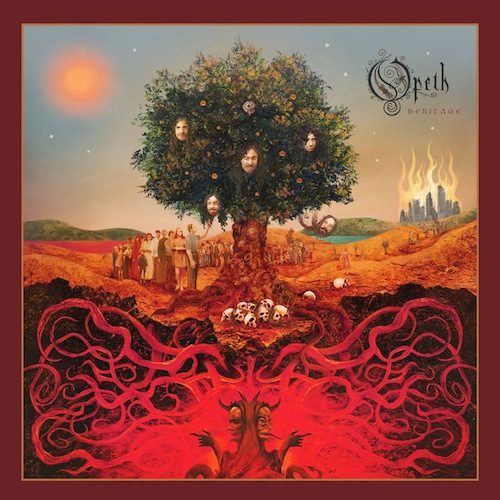
It’s been about a month now since I first acquired a copy of Heritage. I rather wish I’d reviewed it sooner, since my opinions ultimately never really changed. I really liked it on my first listen, and I like it to about the same extent, or perhaps slightly more, for about the same reasons now. Its reception hasn’t really changed either. Labeled pretty much from the start as Opeth’s worst album to date, it continues to wrack up impressively low scores across the board. (The average Encyclopaedia Metallum review is 54%, where no other Opeth album has failed to break at least 75%.) Either popular opinion has placed my presumed disposition towards good taste in dire jeopardy, or else I’m just approaching this from a wildly different perspective than the average listener. I am inclined to believe the latter.
Unfortunately, I cannot treat this as a normal Through the Shattered Lens review. That is, I cannot showcase particular songs via youtube and describe which elements really stand out to me for better and for worse. The band has been pretty forceful lately about preventing any and all means to experience their studio albums without first paying them. I’ll spare you a rant on antiquated copyright laws and record label monopolies, but suffice to say a musician’s attitude towards listeners will always be reflected in some capacity in the music. Whether Akerfeldt (signing to a notorious record label is no excuse) is too selfish or simply too oblivious to respect the means by which he became a celebrity in the first place, there is an over-inflated ego at work here.
But that wasn’t news to me. Really it shouldn’t be news to anyone who’s listened to Roundhouse Tapes and endured the six minutes of dialogue wrapping up the live version of Blackwater Park. (It’s always lame and cliche to mock-hype yourself up to be a celebrity, but it ceases to be tongue in cheek when you really are a celebrity.) At any rate I started losing interest when they released Deliverance, and by Ghost Reveries they were one of those “I really respect them, I just can’t get into their new sound” bands.
So I guess the first big difference between me and, well, pretty much everybody else, was my only thinly-veiled conviction that Opeth were no longer very good. I had absolutely zero expectations, so any mediocrity apparent in Heritage burst no bubbles for me. Rather, it being immediately clear that Heritage was not the sort of album I expected to hear, I ended up listening to it almost as though they were a brand new band. As such, I really can’t find fault in it. Sure, it’s not groundbreaking. It’s unlikely (though not out of the realm of possibility) that it will make my top 10 of the year charts when all is said and done. But damnit, this is a fun, creative, thoroughly entertaining album, and under any other band name I think it would earn fairly positive reviews. Unfortunately, urging people to listen to it with an “open mind” would be pointless, because it’s Opeth. There is no getting around its place in history. If you really liked Watershed it’s unlikely you will enjoy it.
If I could sample the songs here like usual I would treat this whole article differently. I would completely ignore the fact that it’s Opeth, point out all of my favorite bits and pieces, maybe make passing references to the cheesy lyrics and the possibility that they could have done away with a few unnecessary transitions which fail to fit the big picture, and save any mention of the band behind the album until the very end. Hell, maybe I’d say nothing at all and save a rant such as this for a completely separate follow-up article, just to make a point. But since that is not an option, and traditional reviews aren’t my style, the rant will stand alone.
One review I read quoted Akerfeldt as saying “I think you’ll need a slightly deeper understanding of our music as a whole to be able to appreciate this record.” The reviewer’s relative point was not particularly kind, and perhaps mine won’t be either, but I honestly find the quote precisely on the mark. Akerfeldt isn’t some rock solid icon of metal, unyielding and impervious. He’s no Lemmy, no Bruce Dickinson. Perhaps his last few albums were heavy and aggressive enough to make people think otherwise, but what they reflected for me was something quite the opposite–a sort of susceptibility to musical trends, overbearing producers, and well-deserved fame. It was a softness, almost a sort of frailty, that made Orchid, Morningrise, and My Arms Your Hearse so breathtaking, and the more he matured and rose to stardom the more that authenticity faded away, to be replaced eventually by dynamic-driven death metal of the popular sort that only excelled in perfecting a genre with little to no redeeming value to begin with. I think some of his original spirit has resurfaced on Heritage, albeit only slightly and in a very different form. Akerfeldt dumped off a lot of baggage when he chose to create Heritage the way he did, and from what I’ve gathered in interviews, he doesn’t intend to turn back. In retrospect, I’m pretty excited to see what will follow as the leech of popularity upon his creative genius begins to contemplate younger blood. But that wasn’t my first impression. Initially, abandoning all expectations, I just heard something pretty groovy and got into it.
This has been sort of the year of stoner metal. I swear a new entry to the stoner/doom/sludge genre comes out every week. I’ve ignored most of it. It’s not that I dislike it, I just haven’t been in the mood. But once in a while I’ll sample a few tracks here and there, give each band a minute or two of my time. The Flight of Sleipnir didn’t even require that much effort–within the first ten seconds of the opening track I was hooked.
Transcendence
How these guys aren’t on the radar is beyond me, because this is pretty much everything I could ever want from an album. Sure, the production isn’t that great, but neither is Black Sabbath’s, so let’s get over that right form the start and soak this all in. Here’s a band that just hands you everything you could wnat on a silver platter right form the get-go. A killer bluesy stoner metal groove, delicious acoustic interludes, perfectly executed black metal style screaming, beautiful clean vocals that harken to Mikael Akerfeldt, and we’re only five minutes into the album.
As Ashes Rise (The Embrace of Dusk)
As you might have expected, the opener is just an introduction to what they have in store. Sure they’ve played all of their cards. No additional styles or elements are implemented further down the line. But what they’ve introduced just keeps on improving as the album progresses.
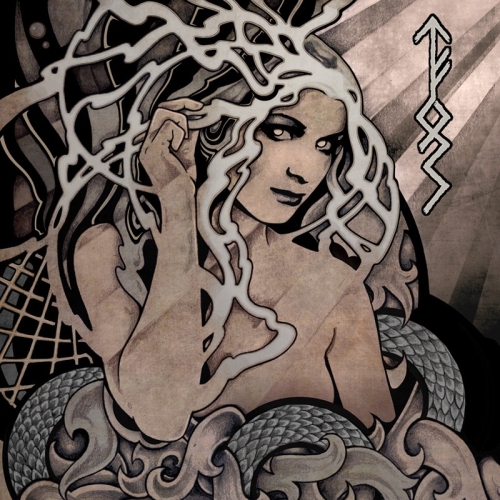
There is a surprising prominence of acoustic melodies packed into Essence of Nine, so much so that I’m inclined to call it folk metal just as much as stoner metal. The abundant allusions to Norse mythology and use of rune stones on a decidedly doom metal album cover suggest that the band would agree. That distinction alone could make an album stand apart, but if “stoner folk metal” is now a term with meaning, they’ve done more than initiate. They’ve come awfully close to perfecting it.
The Seer in White
Because the quality of their song writing overshadows the fact that what they’re doing here is unique. And while I’ve showcased those songs that most appeal to me–the most folk-centric of the lot–there is plenty to be had for fans of the more punishing characteristics of doom. It’s never quite crushing enough to rival the best artists of that sort of music, but as a compliment to the folk side of their sound rather than the main focus of the music, it’s certainly sufficient. Given a live venue and enough amplification I think they would blow me away.
As Cinders Burn (The Wake of Dawn)
Anyway, there you have it. I think I’ll spend more time talking about this album than actually listening to it throughout the year. It’s not the sort of thing I’m always in the mood for, but I can find no fault. People looking for strictly doom metal might find it lacking, but if you’re interested in something a bit more diverse Essence of Nine is a sure bet.
This is a difficult song to introduce. It is not a gradual build-up to an overwhelming conclusion–an accurate description of my other favorite song by them, Wretched Wisdom. It’s not post-metal in that sense (granted most of their songs aren’t.) No, I want to say it reminds me first and foremost of Opeth circa My Arms Your Hearse. The styles aren’t at all alike, but in a similar manner it flows from movement to movement, each astoundingly memorable and neither oppressively aggressive nor tame, before winding down into a slow, apprehensive timebomb anticipating the final desperate explosion that catches you off guard no matter how convinced you are that it’s coming. And though the Drudkh influence is obvious, it’s much like Opeth in that there’s really very little it can be compared to.
If you are familiar with Krallice, the song should strike you from the get-go for beginning in stride rather than exploding out of a wall of feedback or gradually building into anything.
As a final note, notice how significant the bassist’s role is in this song. It’s a feature rather uncommon to the genre.
If you listen to only one version of this, I recommend the studio cut in spite of the poor sound quality on youtube. If you feel inclined to hear it twice though, this second, live video really lets you grasp what’s going on. It wasn’t until I saw them live that I was compelled to really dive into the studio version of this song and realized what a masterpiece it was.
 Through the Shattered Lens