
Review: Icefall (dir. by Stefan Ruzowitsky)


“You don’t find redemption in warmth. You fight for it in the cold.” — Ani

Icefall (2025) is a survival thriller set deep in a frozen wilderness where Ani, a determined Indigenous game warden, and Harlan, a grizzled poacher, find themselves forced together to evade criminals hunting down a crashed plane’s cash stash. Their uneasy alliance forms the heart of the movie, supported by the biting cold, shifting ice, and relentless danger that keeps the tension alive throughout.

The film benefits significantly from its leads’ performances, especially Joel Kinnaman’s portrayal of Harlan. Kinnaman has become something of a seasoned veteran in this kind of gritty thriller and action role, having built a career playing characters who balance toughness with a hint of vulnerability. His familiarity with this genre brings a dependable authenticity to Harlan, who feels weathered but not worn out, someone who understands survival instinctively. Alongside Cara Jade Myers’ portrayal of Ani, their on-screen chemistry roots the film in more than just action beats, making their relationship genuinely engaging amid the harsh landscape.

Speaking of the environment, Icefall uses its setting as more than just a backdrop. The fragile ice and near-empty wilderness create natural obstacles that heighten the sense of peril, reinforcing the story’s theme that nature itself is an adversary. The melting ice becomes a constant threat, lending the narrative a slow-burning pressure that’s as effective as any chase or gunfight. This atmospheric tension is one area where the film really earns its keep, immersing viewers in the dangerous beauty of its frozen world.

However, Icefall stumbles when it comes to story originality and pacing. The film’s premise feels familiar—dangling on the edge of a formula that fans might recognize as similar to the 1993 Sylvester Stallone thriller Cliffhanger. While Cliffhanger had that film’s villain as a magnetic and complex antagonist, Icefall misses that mark. Its criminals lack charisma and depth, removing a vital layer of excitement and tension from the story. Without a compelling foil for Harlan and Ani, many confrontations fall flat, and the thriller’s pulse falters.

The plot is further weakened by a somewhat cluttered narrative, introducing a secret government biohazard subplot that feels shoehorned in and detracts from the simpler core survival story. Characters occasionally make choices that seem more dictated by the demands of the script rather than believable motivations. These factors lead to inconsistent pacing, which can frustrate viewers looking for a tight, focused thriller.

Visually, the film offers moments of stark beauty but is uneven technically. Some sequences perfectly capture the isolating chill and danger of the icy wild, while others suffer from abrupt editing and less convincing digital embellishments that distract from the intended immersion. The cinematography shifts between grand vistas and awkward close-ups, occasionally disrupting the flow of tension.

Characterization is uneven as well. Ani shines intermittently but sometimes veers into typical thriller protagonist territory, exhibiting moments of indecision or cliché. Kinnaman’s Harlan remains the more grounded and believable figure, benefiting from his extensive experience playing similar roles. Meanwhile, the villains fail to rise above stereotype, lacking the nuance or menace that could have made the story pulse with higher stakes.

Still, when the film settles into the rhythm of survival—the crunch of snow underfoot, the slow erosion of trust, the ever-present threat of dissolving ice—Icefall delivers a tense, atmospheric experience. It’s not a revelatory thriller, but it does offer enough grit and moodiness for a single viewing, especially for fans of cold-climate survival dramas.

Icefall is a mixed bag: it has strong performances, especially from Joel Kinnaman, who clearly knows the ropes of this genre and plays an experienced, weathered survivor with ease. The film’s use of environment is a big plus, giving it an edge that many thrillers lack. Yet it suffers from an unoriginal plot that recalls better films like Cliffhanger but without their charismatic antagonists, plus narrative distractions and technical inconsistencies. It’s an okay watch for those in the mood for a frosty thriller with solid leads but never quite rises to leave a lasting impression.
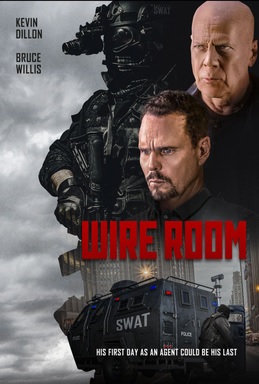
Film Review: Wire Room (dir by Matt Eskandari)


Wire Room tells the story of Justin Rosa (Kevin Dillon).

Once upon a time, Justin was a member of the Secret Service.  But, for reasons that are never really made clear, Justin was eventually demoted and found himself working for Homeland Security.  After 18 years, Justin has finally achieved his dream.  He’s been assigned to a wire room, a high-tech command center where HSI agents conduct surveillance on high-profile criminals.  On his first day, Justin shows up late.  He gets yelled at by his superior, Shane Mueller (Bruce Willis).  Justin explains that he couldn’t find anywhere to park.  Shane is not impressed.  Of course, Shane takes a taxi to and from work because Shane is a total alcoholic who likes to spend his free time at the local strip club.

After meeting Shane and Nour Holborow (Shelby Cobb), Justin is left in the wire room alone.  His sole job is to keep an eye on a British arms dealer, Eddie Flynn (Oliver Trevena, who chews the scenery with relish).  Shane is obsessed with taking down not only Eddie but also all of the corrupt cops that are on Eddie’s payroll.  Eddie has no idea that his entire mansion is wired and that Homeland Security is watching him while he wanders around the house in his leopard-print robe.  Eddie also doesn’t know that a bunch of assassins are coming to his house to try to kill him.

Realizing that Eddie is about to be killed, Justin tries to call Shane but Shane is too busy getting drunk to answer his phone.  When Nour calls about an unrelated manner, Justin asks her for advice.  She tells him to call Shane.  He already tried that!  Realizing that Homeland Security is full of drunks and incompetents, Justin decides to call Eddie himself.  Soon, Justin and Eddie enter into an uneasy partnership.  Justin tries to keep Eddie alive while Eddie tries to figure out how Justin knows what’s happening at his house.  To me, it would seem like it shouldn’t be difficult for Eddie to figure out that Homeland Security has wired his house but no one in this movie is particularly smart.

Wire Room was one of the last movies that Bruce Willis made before announcing his retirement from acting.  Willis doesn’t get much screen time and his dialogue consists mostly of profane insults.  That said, it is nice to see Willis playing a good guy again and there’s even a few hints of the old Willis charisma to be found in his performance.  If nothing else, he seems to enjoy the scenes in which Shane gives Justin a hard time.  As for Justin, he really is a truly stupid character who makes so many obvious mistakes that it’s hard not to worry about the fact that he’s been entrusted with keeping the homeland safe.  Fortunately, Kevin Dillon is an actor who can make stupidity likable.  (There’s a reason why Johnny Drama was the only character on Entourage that anyone really cared about.)

Like the majority of Willis’s recent films, Wire Room is a low-budget action film.  The special effects aren’t particularly special and the action scenes are fairly rudimentary.  A huge problem with the film is that the viewer is never quite sure how close or how far anyone is from the titular location.  For instance, we’re continually told that people are heading towards the wire room but it seems like it takes them forever to actually show up.  At one point, we see a group of bad guys heading up to the wire room but, somehow, Justin and Shane still have time to scrounge up some weapons and have a fairly detailed conversation before any of them actually arrive.  For all of the shooting and the yelling, Wire Room also never convinces us that there’s much at stake as far as the story is concerned.  Shane, for instance, doesn’t seem to be particularly upset when Justin tells him about what is happening at Eddie’s house, despite the fact that Eddie’s death would destroy Shane’s investigation into police corruption.  If Shane, the man in charge of the investigation, doesn’t care about what happens then why should we?

That said, there is some perhaps unintentional enjoyment to be found in Wire Room.  Kevin Dillon plays Justin as being so dense and so slow-witted that the film almost becomes a parody of the recent spate of movies and television shows that have been released about hyper competent government agents.  There are laughs to be found and Bruce Willis gets to be the good guy again.  Wire Room is not a particularly memorable movie but it is a decent time waster.