The Kids Are Not All Right: 6 More Trailers That I Love


Continuing my ongoing survey of classic exploitation and grindhouse film trailers, here’s six more.  

1) Simon, King of the Witches — I’ve never seen this film but I caught this trailer on one of the 42nd Street compilation DVDs.  It doesn’t really make me want to see the film but I love the trailer because it is just so totally and utterly shameless.  Seriously, could this thing be more early 70s?  As well, I’ve always wondered — would witches actually have a king?  I mean, seriously, get with the times.

The film, by the way, stars Andrew Prine who apparently had a really promising film career until his girlfriend, Karyn Kupicent, died mysteriously in 1964.  A lot of people believed that Prine killed her though he always denied any guilt and there’s really no evidence to connect him to the crime.  Interestingly, even more people seem to think that Kupicent was murdered because she knew something about John F. Kennedy’s assassination.  Finally, true crime author Steve Hodel has suggested that Kupicent was actually murdered by his father, Dr. George Hodel.  (Steve also claims that George was the Black Dahlia killer, the Zodiac killer, Chicago’s lipstick killer, and that George was responsible for just about every unsolved murder in history.  Oedipus much?)

2) The Town That Dreaded Sundown Though I didn’t consider this while selecting this trailer, this is another film that features the unfortunate Robert Prine.  I’ve seen this film exactly one time when it showed up on late night television once.  Unfortunately, considering that it was 4 in the morning and the movie was obviously heavily edited for television (not to mention that constant commercial interruptions), I didn’t really get to experience the film under ideal circumstances.  As a result, I’ve been trying to track this movie down on DVD ever since.  It’s not an easy film to find.

One of the reasons this movie fascinates me is because it’s not only based on a true unsolved crime but it actually follows the facts of the case fairly closely.  In the late 40s, Texarkana was stalked by a masked gunman known as the Phantom Killer.  The case was never solved and its gone on to become a bit of a local legend in the rural Southwest.  Part of my interest in this case comes from the fact that I grew up in the rural Southwest.  It’s the part of the country I know best and this film was actually filmed in the southwest as opposed to just an arid part of Canada.  Interestingly enough, the Phantom Killer had a lot of similarities to the later Zodiac Killer.  However, as far as I know, Steve Hodel has yet to accuse his father of haunting Texarkana.

The film itself was made by Charles B. Pierce, a filmmaker who was based in Arkansas and made several independent films in that state.  Perhaps this explains why the trailer refers to “Texarkana, Arkansas” even though everyone knows that the only part of Texarkana that matters is the part that’s in Texas.

3) Nightmares in a Damaged Brain This is one of the infamous “video nasties” (trust the English to not only ban movies but to come up with a stupid and annoying label for those movies).  Like many of those films, this is a gory Italian film that seems to bathe in the sordid. 

It’s also fairly difficult film to find.  The DVD I own is actually a copy of the severely cut version that was eventually released in England, of all places.

(Another thing about the English — why is it that a culture that obsessively uses the word “cunt” in casual conversation seems so driven to distraction by a little fake blood?  It’s as if someone told them that banning movies would somehow make up for the attempted genocide of Catholics in Northern Ireland.)   

However, even in cut form, this is a disturbingly dark and frequently depressing film.  Evil seemed to radiate through my entire apartment the whole time I was watching it and that atmosphere is captured in the movie’s trailer.

As a sidenote, the gore effects in this film are credited to Tom Savini.  At the time of the film’s release, Savini announced that he actually had nothing to do with this movie.

4) To the Devil a Daughter — I recently read a biography of Christopher Lee in which he cited this movie, along with the original Whicker Man, as one of his personal favorites.  It was also the film debut of Natassia Kinski, the daughter of Klaus Kinski.  Considering Klaus’s reputation, the title is ironic.

5) Vampire Circus This is another movie that I’ve never seen but I’ve heard great things about it.  Supposedly, its one of the last great Hammer vampire films.  Reportedly, it was controversial at the time of its release because it featured vampires attacking English children.  (Which, if nothing else, at least prevented from growing up to kill little Irish children.)  Seeing the trailer leaves me even more frustrated that it has yet to be released, in the States, on DVD.

6) Dr. Butcher, M.D. — This is actually a rather odd zombie/cannibal film hybrid from Italy.  It was originally titled Zombie Holocaust but the American distributors retitled it Dr. Butcher.  I love this trailer for much the same reason I love the Simon, King of the Witches trailer.  It is just pure and shameless exploitation.  Plus, it features some of the best moments of the great Donal O’Brien’s performance as the “title” character.  I recently forced my sister Erin to watch Zombie Holocaust.  Ever since, whenever I start to ramble too much, she simply looks at me and says, “Lisa’s annoying me.  About to perform removal of vocal chords…”  She actually does a fairly good impersonation.  Consider this just more proof that the Grindhouse brings families closer together.
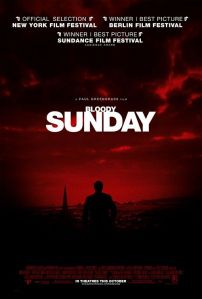
Film Review: Bloody Sunday (dir. by Paul Greengrass)


On January 30th, 1972, in the Bogside area of Derry, Northern Ireland, the British army opened fire on what-was-meant to be a peaceful demonstration.  13 men were killed on the spot, another died later of his injuries.  In the months leading up to the demonstration, the British army had been frequently attacked by pro-independence, largely Catholic “nationalist” groups and the Army was quick to claim that the were acting in self-defense and that they had been fired upon.  Others, however, pointed out that almost all of the men killed (most were just teenagers) had been shot while fleeing the soldiers and none had any weapons on them.  This was the event known that later became known as Bloody Sunday and served as one of the leading catalysts for the decades of “Troubles” that would follow.

Earlier today, 38 years after the fact, British Prime Minister David Cameron finally publicly acknowledged the fact that the 14 men killed on Bloody Sunday were murdered.  Much like the classic Monty Python skit where Eric Idle is convicted of murdering 300 people in one day, Cameron said that he was “very, very sorry.”  (Actually, Idle said that but the idea is the same.)

The Bogside Massacre also served as the basis of one of the best (and most important) films of the first decade of the 21st Century, 2002’s  Bloody Sunday.

Directed by Paul Greengrass (who would later, of course, direct the final two Bourne films), Bloody Sunday is a disturbing recreation of January 30th, 1972.  We watch as the civil rights activist Ivan Cooper (a very likable James Nesbitt) makes his way through the Bogside area of Derry, encouraging people to attend the march while still finding time to beg the local IRA leadership not to start any violence.  While most critical attention is, understandably, given to the scenes that recreate the massacre itself, these early scenes are just as important.  They establish the idea of the people of Bogside as being a community full of actual individuals as opposed to just a collection of pawns in the war between the nationalists and the unionists.

While Cooper tries to ensure peace, we are given contrasting scenes of the British army preparing for the exact violence that Cooper is trying to prevent.  Ironically, in these opening scenes, both Cooper and his military counterparts are motivated by the same basic fear of the IRA.  Its only once the demonstration has started and the first shots are fired that Cooper realizes that the establishment is far more dangerous than the insurgents.

Throughout the film, Greengrass directs in his signature, documentary-style, employing hand-held cameras and rejecting any artistic flourishes that might take the viewer out of the “reality” of the situation.  Each scene ends with a fade-to-black and, as a result, the viewer gets the feeling that he is literally dropping in on the action.  This is not to say that Greengrass is not an artful director.  The power of his artistry, however, comes from his ability to hide the technique.  As a director, he does not demand attention with a lot of showy tricks.  Instead, he earns the attention by perfecting his craft.

Greengrass’s psuedo-documentary style is at its strongest and most devastating during the recreation of the massacre itself.  Perhaps because the film was made for British television at a time when there was still official doubt about what set off the Bogside Massacre, Greengrass leaves hazy the exact reason as to why the army starts firing.  However, what he does make clear is that the 14 men killed were, essentially, murdered.   One of the unfortunate things about being as big a movie fan as I am is that I’ve grown jaded to the sight of people dying on-screen.  However, unlike many other similar films, the deaths in Bloody Sunday are not presented as just being plot devices or as an excuse to get an emotional response from the audience.  Instead, the deaths in Bloody Sunday hurt because you immediately know that, regardless of which you side you support as far as the Troubles are concerned, none of the deaths were necessary.  They were, instead, the product of a nation’s wounded pride.  14 men died so that the British could feel British again.

As you can probably guess, the British don’t come across particularly well in Bloody Sunday and, quite frankly, they shouldn’t.  Watching this movie, you’re left with the impression that the Bogside Massacre was the British Army’s attempt to exorcise the demons of the collapse of the British Empire by killing the Irish.  (Though, in all fairness, the Irish killed a lot of British in the time leading up to Bloody Sunday.)  However, and this is to Greengrass’s credit, individual British soldiers are shown to question the massacre.  Its only when those soldiers are forced give up their individuality and function as a collective that they commit (and, at the film’s end, conspire to cover up) murder.  For just that, this movie should be required viewing for anyone who insists on claiming that “individualism” is a threat to society.

The film ends on a quiet note as a somber Cooper announces that he no longer sees a “peaceful” solution.  This scene gets its power largely from Nesbitt’s own charismatic performance.  Playing the closest thing the film has to a central character, Nesbitt makes his early enthusiasm for the march so infectious that its simply devastating to see him after the massacre, angry and disillusioned.  It also reminds the viewer that, in the years after Bogside, there was no peace and many more innocent people — on both sides of the conflict — would die.  The British army may have thought it was going to scare Northern Ireland into submission but instead, they helped to perpetuate a continuing cycle of death, destruction, and hatred that, regardless of any treaty, continues to this very day.

I should admit that I’m a fourth Irish.  My great-grandparents were born and raised in Ardglass, Northern Ireland.  Though I’ve never been, I hope to visit Ardglass some day.  Though I no longer consider myself to be a member of any religion, I was raised in the Catholic church.  As such, I’ve always had an interest in Irish history and the Troubles in particular.  I’ve also always been biased towards the nationalist side. 

So, it would be fair for someone to ask if I’d have the same reaction to this film if I was a Protestant with family living around London and the honest answer is that I don’t know.

However, the power of Bloody Sunday doesn’t come from political ideology.  Instead, the movie serves as a disturbing but powerful reminder of what can happen when people surrender their free will to groupthink.  Though the oppressors in Bloody Sunday may be British, recent history has proven that, when actively opposed, those with all the power will always react with the same brutal fury.  The forces of oppression remain the same whether they’re in Northern Ireland, Iran, Honduras, or the U.S.A.