On the New Mexico frontier, war is breaking out behind rancher Sam Chew (Noah Beery) and rustler Sonora Joe (Luis Alberni). Both want to control the land and the cattle that graze upon it and innocent settlers are getting trapped in the middle! The governor decides to send a young sheriff named John Steele to maintain order. No sooner has Steele arrived then he meets a young woman (Mae Madison) and her father, who have both been attacked by and had their cattle stolen by Sam Chew. After Sonora Joe and his gang save his life from Sam’s men, Steele realizes that Sam is more malicious and dangerous than Sonora Joe so he decides that the best way to handle the situation is to deputize Joe and team up with him to stop Sam and his men. It’s a tall order but John Steele is just the man to handle it because John Steele is John Wayne!
This was one of the many B-westerns that the former Marion Morrison made in the decade before John Ford made him a star by casting him in Stagecoach. Wayne was always a good hero, even in a 54-minute programmer like this one. Though there is, as the title promises, an impressive stampede, Wayne is the main attraction here, with Noah Beery serving as a good heavy as always. Perhaps the most interesting thing about this movie, if you’re a western or a John Wayne fan, is that Wayne’s horse is named Duke. This was one of six films that Wayne made with Duke. Back in the 30s, the horses were often as a big a star as the men who rode them and, from the posters I’ve seen, it does appear that The Big Stampede was advertised as starring, “John Wayne and DUKE!” At least Wayne was still able to get top billing.
The Big Stampede had previously been made as a silent film and the remake reuses a lot of old footage from the original. John Wayne, needless to say, did not star in the original film, though he did wear the same costume that Ken Maynard wore in an attempt to keep people from noticing that the footage didn’t always match. It’s not a totally successful ploy, though undemanding audiences in 1932 probably accepted it. The Big Stampede would be remade one more time, in 1936, with Dick Foran taking the starring role.
Ben (Sam Bottoms) is a gullible college student working at a gas station in the Mojave desert. Horton Madec (Andy Griffith) is a wealthy attorney from Los Angeles who walks with a limp and who fancies himself a big game hunter. Madec hires Ben to serve as his guide through the desert. Madec says that he’s hunting a ram but instead, he ends up shooting and killing an old prospector. Even after Madec offers to pay him off, Ben wants to go to the police. Madec gives it some thought and decides to hunt Ben himself.
After forcing Ben to strip down to his shorts, Madec sets him loose in the desert. As Ben tries to make his way back to civilization, Madec follows close behind and uses his rifle not to kill Ben but instead to keep him from drinking water or taking shelter from the sun.
Savages deserves to better known than it is. The film does a good job of making you feel as if you’re trapped out in the desert with Ben, trying your damndest to survive while some maniac follows close behind, taunting you and refusing to allow you to get any relief. Horton Madec is pure evil, a maniac who brags about how he can do anything he wants because he has money and he knows people. That he’s played by Andy Griffith makes him even more dangerous because you know there’s no way anyone would believe that Andy Griffith took you out to the desert tried to kill you.
After playing the folksy and friendly Andy Taylor for nine seasons on The Andy Griffith Show, Griffith tried to leave Mayberry behind by taking on villainous roles in made-for-TV movies like this one and Pray For The Wildcats. Though he actually started off his film career by playing a villain in A Face In The Crowd, it was still probably a shock for audiences in 1974 to turn on Savages and see Andy Griffith cruelly drinking a martini while another man nearly died of dehydration in front of him. Griffith goes full psycho in the role of Horton Madec and is totally convincing. (Of course, audiences preferred the folksy side of Griffith which is why, even after ten years straight of playing bad guys, Griffith still ended up starring in Matlock.)
Even though it’s Griffith’s show, Sam Bottom does okay in the role of Ben. He has the right look for the character and that’s really all that the part requires. For the majority of the movie, it’s just Griffith and Bottoms but eventually, James Best shows up as Sheriff Bert Williams. Five years later, Best would achieve a certain immortality when he was cast as Sheriff Roscoe P. Coltrane on The Dukes of Hazzard.
Savages has never gotten an official DVD release but it can be viewed on YouTube, along with Griffith’s other villainous turn from 1974, Pray for the Wildcats.
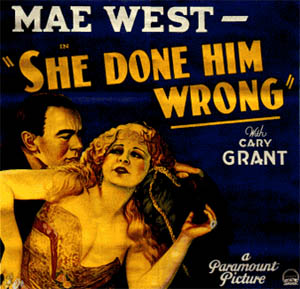
When watching the 1933 film She Done Him Wrong, it helps to know a little something about American history.
It helps to know that the film was made at the tail end of the failed progressive experiment known as prohibition, an attempt to ban liquor in the U.S. which only served to make people idolize criminals and feel nostalgic for the time when you could just safely hang out in a saloon and get drunk with bunch of shady characters.
It helps to know that this film was made at a time when America was struggling through the Great Depression and, more than ever, movies were seen as an escape from reality. The Depression also created a situation where, much like today, most Americans felt as if they were on the outside of the good life and, as a result, the most successful films of the time deal with outsiders getting something over on the smug and judgmental insiders.
It also helps to know that She Done Him Wrong was one of the last of the pre-Code films. Though, by modern standards, the film may seem outwardly tame, the innuendo and subtext is anything but. In fact, She Done Him Wrong was considered to be so racy that some people were actually scandalized when it became the biggest box office success of 1933. (These were largely the same people who, 13 years before, celebrated the passage of prohibition.) The infamous production code was largely instituted to make sure that a film like She Done Him Wrong could never be given another chance to corrupt filmgoers.
What exactly made She Done Him Wrong so controversial?
Well, it took place in a saloon in 1890s. The saloon is owned by Gus (Noah Beery), who uses it as a front for prostitution and counterfeiting. This is a film that features a lot of people drinking a lot of alcohol and it’s also a film that goes so far as to suggest that having a drink or two is not necessarily the worst thing in the world. Captain Cummings (Cary Grant) runs a city mission that has opened up next to the bar and the film devotes a lot of time to poking fun at Cummings’s upright morality. (Of course, Cummings has a secret of his own, one which suggests that his crusading attitude is just a convenient disguise.) Though it would be repealed by the end of the year, Prohibition was still the law of the land when She Done Him Wrong was released and it’s fun to see how much the film has at the law’s expense. That’s the type of fun that would basically be banned by the Production Code.
The Production Code would also require that all criminals be punished for their crimes by the end of a film. In She Done Him Wrong, singer Lady Lou (Mae West) stabs to death the viscous Russian Rita (Rafaela Ottiano) and basically gets away with it. It’s true that Lou was acting in self-defense but what makes She Done Him Wrong unique (for its time) is that Lou shows no remorse and that the killing is handled rather flippantly. When the police, who have been searching the saloon for another criminal, burst into the room after Rita has been stabbed, Lou fools them by placing Rita’s corpse in a chair and combing her hair. (“Haven’t you ever seen anyone comb someone’s hair before?”) After the police leave, Lou has her bodyguard dispose of the body and Rita is never mentioned again. Again, this is something that would never be allowed happen under the Production Code.
And then there’s the naked painting of Lou that hangs in the saloon. Whenever it’s shown a screen, a man in a hat happens to be standing in just the right position to block the viewer from seeing the entire portrait. Again, this would never have been allowed to happen under the Production Code.
And perhaps the biggest indication that this is a Pre-Code film is Mae West herself. Reportedly, She Done Him Wrong was an extremely toned down version of West’s stage act but what was heard on-screen would certainly be enough to throw the guardians of decent society into a panic. Nearly every line that she utters in this film is a double entendre but it’s not only what Mae West says. It’s the way that she says it. West may not have been a great actress but she had enough attitude that she didn’t need to be. With every line, with every glance, with every movement, Mae West announces that she not only has sex but she enjoys it too. In the Pre-Code days, that was unusual. Once the Production Code went into effect, such a portrayal would be impossible.
As for the film itself — well, it’s pretty much just an excuse for Mae to be Mae. There’s a plot, of course. Lady Lou has many suitors and they all converge on the saloon at the same time. However, Lou’s got her eye on the upstanding Captain Cummings. (He’s a man in uniform, after all.) It’s not a great film by any stretch of the imagination but, if you’re into film history or if you’re curious to see how American social mores have changed (and occasionally, not changed) over the years, She Done Him Wrong is a must see.
She Done Him Wrong is only 66 minutes long and it’s the shortest film to ever receive an Oscar nomination for best picture. It received no other nominations and lost to Cavalcade.
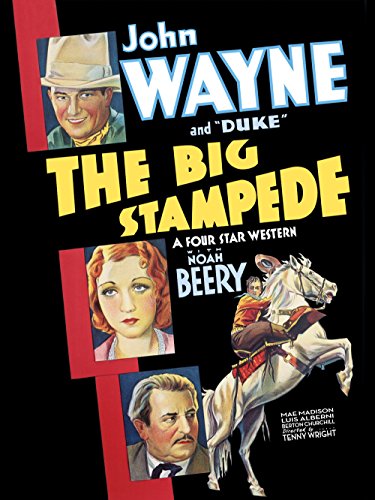 On the New Mexico frontier, war is breaking out behind rancher Sam Chew (Noah Beery) and rustler Sonora Joe (Luis Alberni). Both want to control the land and the cattle that graze upon it and innocent settlers are getting trapped in the middle! The governor decides to send a young sheriff named John Steele to maintain order. No sooner has Steele arrived then he meets a young woman (Mae Madison) and her father, who have both been attacked by and had their cattle stolen by Sam Chew. After Sonora Joe and his gang save his life from Sam’s men, Steele realizes that Sam is more malicious and dangerous than Sonora Joe so he decides that the best way to handle the situation is to deputize Joe and team up with him to stop Sam and his men. It’s a tall order but John Steele is just the man to handle it because John Steele is John Wayne!
 Ben (Sam Bottoms) is a gullible college student working at a gas station in the Mojave desert. Horton Madec (Andy Griffith) is a wealthy attorney from Los Angeles who walks with a limp and who fancies himself a big game hunter. Madec hires Ben to serve as his guide through the desert. Madec says that he’s hunting a ram but instead, he ends up shooting and killing an old prospector. Even after Madec offers to pay him off, Ben wants to go to the police. Madec gives it some thought and decides to hunt Ben himself.
 Through the Shattered Lens