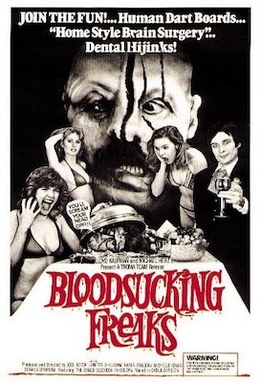
The TSL Horror Grindhouse: Blood Sucking Freaks (dir by Joel M. Reed)


Well, with a title like Blood Sucking Freaks, it has to be good!

Right?

First released in 1976, Blood Sucking Freaks is one of those not particularly good films that every horror fan has to sit through at least once.  Historically, it’s important as an example of a film that generated a thoroughly unnecessary moral panic, largely amongst people who had never actually seen the stupid thing.  It tells the story of Master Sardu (Seamus O’Brien), who runs a Grand Guignol-style theater in SoHo.  Wealthy New Yorkers flock to the theater on a nightly basis, to watch as Sardu and his dwarf assistant, Ralphus (Luis de Jesus), torture women on stage.  The crowd thinks that it’s all fake but what they don’t know is that Sardu and Ralphus are abducting real women and forced them to live in a cage underneath the theater, where they are occasionally brought out to be abused by high-paying patrons.  All of the torture and death that takes place on stage is real.

Most members of the audience enjoy the show and consider Sardu to be a master of transgressive art.  However, critic Creasy Silo (Alan Dellay) doesn’t think much of Sardu or his show and he writes a review in which he refers to whole thing as being pretentious.  Sardu apparently considers “pretentious” to be the worst insult that can be uttered against his production of pain and murder so he orders his followers to abduct Silo.  Held prisoner in the theater, Silo is told the truth about the show and then brainwashed to become a part of the show himself.

Meanwhile, Sardu’s followers have also kidnapped a ballerina named Natasha (Viju Krem).  Sardu feels that, if Natasha can be brainwashed to perform in the show, it’ll lead to greater things.  The show might move to Broadway and then someone might make a movie about Master Sardu!  Natasha’s lunkhead boyfriend, Tom (Niles McMaster), is not happy about Natasha being kidnapped.  He teams up with a sleazy cop (Dan Fauci) and they head down to the theater.

Much as with Snuff, Blood-Sucking Freaks generated a lot of controversy when it was first released, with some speculating that the murders in Blood-Sucking Freaks may have actually been real murders.  It was originally released in grindhouse theaters with an R-rating.  That R-rating might take some people by surprise when you consider how graphic the film supposedly was but it must be understood that the R-rating was self-imposed.  The filmmakers refused to submit the film to the MPAA and just rated it themselves.  When Troma acquired the film and submitted an edited version of the film to the MPAA, the organization refused to even watch the film.  That’s how controversial Blood-Sucking Freaks is!  The MPAA won’t even watch it long enough to tell other not to!

Also, much like Snuff, Blood-Sucking Freaks is actually a pretty boring movie.  Blood-Sucking Friends does deserve some credit for satirizing the pretentions of the underground arts scene but, for the most part, it’s a slow-moving and terribly acted film and the gore, while plentiful, is not particularly convincing.  Seamus O’Brien, who was murdered in an unrelated incident shortly after the film’s release, gives an absolutely lousy performance as Sardu.  Controversy aside, it’s a dumb movie and the only thing that really redeems it is that it knows it’s a dumb movie and doesn’t pretend otherwise.

The main lesson of Blood-Sucking Freaks is that it’s the type of movie that probably would have vanished into obscurity if not for the controversy that it has generated over the years.  Outrage sells.

October Hacks: Alice, Sweet Alice (dir by Alfred Sole)


Eh.  The 1976 film, Alice, Sweet Alice, is one of the few slasher films to have found critical acclaim and to have been seriously studied in the years after its release but I have to admit that it’s never done much for me.

It’s a film that takes place in 1961, in a Catholic neighborhood of Patterson, New Jersey.  It’s perhaps the ugliest setting of a film outside of Combat Shock The houses that we see are run-down.  The apartment building in which much of the action takes place is dirty and rat-infested.  Even the local church looks like it could use a bit of spring cleaning.  Of course, if you think the neighborhood looks ugly, you should see some of the people who live in it.  There’s really not anyone in this film who could be considered to be at all appealing.  Everyone’s either angry or disturbed or grotesquely obese or pervy.  It’s one of those films where everything is so dirty and sleazy that it’s hard not kind of laugh at it all.  John Waters could have worked wonders with this neighborhood but Alfred Sole, Alice’s director, seems to take his story just a little too seriously to give it the camp approach that it deserves.

(In fact, probably the only appealing sight in Alice, Sweet Alice is a picture of John F. Kennedy that is seen hanging in a few offices.  There’s a lot of not positive things that can be said about JFK but at least he was handsome.)

Anyway, the plot deals with Alice Spages (Paul Sheppard), an annoying twelve year-old sociopath who lives in the desolate apartment building and who enjoys tormenting people by putting on a Halloween mask and scaring them.  Alice is basically a bully but I think we’re supposed to sympathize with her because she’s rebelling against the suffocating hypocrisy all around her.  Again, whatever.  I was a brat when I was 12 years old too.

Alice’s younger sister, Karen (Brooke Shields, making her film debut), is as perfect as Alice is troublesome.  Everyone loves Karen, except for Alice who is obviously jealous.  On the day of her first communion, Karen is strangled to death by someone wearing a Halloween mask and a yellow raincoat, one that looks a lot like the one that Alice owns.  The killer steals Karen’s crucifix and tries to set the body on fire.  Father Tom (Rudolph Willrich) is annoyed that the ceremony has been interrupted.  Actually, it’s hard to think of a moment in this film in which Father Tom isn’t annoyed by something.

Did Alice murder her sister?  A lot of people think so, especially after other people who get on Alice’s nerves end up getting attacked.  Alice ends up getting sent to a mental hospital but, of course, Alice isn’t the murderer.  Who is the murderer?  No need for me to say.  If you watch the film, you’ll figure it out easily on your own.

Alice, Sweet Alice is often described as being an early slasher film.  If anything, it’s more of an American giallo, with the emphasis being on figuring out who is the killer behind the mask.  Many critics have praised Alice, Sweet Alice for its atmosphere and its anti-religious subtext but, to be honest, I’ve always found it to be kind of boring.  Part of the problem is that every character is so repulsive (physically, mentally, and morally) that it’s difficult to really care about whether or not they die or if they’re the guilty party.  Even Alice comes across like someone who is destined to start fires once she grows up.  None of the actors gives a good enough performance to hold your attention.  The film attempts to criticize the Church, as many giallo films did.  But one need only compare Alice Sweet Alice to other anti-clerical giallo films, like Lucio Fulci’s Don’t Torture A Duckling or Aldo Lado’s Who Saw Her Die? , to see how simplistic and superficial Alice, Sweet Alice‘s approach really is.

Anyway, a lot of people will disagree with this review and that’s fine.  Some films work for some people while failing to work for others and, in this case, Alice Sweet Alice is just a film that does not work for me.  Que sera sera.