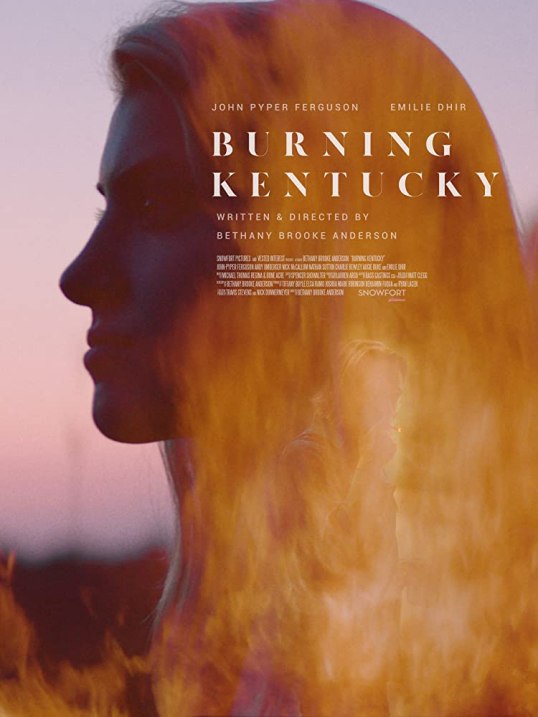
Film Review: Burning Kentucky (dir by Bethany Brooke Anderson)


Burning Kentucky, which I just finished watching on Prime, is a film that has its own unique vibe.  You’re either going to connect with this frequently surreal film or you’re not.  If you do connect with it, you’re going to be aware that, while the film has its narrative flaws, it also has moments of visual brilliance.  If you don’t connect with it, you’ll probably dismiss it as just being another pretentious revenge thriller.  Burning Kentucky currently has a rating of 4.1 over that imdb, not because it’s a bad film but because it’s just not a film for everyone.  It’s not a crowd pleaser but it we’ve learned anything recently it’s that crowds suck.

Burning Kentucky takes place in the hills of Harlan County, Kentucky.  We find ourselves observing two families.  One family lives in a shack and brews moonshine.  They eat whatever animals they catch in the wilderness and about the only thing that’s vaguely modern about them is the camera that their daughter, Aria (played, in her film debut, by Emilie Dhir), carries with her.  (And even that camera appears to be from the mid-20th century.)  Aria also narrates the film, musing about life and death.  In the country, she explains, people understand that death is a part of life.  Regardless of any sentimental feelings, everything dies.

The other family is headed by an man named Jaxson (John Pyper-Ferguson).  Jaxson is the country sheriff, so he’s a man of some importance.  However, it’s also obvious that he’s a man who has long been on a downward spiral.  He drinks too much and he spends most of his time cursing God and complaining about the local preacher, Abe (Andy Umberger).  Jaxson has two sons.  Wyatt (Nick McCallum) appears to be relatively stable.  Rule (Nathan Sutton), on the other hand, is a junkie who lives in a shack that he shares with Jolene (Augie Duke).  Jolene wants to be a singer.  She wants to get off drugs.  Rule, on the other hand, appears to be content to just slowly kill himself.

Whenever Wyatt can get away from his drunk father and his wasted brother, he spends his time with Aria.  They’ve been in love for several years, ever since the night that Aria discovered Wyatt trapped in one of the traps that her family had set around their land.  When we first see Aria and Wyatt together, they talk about how they met on the same night that they each lost their mother.

It takes a while to figure out just what exactly is going on in Burning Kentucky.  The deliberately paced first half of the film freely hops from the past to the present and then back again.  The camera glides over the misty mountains of Kentucky, stopping to linger on deserted houses and crumbling buildings.  Everything seems to be suspended in a state of permanent decay.  The wilderness appears to be both beautiful and threatening at the same time and the imagery, when combined with Aria’s narration, is often surreal.  The first half of the film plays out as if we’re watching a filmed dream.

Unfortunately, the second half of the film is a bit more conventional.  Once we finally discover who everyone is relative to everyone else and after we learn what happened in the past, the film settles down to become a standard revenge thriller, albeit one that’s very much concerned with the concepts of guilt, redemption, and human nature.  Still, the Kentucky hills remains atmospheric and dream-like and the well-selected performers — particularly Augie Duke and John Pyper-Ferguson — continue to bring their haunted characters to life.

As I said, this isn’t necessarily a film for everyone.  The film’s ending will leave a lot of people feeling perplexed but that’s okay.  A story like this doesn’t need a neat ending.  In fact, Burning Kentucky is a film that demands to end on a hint of messiness and ambiguity.  I liked Burning Kentucky.  You might like it too.

Let’s Talk About Nightmare Shark (dir by Griff and Nathan Furst)


Right now, we’re in the middle of SyFy’s Sharknado week.  On Sunday night, SyFy will premiering what they say is going to be The Last Sharknado.  In the days leading up to that moment, they’ve been reshowing all of their classic shark films and premiering a new shark film each night!

Thursday night’s premiere was Nightmare Shark!

Nightmare Shark kind of swam out of nowhere on Thursday and it ended up impressing the Hell out of not only me but almost everyone that I was watching it with.  There’s a neat little twist to Nightmare Shark, one that will be appreciated and loved by anyone who watches SyFy shark films.  In fact, it’s such a wonderful twist that I don’t want to ruin it for those of you who haven’t seen the film yet.  At the same time, I really can’t review the movie without revealing the details of the twist.

So, consider this to be your SPOILER WARNING!  If you haven’t seen Nightmare Shark, just take my word for it that it’s a scary and effective SyFy shark film and stop reading.  Because what follows is going to spoil a huge part of the film for you.  Here, I’ll give you a few minutes to navigate away from the page before I continue.

Here’s a picture of a cute kitty that the rest of us can look at while you leave:

Okay, let’s continue.

Shared cinematic universes are all the rage right now.  In fact, SyFy already has one of its own.  Ian Ziering making a cameo appearance in Lavalantula established that both that film and its sequel took place in the same chaotic universe as Sharknado.  Well, Nightmare Shark established a second cinematic universe.

The film itself deals with a group of shark attack survivors who, having been plagued by shark-related nightmares, agree to take part in an experimental drug trial.  What they don’t suspect is that the outwardly benevolent Dr. Novak (Tony Amendola) actually worships a Hawaiian shark god and his plan is to use them and their nightmares as a way to bring the shark out of their dreams and into the real world.  Among the survivors are Jolene (Lulu Jovovich) and Rob (Thomas Ian Nicholas) and Gina (Rachele Brooke Smith) and Kaplan (Bobby Campo).  Fans of SyFy shark movies will immediately recognize them as the protagonists of, respectively, Trailer Park Shark and Atomic Shark.

So, there you go.  All three of these films take place in the same universe and personally, I would toss Ghost Shark in there as well.  (The Hawaiian shark god definitely seemed to have a bit in common with the Ghost Shark.)  Just as there’s a Sharknado Cinematic Universe, there’s also a Griff Furst Cinematic Shark Universe.

That was a wonderful Easter egg for all of us longtime fans of SyFy shark week.  Since, with the Sharknado franchise wrapping up, this could be the final shark week, Nightmare Shark also gave us a final chance to spend some time with some of our favorite shark movie protagonists.  Unfortunately, not all of them survive their nightmares.

Compared to the whimsical tone that’s present in most SyFy shark movies, Nightmare Shark was a seriously dark film.  Make no mistake about it, this was definitely a horror film.  In fact, it featured some of the most effective jump scenes that I’ve seen in a SyFy film.  The nightmares were all nicely realized and properly surreal.  The film did a good job of keeping viewers off-balance.  You were never quite sure who was awake or asleep and you spent most of the film looking for little clues at to whether we were seeing the real world or the dream world.  Though the film’s influences were clear — A Nightmare on Elm Street was a big one — Nightmare Shark still did a great job of establishing its own wonderfully twisted identity.  Among the cast, the clear stand-out was Tony Amendola, who was enjoyably sinister as Dr. Novak.

Nightmare Shark was an effective horror film, one that proved that there’s still new twists and scares to found in shark week.