
So, this happened:
Every Saturday, I get together with my friends in the Late Night Movie Gang and we watch a movie. I’m usually the one who picks the movie. I usually try to pick something fun and kinda silly. For instance, every Christmas, we watch Santa Claus Conquers The Martians. Last week, we watched Tobor The Great. And this week, I selected a 51-minute program from 1978. The name of that program?
Disco Beaver From Outer Space.
Now, I have to admit that this was one of the rare instances where I didn’t actually bother to watch the entire movie before selecting it. I did watch the first five minutes on YouTube. It featured someone in a beaver costume walking around New York City and eating stuff while disco music played in the background. That was all I needed to see.
An alien beaver eating New York!? I thought, Disco music!? How could this possibly go wrong!?
Add to that, the movie only had 51 minute run time. Even if it’s terrible, I thought, at least it won’t be long!
However, once the film started, I discovered that 51 minutes can be a very long time indeed. Unfortunately, it turned out that the beaver wasn’t actually in much of the film. He showed up at the start of the movie and then he popped up in the middle and finally, he showed up again at the end. That the beaver was cute and came with his own disco song made it all the more regretful that he wasn’t in more of the film.
Anyway, it turned out that the film itself was a collection of vaguely connected sketches. The idea was that a husband and wife were looking for something to watch and , as a result, they kept changing the channel. One channel featured a country western singer. Another channel was showing Masterpiece Theater. And then there was this movie about a vampire called Dragula.
The joke about Dragula was that he was gay and … well, that was pretty much it. Dragula was gay and everyone he bit turned gay and eventually Lynn Redgrave showed up as Dr. Vanessa Van Helsing and she managed to destroy Dragula. If you think this sounds homophobic … well, it was. When the humor wasn’t homophobic, it was misogynistic. I’ve always been proud of the fact that I’m not easily offended and I’ve never been the type to need a safe space but I have to admit that I spent the majority of Disco Beaver cringing. Of course, the problem wasn’t that the humor was politically incorrect. The problem was that the majority of it just wasn’t that funny.
Disco Beaver was produced, for HBO, by National Lampoon. In fact, HBO was only 6 years old when it broadcast Diso Beaver so I’m going to assume that this may have been one of the first original programs ever specifically made for the network. Perhaps that explains why the entire production has a sort of “look how naughty we can be on cable!” feel to it. “We just dropped the F bomb! Here’s a whole skit about breasts! And now, here’s a skit about how to spot a homosexual. We’re so daring!”
From the minute that Disco Beaver started, I felt as if I could literally hear the coke being cut backstage. How many lines of cocaine were snorted over the course of the making of Disco Beaver? Remember that scene at the end of Scarface where Al Pacino had a mountain of white powder on his desk? I imagine that’s what the Disco Beaver production office looked like.
Anyway, we survived Disco Beaver and, at the end of it, we swore that we would never speak of it again. And I learned a very valuable lesson! Always watch the entire movie!

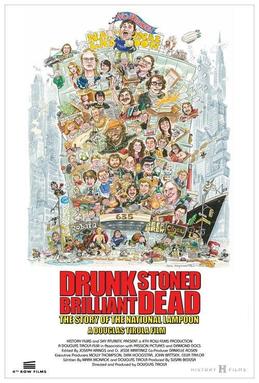 The documentary Drunk Stoned Brilliant Dead pays tribute to National Lampoon. Founded in 1970, National Lampoon was published for 28 years and, at the height of its popularity, its sensibility redefined American comedy. When it came to National Lampoon, nothing was sacred and nothing was off-limits. The success of National Lampoon led to a stage show called Lemmings and The National Lampoon Radio Hour, which featured everyone from John Belushi and Bill Murray to Chevy Chase and Harold Ramis. Michael O’Donoghue, famed for his impersonations of celebrities having needless inserted into their eyes, went from writing for the Lampoon to serving as Saturday Night Live‘s first head writer. National Lampoon’s Animal House, Vacation, and Caddyshack are three of the most influential film comedies ever made. Everyone from P.J. O’Rourke to John Hughes to The Simpsons‘ Al Jean got their start at National Lampoon.

 Through the Shattered Lens