4 Or More Shots From 4 Or More Films is just what it says it is, 4 shots from 4 of our favorite films. As opposed to the reviews and recaps that we usually post, 4 Shots From 4 Films lets the visuals do the talking!
127 years ago, on this date, Frank Capra was born in Sicily. Capra was six years old when his family immigrated to the United States and, for the rest of his long life, he would often talk about seeing the Statue of Liberty from the deck of a boat sailing to Ellis Island. Capra went on to become a director whose work celebrated the ideals and the promise of America. He not only gave us the holiday classic, It’s A Wonderful Life, but he also directed one of the few political films that matteed, Mr. Smith Goes To Washington. And let us not forget that the first two comedies to win the Oscar for Best Picture were directed by Capra, It Happened One Night and You Can’t Take It With You.
In honor of a great career and legacy, here are….
4 Shots From 4 Frank Capra Films
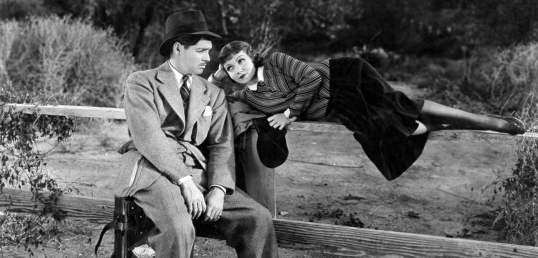
It Happened One Night (1934, dir by Frank Capra, DP: Joseph Walker)
You Can’t Take It With You (1938, dir by Frank Capra, DP: Joseph Walker)
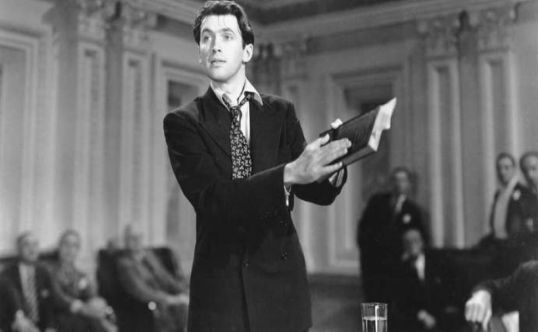
Mr. Smith Goes To Washington (1939, dir by Frank Capra, DP: Joseph Walker)
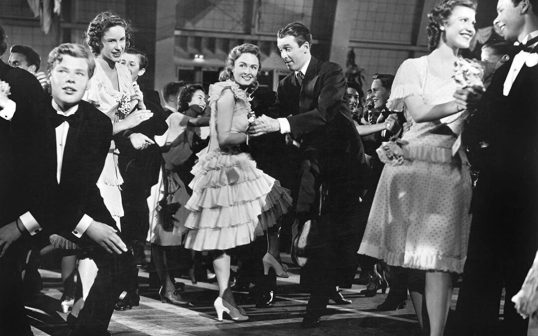
It’s A Wonderful Life (1946, dir by Frank Capra, DP: Joseph Walker and Joseph Biroc)
4 Or More Shots From 4 Or More Films is just what it says it is, 4 shots from 4 of our favorite films. As opposed to the reviews and recaps that we usually post, 4 Shots From 4 Films lets the visuals do the talking!
125 years ago, on this date, Frank Capra was born in Sicily. Capra was six years old when his family immigrated to the United States and, for the rest of his long life, he would often talk about seeing the Statue of Liberty from the deck of a boat sailing to Ellis Island. Capra went on to become a director whose work celebrated the ideals and the promise of America. He not only gave us the holiday classic, It’s A Wonderful Life, but he also directed one of the few political films that matteed, Mr. Smith Goes To Washington. And let us not forget that the first two comedies to win the Oscar for Best Picture were directed by Capra, It Happened One Night and You Can’t Take It With You.
In honor of a great career and legacy, here are….
6 Shots From 6 Films
Ladies of Leisure (1930, dir by Frank Capra, DP: Joseph Walker)
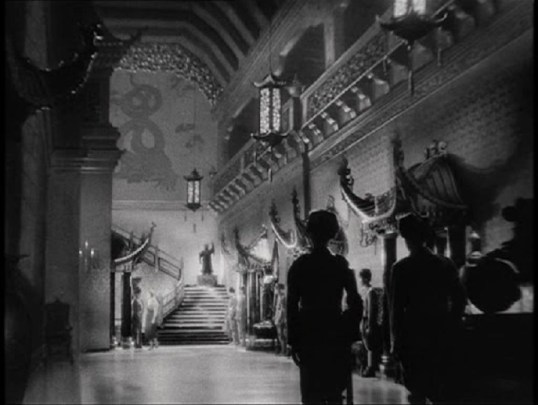
The Bitter Tea of General Yen (1932, dir by Frank Capra, DP: Joseph Walker)
It Happened One Night (1934, dir by Frank Capra, DP: Joseph Walker)
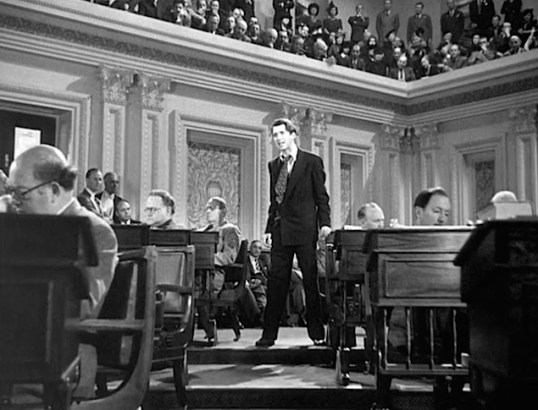
Mr. Smith Goes To Washington (1939, dir by Frank Capra, DP: Joseph Walker)
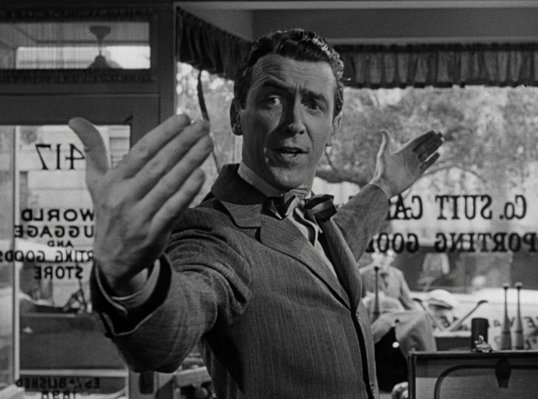
It’s A Wonderful Life (1946, dir by Frank Capra, DP: Joseph Walker and Joseph Biroc)
State of the Union (1948, dir by Frank Capra, DP: George J. Folsey))
So, when you read that I was going to be reviewing 94 political films here at the Shattered Lens, you probably knew that one of them would have to be the 1939 best picture nominee, Mr. Smith Goes To Washington.
So, we all know that story right? The senator from an unnamed state dies. The weak-willed Governor (Guy Kibbee) has to appoint a new senator. Political boss Jim Taylor (Edward Arnold) demands that the governor appoint one of his cronies. The state’s reformers demand that the Governor appoint a never-seen crusader named Henry Hill (who, whenever I hear his name, makes me think of Ray Liotta snorting cocaine in Goodfellas). The Governor’s children demand that he appoint Jefferson Smith (James Stewart, of course!), who is the head of something called the Boy Rangers. The Governor flips a coin. The coin lands on its edge but it also lands next to a newspaper story about Jeff Smith.
So, of course, Mr. Smith goes to Washington.
Now, as the movie quickly makes clear, Jeff Smith is immediately out-of-place in Washington. For one thing, he’s actually excited to be there. He’s convinced that he’s there to make America a better place. When a bunch of drunken reporters (led by the great Thomas Mitchell) make Smith look foolish, Smith responds by running around Washington and punching them out. (That whole sequence probably serves as wish fulfilment for a lot of politicians.) When his cynical legislative aide Saunders (Jean Arthur) tells him that he’s too naive to survive in Washington, he wins her over with the purity of his idealism. When his mentor, Senator Paine (Claude Rains), is revealed to be a part of Washington’s corrupt culture, Smith is stunned. When Taylor tries to destroy his political career, Smith responds by giving the filibuster to end all filibusters. He’s one man standing up against a culture of corruption and…
And there’s a reason why, 76 years later, aspiring political candidates still attempt to portray themselves as being a real-life, modern Jefferson Smith.
This is one of those films that everyone seems to agree is great and, of course, there’s many reasons to love Mr. Smith Goes To Washington. There’s the lead performance of Jimmy Stewart, of course. While this may not be his best performance (I prefer the more layered characterization that he brought to It’s A Wonderful Life and Anatomy of a Murder), it is Stewart at his most likable and, most importantly, he makes you feel Jeff Smith’s pain as he discovers that Washington is not the great place that he originally assumed it to be. Claude Rains was always great when it came to playing good men gone wrong and he’s perfect as Sen. Paine. Thomas Mitchell and Jean Arthur are perfectly cast and I always enjoy seeing the bemused smile on the face of Vice President Harry Carey as Smith conducts his filibuster.
But I think the best thing about Mr. Smith Goes To Washington is that it actually makes you believe that there are Jeff Smiths out there who actually could make a difference. And, until Judd Apatow gets around to remaking the film with Adam Sandler, audiences will continue to believe.
Though some might find it hard to believe, I usually try to keep my personal politics separate from my film reviews.
If there’s anything that truly bothers me about critics like Roger Ebert and his kind, it’s that they often seem to be more concerned with promoting their own personal political views than with actually reviewing the film that they’ve just seen. That’s why you find Ebert throwing a fit over a merely mediocre film like Atlas Shrugged while, at the same time, going out of his way to praise the ludicrous remake of Straw Dogs. That’s also why you find a website like Awards Daily devoting a month to posts attacking a “documentary” like 2016 while, at the same time, praising the latest piece of propaganda from Michael Moore (often times before either one of the documentaries has even been viewed).
I won’t claim to be totally unbiased in my reviews. I’ve always been open about the fact that 1) I’m a civil libertarian and 2) I view all politicians (including both our President and the majority of the people who ran against him in 2012) with a certain amount of disdain. That said, for the most part, I try to set aside my own political beliefs when it comes to talking about the movies. When I find that I can’t set those beliefs aside, I make it a point to be honest about my bias.
For instance, today’s scene that I love is a great scene from a great film. But I’d be lying if I said that this selection had nothing to do with Rand Paul’s 13-hour filibuster about why the President (and, by that, I mean any President) does not have the right to blow up American citizens on American soil. While I would hope that everyone understands that my opinion does not necessarily reflect that opinion of any other contributor to the TSL, I’m still not ashamed to admit that both me and my sister, the one and only Dazzling Erin, found the time to watch at least a few minutes of C-Span 2 yesterday and cheer Rand Paul on.
During Paul’s filibuster, a lot of people on twitter made the comparison between his filibuster and Jimmy Stewart’s filibuster in the classic 1939 film, Mr. Smith Goes To Washington.
However, the genius of Frank Capra’s classic look at one idealist trying to survive in a cynical world is that you can enjoy the filibuster scene regardless of whether you’re a Republican, Democrat, or Independent. Whether you think that the comparison between Sen. Paul and Sen. Smith is fair or not, you can still appreciate the scene as an iconic moment in American cinema and as a reflection of the idealism that far too few of our current leaders seem to possess.
Without further ado, here’s the filibuster scene from Mr. Smith Goes To Washington…
Incidentally, just for the sake of humor, I also wanted to include the filibuster scene from Mr. Smith’s unnecessary 1977 remake, Billy Jack Goes To Washington. Unfortunately, the Billy Jack version has not been uploaded to YouTube. So, here’s the trailer for Billy Jack Goes To Washington.
(Billy Jack Goes To Washington, incidentally, proves just how important Jimmy Stewart was to the success of Mr. Smith Goes To Washington. The Billy Jack version is an almost shot-for-shot remake but, without Stewart’s likable sincerity, the story comes across as being so heavy-handed and preachy that you actually find yourself rooting for the members of the corrupt political establishment.)




 Through the Shattered Lens