What Lisa Watched Last Night #229: Sleepwalking In Suburbia (dir by Alex Wright)


Last night, I watched the classic 2017 Lifetime film, Sleepwalking In Suburbia.

Why Was I Watching It?

I was watching it as a part of the #MondayMania watch party!  We’ve been watching the Stalked By My Doctor films and Sleepwalking In Suburbia, along with being a stand-alone film, leads into the fourth Stalked By Doctor film.  While I watched, I realized that I hadn’t reviewed this film yet so I decided to get on it.

What Was It About?

Michelle Miller (Emillie Ullerup) has a nice house in the suburbs and a successful husband (Giles Panton) but she also has a sleepwalking problem.  At night, she’ll get out of bed, leave the house, and, while in trance, go inside someone else’s house and either have sex in the living room or join them in bed.  She’s been diagnosed with “sexsomia.”

One sleepwalking incident leads to her having sex with her neighbor, Luke (Carlo Marks).  Now, every time that Luke sees Michelle, he’s like, “When are you coming by again?” and Michelle is like, “What are you even talking about, weirdo?”

Michelle’s pregnant!  Her husband is all excited but is he the father or is it Luke?  And when Luke’s wife seemingly vanishes, Michelle suspects that there might be murder in suburbia as well!

What Worked?

What worked?  The entire movie, that’s what worked!  Seriously, this was one of the greatest Lifetime films ever made.  It embraced the melodrama.  The plot featured twist after implausible twist.  The performances were enjoyably over-the-top and I defy anyone not to smile when the kindly doctor announces that Michelle has “sexsomia.”

Here’s the thing: sexsomia is a real thing.  Now, if you look it up on Wikipedia, it redirects to “sleep sex” but this is a Lifetime film and it’s obvious that it was understood that “sexsomia” just sounds better than “sleep sex.”  Was this film a realistic portrayal of sexsomia?  Who knows and who cares?

The title was absolutely brilliant.  Anytime you see the word “suburbia” in the title of a Lifetime movie, you know you’re about to see something special.  And I have to say that the film made the suburbs look very nice.  All the houses were big and well-decorated. No one in the Lifetime universe lives in a small house (unless they’re living in a trailer parker, which does happen on occasion.)  That’s the way things should be.

Emillie Ullerup gave a great performance as Michelle.  Her intense sleepwalking stare was one of the thing that made this film so entertaining.  Giles Panton and Carlo Marks also gave good performance as two of the men in her life in her waking and sleeping life.  The scene where Panton, as Michlle’s husband, reveals that he wants to handcuff Michelle in bed so that she won’t leave is both horrifying and slightly funny.  “Not kinky!” her husband assures her.

Finally, the film ended with one of those out-there twists that Lifetime is known for.  Seriously, when you’re in a Lifetime film, trust no one!  The film’s ending was also open-ended enough that it allowed Michelle to return for Stalked By My Doctor: A Sleepwalker’s Nightmare.

What Did Not Work?

It all worked!  This is a film that relentlessly and unapologetically embraced the melodrama in the best Lifetime tradition!  When I talk about the best Lifetime films being self-aware without being too in-your-face about it, this is the type of film that I’m talking about.

“Oh my God!  Just like me!” Moments

Wandering around in your night clothes in the middle of the night?  Hey, I’ve been there!  Of course, in my case, I was actually awake and I was checking on a cat.  I have never broken into a house while just wearing a slip.  I usually at least put on a robe before doing something like that.

Lessons Learned

Lock the door before you go to sleep.  And the windows!

October Positivity: Leap (dir by Chris Tempel)


Parkour!

Parkour was quite a thing for a while, though I’m not sure if it’s as big a deal now as it used to be.  Back in the day, YouTube was full of videos of people jumping off of roofs, skipping up walls, jumping over tables, and rolling around in the dirt.  The main thing I remember about parkour was that, whenever anyone jumped over a bench, everyone watching had to go, “Whoa!  HE JUMPED OVER A BENCH!”  I also remember that the Divergent films were an attempt to present parkour as the key to surviving a dystopian future.

2010’s Leap opens with a college student spotting a guy named Shane (Alexander J. Bonda) leaping over a railing on campus.  When Shane is asked what he’s doing, Shane replies, “Parkour.  It’s from France.”

Now, really, that should have been a red flag right there.  It’s from FRANCE!  You know, the same France that surrendered to the Nazis and then spent years whitewashing the activities of the Vichy government?  French is a beautiful language and the country has given us some of the greatest films ever made.  Actually, to be honest, I love visiting France but still, when it comes to self-defense, they’re perhaps not the the best role model.

Soon, Shane is teaching a group of college students how to do parkour.  There’s a lot of parkour in this movie and, for the most part, it’s scored to some of the mellowest heavy metal out there.  When Shane’s students invite him to Bible Study, it upsets Shane’s girlfriend, Crystal (Chelsea Raugast).  When Shane and his students decide to build a Christian outreach program around parkour, they start getting threatening letters.  “Who could be threatening us?” one of the student asks.  “Atheists,” comes the reply.  Soon, Crystal is chasing Shane across campus and the two of them get to show off their parkour skills.

I really do have to mention the chase scene because it goes on for several minutes and it really doesn’t make much sense.  (Crystal, who is apparently looking to kill Shane, drops her gun just so she can chase him.)  What’s funny about it is that, even while running for his life, Shane still has to show off his parkour skills.  For instance, when he sees a picnic table in front of him, he doesn’t simply run around it.  Instead, he jumps on top of it and then rolls off.  It reminded me a bit of the classic 80s action film Gymkata, in which a city in Eastern Europe was full of random pommel horses so that the gymnast hero could show off his moves while fighting the bad guys.

Leap was made for $200 and the cast was largely made up of volunteers.   I have a weakness for low budget passion projects and I was willing to cut this film a bit of slack but then I reached the Bible Study scene where a youth minister explained that HIV was God’s way of punishing the nonbelievers for failing to follow him and that was such an icky statement that I can’t overlook it.  The film ends with the end times approaching and the promise of a sequel.  Can parkour defeat the Beast?  We’ll find out, I guess.

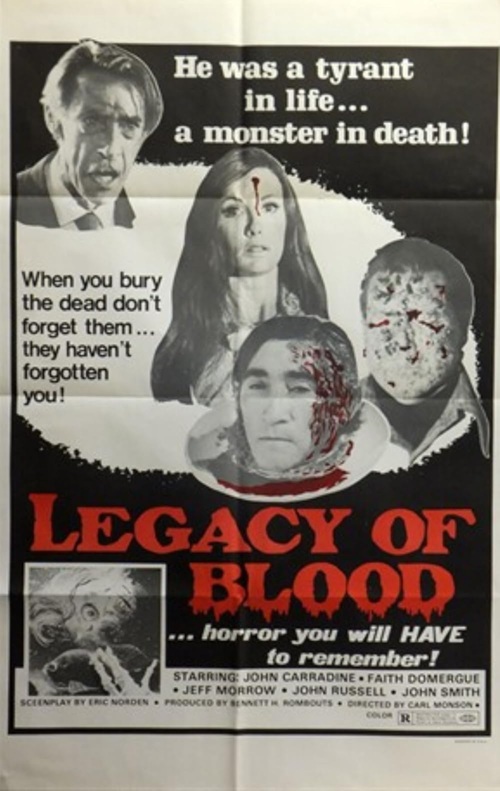
October Hacks: Blood Legacy (dir by Carl Monson)


a.k.a. Blood Legacy

In this 1971 film, John Carradine briefly plays Christopher Dean, a wealthy man who hated his family and his servants.  He dies before the film actually begins but we do get to see him in flashbacks and we also hear his voice at the reading of his will.  Dean leaves a fortune to his children and his servants, but he does so only on the condition that they spend a week at Dean’s estate.  If anyone dies or leaves the estate, they will lose their inheritance and the money will be split amongst those who stayed and/or survived.  You can see where this is leading, right?

This is actually a promising premise and it’s easy to imagine how it could have inspired an American version of Mario Bava’s Bay of Blood, where one person is killed by another just for that killer to then be killed by someone else until eventually, there’s no one left.  Unfortunately, while the characters are all unpleasant and greedy, none of them are as memorable as anyone in Bava’s classic shocker.  They’re all generic jerks and, as such, it’s hard to have much of a reaction when they start dying.  The film does feature several familiar B-movie stars.  Jeff Morrow and Faith Domergue (both of whom were in This Island Earth) appear as brother and sister.  Richard Davalos (who played James Dean’s brother in East of Eden) has an eccentric role.  Western character actor Rodolfo Acosta plays the sheriff who eventually takes an axe to the forehead.  B-movie veteran Buck Kartalian plays Igor, the butler.  (His name is actually Igor!)  Some of the members of the cast were good actors but few of them are particularly good in this film.  I did appreciate the weird energy of Buck Kartalian.  John Carradine doesn’t do much but he does deliver his lines with the proper amount of contempt.

The film does have a few vaguely interesting kills.  Bees are used as a weapon at one point.  A head is found in a refrigerator and Richard Davlos says, “This is just like a horror movie.”  Wow, Richard, thanks for sharing!  There’s a big twist ending but it really not that impressive of a twist.

Probably the most interesting thing about Blood Legacy is that it’s essentially a remake of Andy Milligan’s The Ghastly Ones. (Director Carl Monson had a habit of ripping off other films.  In 1973, he remade Roger Corman’s Little Shop of Horrors.  Monson called his remake Please Don’t Eat My Mother.  The film starred Buck Kartalian.)  Blood Legacy was originally released under the title Legacy of Blood but Milligan was so annoyed at being ripped-off that he later made his own remake of The Ghastly Ones and decided to give it the same title as Carl Monson’s rip-off.  Monson changed his film’s title and distributed it under the names Will To Die and Blood Legacy so that it wouldn’t be confused with Andy Milligan’s Legacy of Blood.  It makes sense.  Why would anyone want their Andy Milligan rip-off to be confused with an actual Andy Milligan film?

The TSL Horror Grindhouse: Mary, Mary, Bloody Mary (dir by Juan López Moctezuma)


In 1975’s Mary, Mary, Bloody Mary, Cristina Ferrare plays Mary, an American painter who lives and works in Mexico.

Mary seems to be living her ideal life.  She paints.  She travels.  Her work is popular.  She has glamorous and wealthy friends.  She has her independence.  Even when she starts a relationship with a young American diplomat named Ben (David Young), he seems like a genuinely nice guy who respects her need to have a space of her own.

However, Mary has a secret.

Mary is a vampire.  She doesn’t have fangs, she doesn’t sleep in a coffin, and she can go out in the daylight.  But she has an obsessive need to drink blood.  Whenever she can get away from Ben, she’ll pull out a knife and slit the nearest throat.  On the beach, a pushy, middle-aged man falls victim to her.  Back in the city, she kills her former lover (Helena Rojo), who is not happy that Mary is now dating a man.  Mary does her best to hide her murderous inclinations from Ben, even as she finds herself tempted to taste his blood.

However, someone else has recently arrived in Mexico and he appears to be looking for Mary.  The Man (John Carradine) dresses in black and wears a mask over his face.  The Man also carries a blade and, like Mary, he drinks the blood of his victims.  When Mary reads a newspaper story about a murder that she didn’t commit, she realizes that she’s not the only vampire in Mexico.  At the film progresses, we learn that Mary and the Man share a very close connection and Mary is forced to confront whether or not she can be both in love and a vampire.

One thing that I appreciated about Mary, Mary Bloody Mary is that it didn’t leave much ambiguity as to whether or not Mary was actually a vampire.  At first, it seemed like the movie was going to play the “Is-she-or-isn’t-she” game and maybe suggest that Mary was just mentally disturbed,  But instead, the film makes it clear that Mary is dependent upon drinking the blood of others.  It’s suggested that vampirism is something that was passed down to her, much like how I inherited my red hair from my father’s side of the family.  But, in the end, there’s no doubt that Mary actually is a vampire.  Cristina Ferrare occasionally seems miscast as a ruthless killer but, ultimately, she brings the right amount of sophistication to the role and John Carradine is, as always, a nice addition to the cast.

Unfortunately, the majority of Mary, Mary, Bloody Mary is very slowly paced.  I can appreciate a film that takes it time but the first 45 minutes of Mary, Mary, Bloody Mary really does sometimes feel like an endurance test.  Once The Man shows up, the film’s pace starts to pick up and Mary is very quickly forced to confront the truth of her cursed existence.  At times, I got the feeling that the director was trying too hard to convince me that there was more to Mary, Mary, Bloody Mary than there actually was.  The film is littered with scenes that suggest the story was meant to be a statement on the human condition but …. nah.  Ultimately, it’s just a film about a woman who drinks blood.

Horror Scenes That I Love: “They’re dead …. they’re all messed up” From Night of the Living Dead


I’ve always loved the interview with the chief of police in the original Night of the Living Dead.  I love the delivery of that classic line.  “….they’re all messed up.”  Yes, they are.  The chief doesn’t seem to be particularly perturbed by the fact that the dead are coming back to life.  Instead, his attitude is very straight-forward.  To quote Tommy Lee Jones in Rolling Thunder, “Let’s go clean ’em up.”

When we first see this interview, it’s easy to laugh at the sight of the chief’s posse and everyone’s odd confidence that the dead will somehow just go away.  (Death, after all, is the one thing that is guaranteed to happen to everyone eventually.)  Once you know how the story’s going to end, though, this scene becomes much more ominous.

Horror Film Review: Evils of the Night (dir by Mardi Rustam)


How dumb can one movie be without becoming unwatchable?

1985’s Evils of the Night is here to answer that question!

Three space alien vampires (John Carradine, Julie Newmar, and Tina Louise) have led an expedition to Earth.  They’ve taken over a hospital and they’re stealing the blood of their patients so that it can be sent back to their dying planet.  They especially want young blood, which is why they specifically came to a college town.  Unfortunately, their intelligence was faulty and they arrived during the summer, when the campus was closed.  (I guess this is one of those rare colleges that don’t offer a summer term.)  There’s actually a very lengthy scene in which Carradine explains the faulty intelligence to Newmar and Louise and then Newmar complains about how the alien intelligence service just isn’t that good.  What makes this scene so special is that Carradine delivers his lines with a straight face and Newmar actually seems to be sincerely annoyed.  Aliens — they’re just like us!

Just because college is out of session, that doesn’t mean that there aren’t any young people hanging out down at the lake.  There’s actually quite a few, though all of them look to be a little bit too old for high school or college or whatever they’re supposed to be attending.  Several of them are played by veterans of the adult film industry, including Amber Lynn and Jerry Butler.  Everyone wants to get laid down at the lake, which is probably the most realistic thing about Evils of the Night.  However, John Carradine needs their blood so he has Julie Newmar hire two slovenly mechanics, Kurt (Neville Brand) and Fred (Aldo Ray), and sends them out to kidnap any young people that they find.  Kurt and Fred are very good at their job.  Newman pays them and mocks them for caring so much about coins.  Little do the mechanics realize that the aliens are planning on shooting them with their space laser as soon as they leave the planet.

Evils of the Night is a good example of a bad movie that is oddly watchable just because the viewer finds themselves curious as to just how stupid things can get.  The answer here is very stupid and very nonsensical  It never seems to occur to anyone just go to a different lake or maybe just do their skinny dipping in a pool somewhere.  The plot has a “make it up as you along” feel to it and that, at the very least, keeps things vaguely interesting.  The actors playing the “teen” victims are enthusiastic without being particularly good while most of the veterans in the cast are all obviously just there for the paycheck.

That said, John Carradine.  Wow.  What a career.  A trained Shakespearean actor who made his stage debut in 1925 and went on to appear in a countless number of movie, Carradine was a favorite of both John Ford and Fred Olen Ray.  Carradine appeared in hundreds of a theatrical films.  In fact, his final film was released seven years after Carradine’s death.  Carradine was one of the great actors, with that deep voice and that commanding stare.  But he was also one of those actors who was apparently willing to appear in just about anything and that’s one reason why he’s still such a beloved icon.  Playing an outer space vampire-turned-doctor was definitely not the strangest role that Carradine ever played.  Carradine handles his scenes like a pro!

Evils of the Night is dumb but I dare you to look away.

October True Crime: The Onion Field (dir by Harold Becker)


This 1979 true crime drama opens in Los Angeles in 1963.

Rookie Detective Karl Hettinger (John Savage) has just joined the Felony Squad and met his new partner, Ian Campbell (Ted Danson, making his film debut).  Ian is a tall, somewhat eccentric detective, the type who practices playing the bagpipes in the basement and who takes Hettinger under his wing.

Meanwhile, Jimmy Smith (Franklyn Seales) has just been released from prison.  The nervous and easily-led Jimmy almost immediately runs into Gregory Powell (James Woods), a small-time hood with delusions of grandeur.  Powell is the type who talks a big game but who really isn’t even that good of a thief.  Smith and Powell form an uneasy criminal partnership.  They are easily annoyed with each other but they also share an instant bond.  Though the film doesn’t actually come out and say what most viewers will be thinking, there’s a lot of subtext to a brief scene where Powell appears to caress Smith’s shoulder.

One night, Hettinger and Campbell are kidnapped by Smith and Powell.  Smith and Powell drive them out to an onion field.  Because he’s misinterpreted the Federal Kidnapping Act and incorrectly believes that he and Smith are already eligible for the death penalty because they kidnapped two police officers, Powell shoots and kills Campbell.  (The close-up image of Campbell falling dead is a disturbing one, not the least because he’s played by the instantly likable Ted Danson.)  Hettinger runs and manages to escape.  He saves his life but he’s now haunted by the feeling that he abandoned his partner.

The rest of the film deals with the years that follow that one terrible moment in the onion field.  Treated as a pariah by his fellow cops, Hettinger sinks into alcoholism and eventually becomes a compulsive shoplifter.  Smith and Powell, meanwhile, use a variety of tricks to continually escape the death penalty and to keep their case moving through the California justice system.  Powell, for instance, defends himself and then later complains that he had incompetent counsel.  Smith, meanwhile, is defended by the infamous Irving Karanek, a legendary California attorney who specialized in filing nuisances motions.  (Later Karanek found a measure of fame as Charles Manson’s attorney.  Eventually, he had a nervous breakdown in 1989, lived in his car, and was briefly suspended by practicing law.)  While Smith and especially Powell quickly adjust to being imprisoned, Hettinger spends the next decade trapped in a mental prison of guilty and bitterness.

Based on a non-fiction book by Joseph Wambaugh, The Onion Field is a compelling look at a true crime case that continue to resonate today.  The film can be a bit heavy-handed in its comparisons between the two partnerships that define the story.  Both Hettinger and Smith are young and neurotic men who find themselves working with a more confident mentor.  The difference is that Hettinger’s mentor is the cool, composed, and compassionate Ian Campbell while Smith’s sad fate is to be forever linked to the erratic Gregory Powell.  While the film may have the flat look of something that was made for television, it’s elevated by the performances of its lead actors.  James Woods give an especially strong performance as the cocky Powell, a loser in the streets who becomes a winner behind bars.  Over the course of the film, he goes from being a joke to being the prisoner that others come to for legal advice.  John Savage, meanwhile, poignantly captures Hettinger’s descent as the trauma from that night leaves him as shell of the man that he once was.

The film’s supporting cast is full of familiar faces.  Christopher Lloyd and William Sanderson show up as prisoners.  Ronny Cox plays the detective in charge of the onion field investigation.  David Huffman plays a district attorney who is pushed to his breaking point by the obstructive tactics of Smith’s attorney.  Priscilla Pointer play Ian Campbell’s haunted mother.  All of them do their part to bring this sad story to life.

The Onion Field is a chillingly effective true crime drama and a look at a murder that was inspired by one man’s inability to understand federal law.

Horror Song of The Day: Cat People (Putting Out Fire) by Giorgio Moroder and David Bowie


Today’s horror song comes the hypnotic soundtrack of Paul Schrader’s Cat People.  This song was so good that it later showed up and was used to equally strong effect in Quentin Tarantino’s Inglourious Basterds.

4 Shots From Horror History: 1930s Part One


This October, I’m going to be doing something a little bit different with my contribution to 4 Shots From 4 Films.  I’m going to be taking a little chronological tour of the history of horror cinema, moving from decade to decade.

Today, we take a look at the start of the 1930s.

4 Shots From 4 Films

Dracula (1931, dir by Tod Browning)

Dracula (1931, dir by Tod Browning)

Frankenstein (1931, dir by James Whale)

Frankenstein (1931, dir by James Whale)

Vampyr (1932, dir Carl Theodor Dryer)

Vampyr (1932, dir Carl Theodor Dryer)

White Zombie (1932, dir by Victor Halperin)

White Zombie (1932, dir by Victor Halperin)

Join #MondayMania For Sleepwalking In Suburbia!


Hi, everyone!  Tonight, on twitter, I will be hosting one of my favorite films for #MondayMania!  Join us for Sleepwalking in Suburbia!

You can find the movie on Tubi and then you can join us on twitter at 9 pm central time!  (That’s 10 pm for you folks on the East Coast.)  See you then!