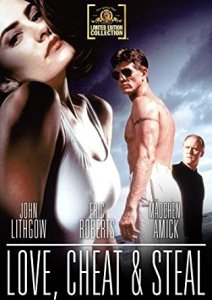
A Movie A Day #92: Love, Cheat, & Steal (1993, directed by William Curran)


Paul Harrington (John Lithgow) is a wealthy banking consultant who has just married a sexy, younger woman, Lauren (Madchen Amick).  Paul thinks that Lauren is perfect but then her brother, Donald (Eric Roberts), shows up.  What Paul does not know is that Donald is not actually Lauren’s brother.  Instead, Donald is Reno, Lauren’s first husband who she never actually divorced. Reno has just escaped from prison where he was serving time for a crime for which he believes Lauren framed him.  While Paul tries to save his father’s failing bank, Reno starts to plan a bank robbery and Lauren tries to balance her old life with Reno with her new life with Paul.

Mild neo noirs like Love, Cheat, & Steal were a dime a dozen in the 1990s.  Love, Cheat, & Steal was made for Showtime and, throughout the 1990s, it used to tempt kids like me with its promise of “Brief Nudity” and “Adult Situations.”  The only thing that makes it memorable is the presence of Madchen Amick, who was always the most beautiful of all of the Twin Peaks starlets, even if she often was overshadowed by Sherilyn Fenn and Lara Flynn Boyle.  Madchen Amick has the right combination of girl next door innocence and enigmatic sultriness to make her perfect for movies like Love, Cheat, & Steal.  Other than the presence of Madchen Amick, Love, Cheat, & Steal is best remembered for being your only chance to see Eric Roberts do a Jack Nicholson imitation.

One final note: Irish actor Dan O’Herlihy has a small role.  Though he is best known for playing Conal Cochran in Halloween 3, he also co-starred with Amick during the second season of Twin Peaks.
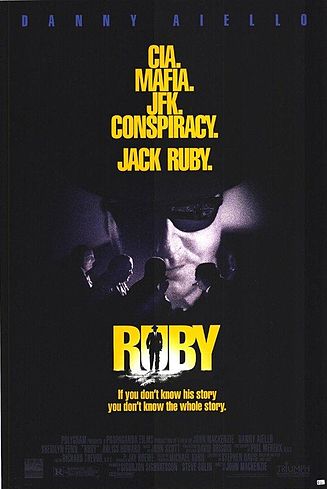
A Movie A Day #91: Ruby (1992, directed by John Mackenzie)


Of all the stars to come out of Twin Peaks, Sherilyn Fenn’s star briefly shined the brightest and sadly, she was the most misused by Hollywood.  While it is true that Fenn has worked regularly since Twin Peaks went off the air, she has rarely gotten the great roles that someone with her talent deserves.  Instead, her performances have far too often been the best thing about an otherwise mediocre film.
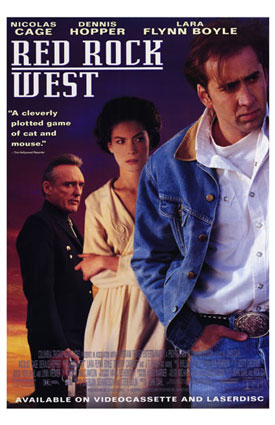
For example, Ruby.

In this very speculative biopic about the strip club owner who killed Lee Harvey Oswald and whose organized crime background has put him at the center of a thousand conspiracy theories, Danny Aiello plays Jack Ruby and Sherilyn Fenn plays his only friend, Sheryl Ann Dujean (or, when she’s stripping in the Carousel Club, Candy Cane).  The film portrays Jack Ruby as being a low-level mobster who is never as valuable or as important to his superiors as he thinks he is.  In this movie, Ruby is always on the outside looking in on the conspiracy and, when he kills Oswald, it is because he wants to prove that he is more than just a small time hood.  Candy, who was a composite of several Carousel Club dancers, maintains a strong platonic friendship with Jack and is always there for him to talk to, except for when she goes to Vegas to perform for and sleep with the President.

Ruby came out as the same time as JFK and it often seems like a fanfic based on Stone’s film.  Low budget and overwritten, Ruby never works as a movie but Danny Aiello is perfectly cast as the bombastic but insecure Jack Ruby.  Unfortunately, Ruby‘s screenplay often does not seem to know what it wants to say about its main character.  As Candy, Fenn is not given nearly enough to do but she still manages to show the same natural spark that made her a star on Twin Peaks.

Sherilyn Fenn is not the only Twin Peaks cast member to have a role in Ruby.  Keep an eye out for a post-Twin Peaks, pre-X-Files David Duchovny, playing the role of J.D. Tippit.

A Movie A Day #90: Red Rock West (1992, directed by John Dahl)


The place is Red Rock, a little town located in the middle of nowhere Wyoming.  When a man from Texas (played by Nicolas Cage) wanders into his bar, the owner, Wayne (J.T. Walsh), assumes that the man is Lyle From Dallas, the semi-legendary hit man who Wayne has hired to kill his wife, Suzanne (Lara Flynn Boyle).  Wayne gives the man half of his payment in advance and promises the other half after Suzanne is dead.  What Wayne doesn’t realize is that Lyle From Dallas is not actually Lyle From Dallas.  Instead, he is a drifter named Michael who has just recently lost his job.  Michael takes Wayne’s money but, when he sees Suzanne, he tells her that Wayne wants her dead.  Suzanne responds by offering to pay Michael to kill Wayne.  Michael mostly just wants to leave town but his every effort is thwarted, with him continually only managing to get a mile or two out of town just to then find circumstances forcing him to once again pass the Red Rock welcome sign.  Meanwhile, the real Lyle From Dallas (Dennis Hopper) has shown up and he is pissed.
Red Rock West is a clever and energetic neo noir that plays out like the child of a marriage between the Coen Brothers and David Lynch.  Like the Coens’ Blood SimpleRed Rock West is a violent movie that is full of twist and turns and features characters who are often confused and rarely understand what is actually going on.  From David Lynch, it borrows both Twin Peaks‘s Lara Flynn Boyle and Blue Velvet‘s Dennis Hopper.  Red Rock West was made when Nicolas Cage still gave a damn and it also shows why, during his short career, J.T. Walsh was everyone’s favorite duplicitous character actor.  Hopper is his usual crazy self and Boyle is a sultry and sexy fatale.  Red Rock West is one of the best neo noirs of the 1990s.

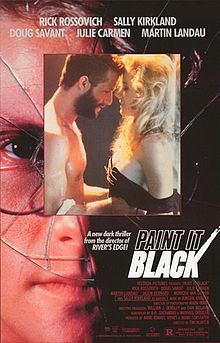
A Movie A Day #89: Paint It Black (1989, directed by Tim Hunter)


This month, since the site is currently reviewing every episode of Twin Peaks, each entry in Move A Day is going to have a Twin Peaks connection.  Paint In Black was directed by Tim Hunter, who directed three episodes of Twin Peaks, including the one that I reviewed earlier today.

Jonathan Dunbar (Rick Rossovich) should have it all.  He is an acclaimed sculptor but he’s being cheated financially by his dealer and sometimes girlfriend, Marion Easton (Sally Kirkland).  Things start to look up for Jonathan after he has a minor traffic accident with Gina (Julie Carmen).  Not only are he and Gina immediately attracted to each other but it turns out that Gina is the daughter of Daniel Lambert (Martin Landau), who owns the most prestigious art gallery in Santa Barbara.  It appears that Jonathan is finally going to get the big show that he has always dreamed of, but only if he can escape from Marion’s management.

One night, Jonathan helps out a man who was apparently mugged outside of an art gallery.  The man, Eric (Doug Savant), says that he’s an art collector and that he is a big fan of Jonathan’s work.  When Jonathan opens up about his problems with Marion, Eric decides to return Jonathan’s favor by killing Marion and anyone else who he feels is standing in the way of Jonathan’s success.  Because of the way that Eric artistically stages the murders, the police suspect that Jonathan is the murderer.

Depending on the source, Paint It Black’s original director was either fired or walked off the project and Tim Hunter was brought in to hastily take his place.  According to Hunter, he spent the production “shooting all day and rewriting all night.”  Paint it Black is a standard late 80s, direct to video thriller but it is interesting as a tribute to Alfred Hitchcock.  Hunter taught a class on Hitchcock at the University of California at Santa Cruz and Paint it Black is full of shout outs to the master of suspense.  Marion’s murder is staged similarly to a murder in Frenzy.  There are frequent close-ups of scissors, a reference to Dial M For Murder.  Probably the most obvious homage is the character of Eric, who appears to be based on Robert Walker, Jr’s character from Strangers on a Train.

Rick Rossovich was best known for playing cops, firemen, and soldiers in movies like Top Gun, Navy SEALS, and Roxanne.  He’s not bad in Paint it Black but he is still not the most convincing artistic genius.  Doug Savant and Sally Kirkland were better cast and more enjoyable to watch.  In fact, Kirkland is killed off too early.  The movie loses a lot of its spark once she is gone.

Paint It Black may not live up to being named after one of the best songs that the Rolling Stones ever recorded but Tim Hunter took unpromising material and shaped it into something that is far more watchable than anyone might expect.


A Movie A Day #88: Where The Day Takes You (1992, directed by Marc Rocco)


This month, since the site is currently reviewing every episode of Twin Peaks, each entry in Move A Day is going to have a Twin Peaks connection.  Where The Day Takes You is a movie that has not just one but two connections to Twin Peaks.

Where The Day Takes You is an episodic film about young runaways living on the streets of Los Angeles.  Led by 22 year-old King (Dermot Mulroney), who ran away from home when he was 16, the runaways form a surrogate family.  While being constantly harassed by both the police and well-meaning social workers, some of the runaways get addicted to drugs while others turn to prostitution in order to survive.  Some find love.  Some find death.  They all go where the day takes you.  (Not sure if that was the movie’s tag line but it should have been.)

Where The Day Takes You is a gritty and often tough film, though it’s effectiveness is undercut by a predictable ending and the presence of too many familiar faces in the cast.  The runaways are made up of a who’s who of prominent young actors from the 1990s.  Balthazar Getty plays King’s second-in-command.  Sean Astin plays an obviously doomed drug addict.  Alyssa Milano and David Arquette play prostitutes.  Ricki Lake and James Le Gros play comedic relief.  Will Smith, in his film debut, plays a wheelchair-bound runaway.  Christian Slater and Laura San Giacomo show up as social workers while the police are represented by Rachel Ticotin and Adam Baldwin.  Everyone gives a good performance but the film would have worked better with unknown actors or even real runaways.  No matter how good a performance Sean Astin gives as a heroin addict, he is always going to be Sean Astin and it is always going to be difficult to look at him without saying, “I might not be able to carry the ring but I can carry you!”

The movie’s first Twin Peaks connection is that Lara Flynn Boyle, who played innocent Donna Hayward on Twin Peaks, plays innocent runaway Heather in Where The Day Takes You.  The role is cliché but Boyle shows the same charm that she showed while playing Donna.

The movie’s second Twin Peaks connection is more unexpected.  Kyle MacLachlan is effectively cast against type as Ted, the drug dealer who keeps most of the runaways hooked on heroin and who is perfectly willing to leave an overdosed junkie in a garbage bin.  Ted is about as far from Dale Cooper as you can get.

A Movie A Day #87: Free Grass (1969, directed by Bill Brame)


As everyone surely knows, before they appeared as Dr. Lawrence Jacoby and Benjamin Horne on Twin Peaks, Russ Tamblyn and Richard Beymer co-starred in West Side Story.  Tamblyn played Riff, the leader of the Jets.  Beymer played his best friend, Tony, who fell in love with Natalie Wood.  West Side Story is a classic that won several Oscars.  What is not as well known is that, in between West Side Story and Twin Peaks, Beymer and Tamblyn co-starred in one other movie, a hunk of psychedelic cheese called Free Grass.
By the late 60s, both Beymer and Tamblyn had tired of their clean-cut images and, like their characters in Free Grass, had become card-carrying members of the Hollywood counter-culture.  Beymer plays Dean, a motorcycle-riding drop-out from conventional society.  Dean meets and falls in love with buxom, mini-skirted Karen (played by Lana Wood, younger sister of Natalie).  When a riot breaks out on the sunset strip, Dean punches a cop.  With the Man now looking for him, Dean needs some quick cash so that he and Karen can escape to Dayton, Ohio.

(Dayton, Ohio?)

That’s where Russ Tamblyn comes in.  Tamblyn plays Dean’s friend, Link.  Link works for a drug kingpin named Phil (played not very convincingly by Casey Kasem, of all people).  Phil is willing to pay Dean $10,000 if he smuggles several pounds worth of grass across the Mexican border.  Dean agrees but soon finds himself being pursued by two narcotics agents, played by Jody McCrea and Lindsay Crosby (sons of Joel McCrea and Bing Crosby, respectively).  Because Dean is not willing to commit murder, Link plots to kill him.  But first, Link doses Dean with LSD, which leads to the de rigueur psychedelic 60s light show.

Slow-moving and ineptly directed, Free Grass is for fans of the 1960s counterculture only.  Russ Tamblyn provides the movie with what little energy it has but Richard Beymer apppears to be just as uncomfortable here as he was in West Side Story and Casey Kasem shows why he was better known as a DJ than an actor.  Lana Wood does look good in a miniskirt, though.  Otherwise, Free Grass shows why both Tamblyn and Beymer grew so frustrated with Hollywood that they were both in semi-retirement when David Lynch revitalized their careers by casting them on Twin Peaks.

A Movie A Day #86: Don’t Tell Her It’s Me (1990, directed by Malcolm Mowbray)


This month, since the site is currently reviewing each episode of Twin Peaks, every entry in Move A Day is going to have a Twin Peaks connection.  I am going to start things with Don’t Tell Her It’s Me, a movie that I normally would never think of as having anything to do with Twin Peaks or anything else that David Lynch has ever been associated with.
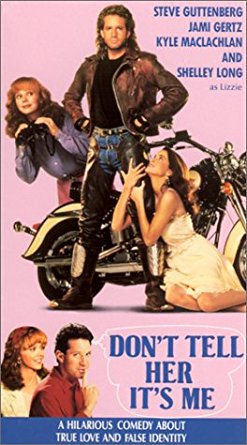
In this very minor romantic comedy, Gus (Steven Guttenberg) is a cartoonist who has just recently beaten cancer.  The treatment has left him bald, overweight, and lonely.  His sister, a popular romance novelist named Lizzie (Shelley Long), sets hm up with her friend, a journalist named Emily (Jami Gertz).  When Emily does not return Gus’s affection, Lizzie decides to transform Gus into every woman’s dream, which in this movie is a rebel named Lobo who comes from New Zealand and rides a motorcycle.  Gus spends a month working out, growing his hair long, and learning how to speak with a New Zealand accent.  Emily falls in love with Lobo, never realizing that he is actually Gus but what will happen when Gus has to finally tell her the truth?  Despite good performances (especially from Shelley Long), Don’t Tell Her It’s Me it too formulaic and predictable to be memorable.  Even if he does have a mullet and is speaking with a different accent, Steve Guttenberg is always going to be Steve Guttenberg and it’s hard to believe that Emily would not be able to see through his act.

Don’t Tell Her It’s Me actually has two Twin Peaks connections.  Kyle MacLachlan, the one and only Dale Cooper himself, plays Trout, who is both Emily’s editor and her cad of a boyfriend.  It’s a nothing role but fans of Twin Peaks will be interested to know that, when Trout is inevitably revealed to be cheating on Emily, the woman that he’s cheating with is played by MacLachlan’s Twin Peaks co-star, Madchen Amick.

If only the Log Lady had been around, Don’t Tell Her It’s Me could have been a much different picture.

A Movie A Day #85: Blue Skies Again (1983, directed by Richard Michaels)


As Lisa said in her review of Night Game, Erin asked for baseball reviews today and there is no way you can turn down Erin.  So, I watched Blue Skies Again on YouTube.

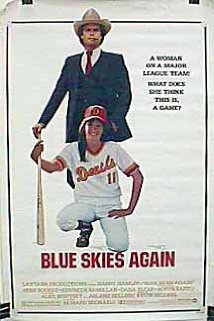
The Denver Devils is a minor league baseball team that is coming off of its worst season ever.  The new owner (Harry Hamlin) is only concerned with making money and does not know anything about baseball.  The veteran coach (Kenneth McMillan) does not have the respect of his players.  Teammates like Ken (Andy Garcia), Calvin (Joseph Gian), and Wall Street (Cylk Cozart) are worried that they could lose their place on the team at any moment.  The only good news is that two sports agents (Mimi Rogers and Dana Elcar) have found the perfect prospect for the Devils.  This player can play second base.  This player can catch a grounder and turn it into a double play.  This player can hit the ball out of the park.  The only problem?  The player’s name is Paula (Robyn Barto) and she’s a girl!

Robyn Barto was asked to audition after a casting director saw her playing softball for her community college.  Blue Skies Again was her first film role.  In the role of a professional baseball player, Barto was a very convincing softball player.  But Barto was likable and had an engaging screen presence so it’s too bad that this movie was not only her first but also her last.  In the publicity leading up to the release of Blue Skies Again, Barto got to throw out the opening pitch at a Dodger game but that was it for her time in the spotlight.  According to one article that I found that was written ten years after the release of Blue Skies Again, Barto never regretted not having a film career and ended up coaching the softball team at her old high school.

Blue Skies Again was not only the debut of Robyn Barto but also the first feature film for both Mimi Rogers and Andy Garcia.  Garcia does not get to do much but Mimi Rogers shows off the sexy and fun screen presence that always makes me wonder why she never really became a big star.

Blue Skies Again is an okay movie but it does not add up to much.  No one wants to play with a girl but then she gets a hit so everyone changes their mind.  It’s the type of movie that, today, would be made for Hallmark or the Family Channel.  It’s a nice baseball movie but it can’t compare to the real thing.


A Movie A Day #84: Made In U.S.A. (1987, directed by Ken Friedman)


Dar (Adrian Pasdar) and Tuck (Chris Penn) are two losers.  Dar is angry.  Tuck is a moron.  They live in a dying Pennsylvania industrial town, where they have no future.  Dar is worried that the air has been poisoned by the nearby coal mine.  He and Tuck decide to go to California so that they can look for a woman whose picture they’ve seen in a magazine.  Since Dar and Tucker have no money and no one is willing to pick up two hitchhikers who look like they are on sabbatical from the Manson Family, they end up having to steal cars and hold up convenience stores.  They also pick up a mentally unstable woman named Annie (Lori Singer).  Annie may be dying because of all the pollution in the world.  Dar and Tuck take the time to transport a Native American runaway back to her reservation, where they both get scalped.  Mostly, Dar and Tuck just drive through some of the ugliest parts of America and talk about how, because of pollution, everything is all messed up.
In the 1990s, Made In U.S.A. used to show up frequently on HBO.  It’s a lousy movie, featuring one of the worst performances of Chris Penn’s career.  (Adrian Pasdar is also pretty bad but more is expected from Chris Penn than from Adrian Pasdar.)  Made in U.S.A. does provide a contrast to the relentlessly pro-American films that dominated the box office in the 1980s but it’s really only noteworthy for the soundtrack, which features songs by Sonic Youth and Timbuk3.

Whatever you do, do not mistake this Made In U.S.A. for Jean-Luc Godard’s.

A Movie A Day #83: Shattered: If Your Kid’s On Drugs (1986, directed by Burr Smidt)


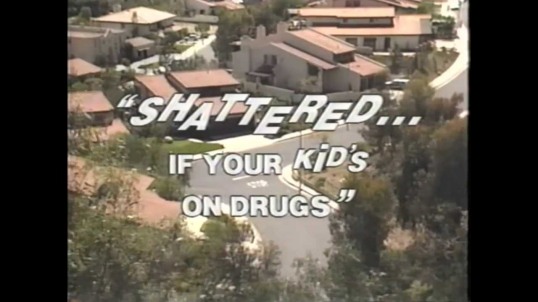
Shattered: If Your Kid’s On Drugs is a typical anti-drug video from the 1980s.  The story is familiar after school special material.  Kim (Megan Follows) and Rick (Rick Segall) are upper middle class kids who live in the suburbs.  Rick is a track star.  Kim is at the top of her class.  That all changes when they start hanging out with the local drug dealer (Dermot Mulroney), who gets Rick hooked on marijuana and Kim hooked on cocaine.  Kim gets an F on her report card.  Rick can no longer jump the hurdles.  Eventually, their parents stop drinking and taking valium long enough to force them into rehab.  The message is that tough love is the only solution.

The only thing that makes Shattered: If Your Kid’s On Drugs noteworthy is the strange and unexpected presence of Burt Reynolds and Judd Nelson, playing themselves and commenting on the action.  The first scene in the video is Burt and Judd driving their pickup truck through the suburbs, talking about how nice it is.  “Lot of nice restaurants,” Burt says.  “Are you going to buy me lunch?” Judd asks.  “Lot of nice restaurants,” Burt replies.  “This town is the American Dream,” Judd says.  “Or the American nightmare,” Burt adds.  When Kim and Rick are getting high in Dermot Mulroney’s chartreuse microbus, Burt and Judd sit on a picket fence and shoot the crap.  Burt can’t understand why teens would use drugs and Judd reminds him that it has been a while since he was a teenager. Rumor has it that both Burt and Judd appeared in this video to fulfill court-ordered community service.

Everything works out in the end.  If you have any doubt, just look at Burt giving us a thumbs up before the final credits roll.