Late Night Retro Television Review: Monsters 3.19 “A Face For Radio”


Welcome to Late Night Retro Television Reviews, a feature where we review some of our favorite and least favorite shows of the past! On Wednesdays, I will be reviewing Monsters, which aired in syndication from 1988 to 1991. The entire series is streaming on YouTube.
This week, it’s terror on the radio!

Episode 3.19 “A Face For Radio”

(Dir by Bruce Feirstein, originally aired on February 3rd, 1991)

Late night radio talk show host Ray Bright (Morton Downey, Jr.) is sleazy guy who describes his own show as being “hate radio.”  Over the course of one program, he tries to humiliate two female guests.  The first is a psychic (Julie Wilson) who says that she’s had visions of Ray trapped in a dark room.  The second is Amada Smith-Jones (Laura Branigan), who claims that she was once abducted by aliens.  She carries with her a cage that she says contains the alien.  Ray takes one look at the ugly and snarling little creature inside the cage and dismisses it as a puppet.  Amanda says that the alien is real and that it eats “bad” people, but only if they give their permission first.  Will Ray be stupid enough to give his permission?

You probably already guessed the answer to that question.  Though predictable in the way that anthology shows often are, this was still an effective episode.  Downey, who I understand was an actual talk show host, was very believable as the incredibly sleazy (and incredibly stupid) Ray and Laura Branigan was just as effective as the enigmatic Amanda.  As for the alien in the cage, it was actually one of the more effective monsters to appear on Monsters.  I had to laugh when Ray dismissed at as being a puppet because, after so many episodes featuring creatures that obviously were puppets, this episode featured a creature that looked very much alive.

The episode ended on a bit of a foul note, largely due to the fact that a new character showed up and started speaking with one of the fakest Texas accents that I’ve ever heard.  Otherwise, though, this was a well-done 21 minutes.
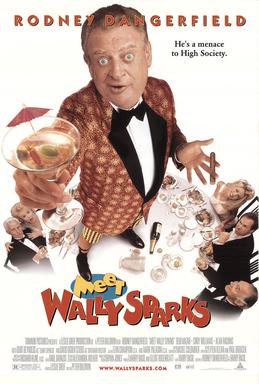
Meet Wally Sparks (1997, directed by Peter Baldwin)


Wally Sparks (Rodney Dangerfield) is a talk show host with a program that is so raunchy that even Jerry Springer says, “At least this isn’t The Wally Sparks Show!”

Despite being a huge hit amongst teens and college students, the show is on the verge of being canceled by the head of the network, Mr. Spencer (Burt Reynolds, wearing a fearsome toupee).  He is tired of Wally’s antics and he tells Wally and his producer, Sandy Gallo (Debi Mazar), that they have a week to make the show respectable.

Wally doesn’t know what to do.  Wally Sparks act respectable?  Wally’s a guy who don’t get no respect, no respect at all.  Then Sandy finds a letter inviting Wally to attend a party at the home of Georgia Governor Floyd Patterson (David Ogden Stiers), a noted critic of the show.  Hoping to get the interview that will save the show, Wally and Sandy head down south.

At the party, Wally acts like Wally and scandalizes all of the politicians and socialites.  He also shares a bottle of whiskey with a horse and then rides the horse through the mansion.  The party is a disaster but, after Wally claims that he can’t walk because of a spinal injury he suffered when he fell off the horse, the Governor allows him to recuperate in the mansion.  Wally causes more chaos while also teaching the Governor’s wife (Cindy Williams) how to play strip poker and eventually exposing a scheme to blackmail the Governor into building  a Confederate-themed amusement park.

Rodney Dangerfield playing a talk show host sounds like a great idea and there are a lot of talented people to be found in Meet Wally Sparks.  Debi Mazar is an actress who should have appeared in a lot more movies and she and Rodney Dangerfield make a good team.  The movie actually gets off to a funny start, with a montage of actual talk show hosts talking about how much they hate Wally Sparks and his show.  Gilbert Gottfried has a cameo as a manic guest and Wally repeats some of Rodney Dangerfield’s classic jokes.

Unfortunately, the movie starts to fall apart as soon as Burt Reynolds threatens to cancel the show for being too lowbrow.  No network executive has ever threatened to cancel a show that’s bringing in the ratings, regardless of how lowbrow it might be.  Things get even worse after Wally goes to Atlanta and ends up staying there.  The movie tries to recreate the Snobs vs. the Slobs dynamic of previous Dangerfield films but the Governor comes across as being such a decent man that there’s no joy to be found in watching his life get turned upside down.  The movie has a surprisingly large number of subplots, including one about Wally’s son (Michael Weatherly) falling for the Governor’s daughter (Lisa Thornhill), but most of them go nowhere and just distract from the man who should have been the film’s main attraction, Rodney Dangerfield.  By the end of the movie, even the usually irrepressible Dangerfield seems to have been neutered.

Rodney Dangerfield was a national treasure but Meet Wally Sparks was not the best showcase for his persona or his style of humor.  Fortunately, Caddyshack and Back To The School are available to watch anytime that we need a good laugh and we want to show Rodney Dangerfield a little respect.

A Movie A Day #116: Evocateur: The Morton Downey, Jr. Show (2012, directed by Seth Kramer, Daniel A. Miller, and Jeremy Newberger)


Long before the rise of trash TV, reality television, Jerry Springer, Maury Povich, Fox News, and MSNBC, there was The Morton Downey, Jr. Show.  Airing at the end of the 1980s, The Morton Downey, Jr. Show featured its host railing against liberals, vegetarians, communists, feminists, libertarians, animal rights activists, teenagers, and pot smokers.  Though the show only lasted for two seasons and ended after a bizarre incident in which Downey faked being the victim of a hate crime, The Morton Downey, Jr. served as a forerunner to the rise of our current toxic political culture.
At least, that is the claim made by Evocateur, a documentary about both the show and the controversial showman who hosted it.  Since I was too young to watch the show when it originally aired, it was interesting, for me, to watch the many clips that were featured in this documentary.  Downey would chain-smoke and shout, while kicking people off his stage.  At one point, Downey literally wrapped himself in an American flag and ordered a guest to kiss his ass.  On another show, Downey provoked then-Libertarian presidential candidate Ron Paul into shouting at him to shut up.  One of the high points of the documentary comes when guest Roy Innis loses his temper and sends Al Shaprton falling to the floor.  The audience would into it, chanting “Mort!  Mort!  Mort!” in the same way that the audience of The Jerry Spring Show chant “Jerry!” whenever a fight breaks out or a guest takes a spin on a the stripper pole.  As way of comparison, a clip of Phil Donahue respectfully interviewing a professional foot model (and promising to let his audience know if maybe they could become a foot model too) is used to illustrate just how different The Morton Downey, Jr. Show was from everything else on the air at the time.  It is a stretch to try to connect (as this film attempts to do) The Morton Downey, Jr. Show to the rise of the Tea Party but it is true that both Donald Trump and Morton Downey, Jr. borrowed a page from the same populist playbook.

Through home video footage and candid interviews, the documentary attempts to show how Morton Downey, Jr. went from being the son of a famous Irish crooner and a friend of Ted Kennedy’s to being the forerunner of trash tv.  There is a lot of speculation about what motivated Downey, some parts of which are more credible than others.  A lot of attention is given to Downey’s relationship with his father and his early attempts to have a musical career of his own. As a singer, Mort was always overshadowed but, as a political provocateur and, later, as an anti-smoking activist, Mort was able to establish an identity of his own.  Along with archival footage and talking head clips, Evocateur uses animation to tell a good deal of the story.  It’s distracting but that currently seems to be the trendy thing to do when it comes to documentaries.

Despite its flaws, Evocateur is an interesting profile of a man whose influence is still being felt even if he has largely been forgotten.


A Movie A Day #47: Body Chemistry II: Voice of a Stranger (1992, directed by Adam Simon)


body-chemistry-ii-the-voice-of-a-stranger-movie-poster-1992-1020211070Dr. Claire Archer is back!

Having gotten away with murder at the end of the first Body Chemistry, Claire (played again by Lisa Pescia) is now working as a radio psychologist, taking the 9 pm to 1 am slot at a station managed by a sleazy chain smoker named Big Chuck (played by real-life sleazy chain smoker Morton Downey, Jr.).  Claire invites her listeners to call with their deepest desires.  “Without pain, you’re not truly alive.”

One night, “John” calls.  When Claire looks at the list of callers and sees, “John likes rough sex,” she immediately put him on the air.  John is actually Dan (Gregory Harrison).  Dan is dating Claire’s call screener, Brenda (Robin Riker), who cannot recognize her own boyfriend’s voice over the telephone.  Dan is a former high school football star who left town and became a cop in Los Angeles.  When his violent impulses became impossible to control, Dan was kicked off the force and he returned home.  Dan wants to suppress his dark side but Claire has other ideas.

Body Chemistry II is a marginal improvement over the first Body Chemistry, because Dan is a more sympathetic victim character than Marc Singer was in the first film and Body Chemistry II puts Lisa Pescia’s vampy performance front and center.  Though both films tell the same basic story, Body Chemistry II is stylistically a very different film.  Body Chemistry II takes it cue from film noir, which means a lot of dark rooms with Venetian blinds.  Dan’s flashbacks and nightmares also add some surreal moments to Body Chemistry II, distinguishing it from the more straight forward first film.

Though there would be two more Body Chemistry sequels, this would be the last time that Lisa Pescia would play Dr. Archer.  Keep an eye out for Clint Howard, Jeremy Piven, and director John Landis, all of whom show up in small roles.

For tomorrow’s movie a day, Shari Shattuck takes over the role of Claire Archer in Body Chemistry III: Point of Seduction.


Horror on TV: Tales From The Crypt 2.16 “Television Terror” (dir by Charlie Picerni)


Tonight’s excursion into televised horror is the 16th episode of the 2nd season of HBO’s Tales From The Crypt!

Television Terror, which originally aired on July 17th, 1990, tells the story of Horton Rivers (Morton Downey, Jr.)  Horton has his own television show, one where he hunts for ghosts and seeks proof of the supernatural.  Needless to say, Horton’s a big fake, a nonbeliever who loathes his audience.  It’s kind of like Ghost Hunters, except for the fact that — over the course of this episode — Horton actually finds something.  Or perhaps we should say that something find Horton…

Needless to say, things do not end well.

Television Terror has a lot of atmosphere and, with its theme of venal television hosts and gullible audiences, it’s probably even more relevant today than when it was first broadcast.

Enjoy!