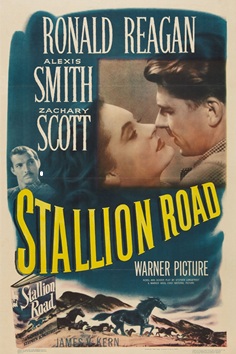
Stallion Road (1947, directed by James V. Kern)


Writer Stephen Purcell comes out to the country to visit an old school friend, veterinarian Larry Hanrahan (Ronald Reagan).  Larry is great at taking care of horses but a little clueless when it comes to women.  Both rancher Rory Teller (Alexis Smith) and Rory’s neighbor, Daisy Otis (Peggy Knudsen), have a thing for Larry but Larry is kept pretty busy taking care of all the horses in the community.  Stephen decides that he likes Rory but, deep down, he knows there’s no way he can compete with Larry.  When Larry gets busy tending to an anthrax outbreak, Rory finds herself tempted to give Stephen a shot.

When Stallion Road originally went into production, Humphrey Bogart was cast as Stephen and Lauren Bacall was cast as Rory.  Both of the stars refused to do the movie, feeling it was too lightweight.  Audiences were cheated out of a chance to see Reagan and Bogart, who were friends despite their differing styles of acting, co-starring opposite each other.  (They were both in Dark Victory but they didn’t share any scenes.)  Speaking of Bogart and Reagan, it’s a Hollywood legend that Reagan was originally offered the role of Rick in Casablanca though I’ve also read that Reagan was actually offered the role of Victor Laszlo.

Bogart and Bacall were right.  Stallion Road is the epitome of lightweight entertainment, with Reagan giving a pleasant but bland performance as Larry and the film never really allowing any doubt as to who Rory belongs with.  It’s the type of movie that would be a Hallmark film today so if you’re actually looking for a realistic drama about ranching and taking care of horses, it’s best to look elsewhere.  This film does show why Reagan was such a successful politician.  Even though his character isn’t exactly exciting, he’s innately likable and, from the minute he first appears, he’s dependable.  He’s someone who any rancher would trust to take care of their horses.
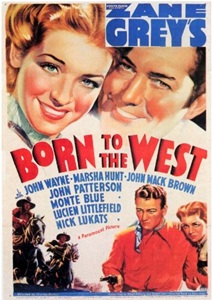
 

Born To The West (1937, directed by Charles Barton)


John Wayne plays Dare Rudd, a friendly rogue who aspires to be the best poker player west of the Mississippi.  When he and his sidekick, Dinkey Hooley (Syd Saylor), ride into Montana, they meet up with Dare’s cousin, Tom Filmore (Johnny Mack Brown, billed as John here).  Filmore needs some help on his cattle drive and Dare sure does like Tom’s girl, Judy (Marsha Hunt).  Dare replaces Lynn Hardy (John Patterson) as head of the cattle drive and Lynn teams up with rustler Bart Hammond (Monte Blue) to try to get revenge.  While Dinkey tries to sell lightning rods, Dare moves the herd and even finds time to play poker with notorious gambler Buck Brady (James Craig).

This is another one of the B-westerns that John Wayne made before John Ford made him a stars by casting him in Stagecoach.  This one is interesting because Wayne is not playing his usual stolid do-gooder or even an expert marksman.  Instead, Dare is impulsive and reckless and he’s ultimately not as smart a card player as he thinks he is.  It’s rare to see John Wayne need help from anyone but that’s what he gets from Johnny Mack Brown, who shows up in time to reveal that Dare is getting cheated in his poker game.  For fans of the genre, this short oater is worth watching for the chance to see two western icons acting opposite each other.  Johnny Mack Brown and John Wayne would both go on to appear in a countless number of westerns.  Wayne became a superstar, appearing in big budget studio films.  Brown remained a mainstay on the B-circuit.  They’re amusing to watch in this film as they bounce dialogue off of each other and continually try to steal scenes from one another.  Brown is playing the type of no-nonsense, hard-working westerner who would later become John Wayne’s trademark character.

Based on a novel by Zane Grey, Born to the West is a fast-paced western featuring two of the best to ever ride a horse.

3 Desperate Men (1951, directed by Sam Newfield)


Tom and Fred Denton (Preston Foster and Jim Davis) are two frontier lawmen who are frustrated with their jobs.  They are both owed backpay.  When they shoot an outlaw, they are expected to pay the $80 burial fee.  Neither Tom nor Fred feels that they are appreciated by banks and the railroads that expect them to risk their lives on a daily basis.

When Tom and Fred are informed that their younger brother, Matt (Kim Spalding), has been convicted of murder and sentenced to hang in another town, they ride off to save him.

Even though Tom and Fred can both provide an alibi for Matt and it is obvious that Matt has been framed by a corrupt railroad agent, the town is still determined to hang him.  Tom and Fred manage to rescue him from the gallows but, in the process, a deputy is killed.  Now wanted by the authorities, the Denton brothers are forced to team up with the same outlaws that they used to hunt.  Soon, the Dentons are robbing banks and trains and their old friend, Pete Coleman (Monte Blue), has been ordered to captured them, dead or alive.

One of the many low budget westerns to be produced by the Lippert Company, Three Desperate Men is a cut above the usual B-western.  None of the Dentons want to be outlaws but they are forced into it by circumstances out of their control.  The real villains of the film are the bankers and the railroad tycoons who hoard the land and the money and who try to cheat men like Tom and Fred out of their rightfully earned wages.  The Denton brothers ultimately decide that their number one loyalty is to each other and that leads to the movie’s fatalistic conclusion, which is surprisingly violent for a 1951 western.  Preston Foster, Jim Davis, and Monte Blue head a cast that is full of tough and authentic western veterans and the action scenes are imaginatively staged by director Sam Newfield.  Three Desperate Men is a B-western that can be enjoyed even by those who don’t like westerns.

Cleaning Out The DVR #16: Johnny Belinda (dir by Jean Negulesco)


X-johnnybelindalenda48-jjp

Continuing my effort to watch 38 films in 10 days (and, as of today, I only have 6 days left!), I spent part of last night watching the 1948 film Johnny Belinda.

Johnny Belinda takes place in Canada, on Cape Breton Island.  The residents of the island are a hearty, no-nonsense group of people.  They work hard, they don’t play hard because they never play, they farm, and they don’t have much use for outsiders.  When a new doctor, Robert Richardson (Lew Ayres), arrives on the island, he has to work hard to earn their trust.

Dr. Richardson is fascinated by Belinda McDonald (Jane Wyman), a young woman who is deaf and mute.  Belinda lives on a farm with her father (Charles Bickford) and her aunt (Agnes Moorehead).  Everyone in the community assumes that Belinda is a simple-minded and, because her mother died giving birth to her, she is resented by her father.  Only Dr. Richardson believes that Belinda is in any way intelligent and, over her father’s objections, he teaches Belinda sign language.

Dr. Richardson’s secretary, Stella (Jan Sterling), falls in love with him and grows angry when it becomes apparent that he’s more interested in taking care of Belinda than pursuing an adulterous romance with Stella.  Meanwhile, Stella’s husband, a viscous alcoholic named Locky (Stephen McNally), gets drunk and rapes Belinda.  9 months later, when Belinda gives birth to a boy that she names Johnny, everyone assumes that Dr. Richardson is the father.  Soon, both Richardson and the McDonald family are being shunned by the judgmental community.

Locky, meanwhile, is determined to keep anyone from finding out about his crime, to the extent that he’s willing to commit murder.  Both Locky and Stella are determined to take Johnny away from Belinda and it all eventually leads to further tragedy and, somewhat inevitably, a dramatic murder trial.

Much like Random Harvest, Johnny Belinda is another film that I could imagine being remade for Lifetime.  It’s a well-made melodrama that appeals to all of the emotions and features a cast of talented actors doing good work playing characters that are probably just a bit too familiar.  In fact, there’s really not a single moment of Johnny Belinda that will take you by surprise but, despite that, the film still works.  Jane Wyman does such a good job playing the silent Belinda that it makes the entire movie worth watching.  (It’s interesting to contrast Wyman’s innocent, vulnerable, and sympathetic performance here with her far more severe work in The Yearling.)  Reportedly, Wyman devoted so much time and effort to her performance that it was cited as a reason for her divorce from future President Ronald Reagan.  For Johnny Belinda, Wyman lost the chance to be first lady but she did win an Oscar.

(And, for the record, Wyman voted for Reagan in 1980 and 1984, saying that it wasn’t often that you got to vote for your ex-husband.)

Johnny Belinda was nominated for best picture of the year and, with 10 nominations, it was the most nominated film of 1947.  Though it won an Osar for Wyman, it lost best picture to Laurence Olivier’s Hamlet.