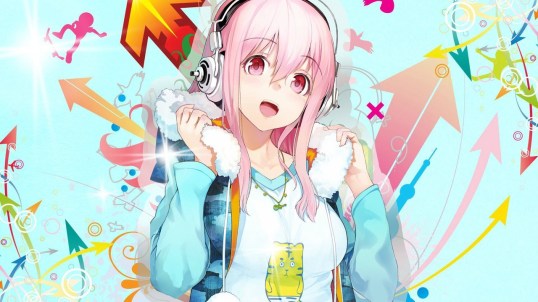
Two words that literally will elicit either two reactions from fans of all things Japanese pop culture. One reaction would be a groan and a shaking of the head that a mascot for a Japanese software company will get her own anime series. For these individuals it’s bad enough that she’s flooded the collectibles’ market with everything Super Sonico from vinyl figures (even one that’s 1/2 scale), posters, keychains, bedspreads, pillow cases and uncounted more things made to separate an otaku from their cash.
The other reaction would be on the other side of the spectrum. A reaction of unrestrained glee. Super Sonico has almost become not just the mascot for Nitro+ but for the current trend in Japanese pop culture that goes by the label of moe. So, Super Sonico finally having her very own anime series was just the logical progression for a character that’s already on everything else sold in Japan and overseas.
From the press release from Nitro+…
“The staff of the Japanese software maker Nitroplusconfirmed on Saturday that a television anime adaptation of its Super Sonico mascot has been green-lit. Nitroplus already opened a website for SoniAni -Super Sonico the Animation-, which was first announced at the Nitro Super Sonic 2013 event earlier in the day.
Super Sonico is the mascot girl of the “Nitro Super Sonic” events held by Nitroplus. In her back story, she is already a photoshoot model, game character, and a musician, even as she studies as a college student. She is also part of a three-piece girl band named “Daiichi Uchū Sokudo” (Fastest Speed in Space) as the vocalist and guitarist.
The character already inspired her own line of games, and figures including a giant 1/2-scale statue. Super Sonico is also appearing in Namco Bandai Games‘ Super Heroine Chronicle for the PlayStation 3 and PS Vita systems and even in a promotion for THQ’s Saints Row: The Third game.”
The question that should be going through the minds of fans until it’s announced would be which anime studio will do the animation and when the series will have a premiere date.
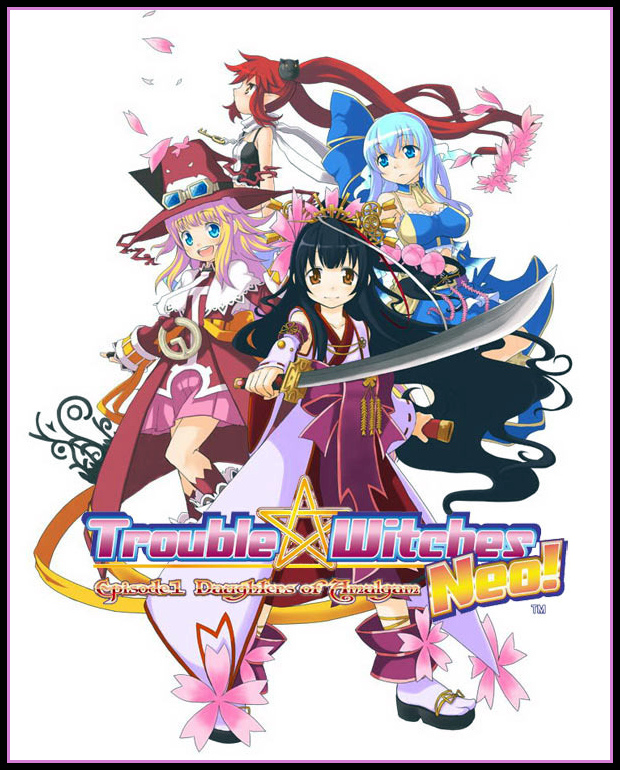
Over this weekend I came across a little game over on Xbox LIVE Arcade listings that I knew I had to buy and play. Of late, I’ve been playing quite a bit of the so-called “shmup” (shoot ’em up) arcade shooters. While I’ve played such games in the past the niche shmup titles of the gothic lolita variety which have become quite popular in Japan was still new to me. My first introduction to this subgenre of the shmup was when I bought a copy of the gothic lolita arcade shooter Deathsmiles for the Xbox 360. Less than a year later I’ve bought a second game which improves on the previous one I bought. Trouble Witches NEO from SNK was seen, downloaded and soon played for countless hours over the weekend.
Trouble Witches NEO (developed by the doujin team from Studio Siesta in conjunction with Bouken and SNK) is quite similar to the many shmup arcade shooters now coming out of Japan and being discovered by Western gamers. Like Cave’s Deathsmiles series (there’s two games released for the series and plans for more), this title is bullet hell taken to the next level. It also uses the popular trend of using “moe” (overly cute) character designs that usually range means all characters will look like gothic lolita in design. While Trouble Witches NEO does have it’s gothrori look it does share lots of similarities with the cult shmup series Touhou Project. That series is pretty much a “mahou shoujo” (magical girl) smorgasbord and Studio Siesta’s own title bear’s similarities.
Sure, one would say the game is very cute to the point of sickening (for some but not to me), but is the game any good they would ask. I would happily declare that the game is quite good. It boasts three different difficulty levels that should allow for all sorts of gamers to try from the pathetically newbie to the shmup genre to the hardest of the hardcore who have mastered all the shmup titles Japan has to offer. The game also offers several game modes from the title’s Original version which pretty much ports the Japanese arcade version straight to the console as seen by the 4:3 aspect ratio gaming screen. There’s also the “Arrange 360 Mode” which updates the game’s graphics for the Xbox 360 and gives it widescreen gaming window. It’s in this newer mode that one can play single-player, multiplayer (offline with another controlled and player), Story Mode and an online co-op through Xbox LIVE. There’s also the usual Score and Boss Attack modes which should challenge even the most hardcore shmup gamer.
It’s in the Story Mode where one can unlock two other maid-witches (the term generally used for the playable characters in this game and others of its kind) by playing through the mode with each of the 6 available playables. For 160 MS Points a player can download a 9th playable character. It’s not necessary to buy this playable, but for 160 points it’s not bad and she’s actually much more powerful then the other 8 which should help in trying to rack up a major high score in the Score and Boss Attack Modes. The former just needs a player to score as many points in the time allowed (3 or 5 minutes). The latter mode just has a player fighting the 6 bosses in the game over and over until all their lives are spent. So, as you can see this game doesn’t lack for replayability value. Just trying to go up in the online leaderboard ranks should occupy a gamer days if not weeks to try and accomplish.
The gameplay itself is not to difficult to do. The left analog stick or the D-Pad ( I recommend using the analog stick option) controls the player’s maid-witch while the A-button fires her basic attack. The B-button activates one of three Magic Cards a player can buy in a floating magic shop. Each card gives a player different attack options. Some are as basic as a 7-way fire which fills the screen to a decoy that attracts enemy fire to the ultra-powerful Fire Bomb which literally takes out everything it touches on the screen. The shop itself also sells extra health (lives in this game) and a magic potion which will increase the time a player can use the all-important Magic Barrier.
The Magic Barrier (activated by pressing the X-button) creates a circular barrier around the player which slows down incoming fire by turning them a purplish-pink. To make it even more interesting, if a player destroys the enemy whose fire has been caught in the Magic Barrier those very enemy fire turns into Gold Coins (Star Coins if a Magic Card ability is used to destroy the enemies) which can now be used to buy replacement Cards or buy new health/increase magic level. The Magic Barrier lasts only as long as the player’s total amount of magic which begins at a default 120. One can remove the barrier at any time by pressing the X-button again which will allow it replenish on its own. Gamers will soon learn to use this Magic Barrier strategically. It’s best used when there are a lot of enemies on the screen who give off tons of fire.
Overall, Trouble Witches NEO is another shmup arcade shooter which has made its way into the Xbox 360 and one that is worth the 800 MS points needed to buy it (960 points if one buys the 9th playable). It’s a fun game that’s readily accesible to all levels of gamer, but still very challenging to the veteran shmup gamer (I’d dare say even those would have a hard time mastering this title). While only a couple of these shmup titles have been available to North American Xbox 360 users there’s many more available to Japanese Xbox 360 owners and hopefully those other titles will make the jump to the West just like Trouble Witches NEO.
PS: As a treat to fans of this type of game Trouble Witch NEO comes not just with the localized English-language voice acting (which is hilarious in it’s awfulness when heard during the Story Mode cutscenes), but with the original Japanese-language voice. Just my preference I always switch the setting to Japanese language. The game retains it’s “moe” factor in that setting and definitely loses it when the English-language was picked.
The latest choice for “anime of the day” is the one and only Azumanga Daioh.
Azumanga Daioh is the extremely popular and critically-acclaimed series that was adapted from the manga of the same by. The manga ran for over three years and has been collected into three massive volume called tankobon. It’s creator is mangaka Azuma Kiyohiko and just looking at the name one sees the etymology of the series’ name.
The anime adaptation was done by anime studio J.C. Staff and shown by the Japanese tv network TV Tokyo over 26 episodes. The North American license used to be under ADV Films before it’s inevitable collapse wherein the North American licensing rights was bought by a Houston-based company called Aesir Holdings. One could still find the anime series on DVD which is great news since Azumanga Daioh is one of the best slice-of-life genre series with characters fully realized and storylines which range from comedic to drama with the two overlapping at times.
The series is about the lives of six Japanese high school girls and how their friendships evolve through their times together at school and out of it. There’s fan favorite Chiyo Mihama, the child prodigy, who struggles to fit in with her classmates who happen to be five years older. Then there’s the athletic Kagura whose friendly rivalry with the reserved Sakaki forms one subplot in the series. There’s Osaka the transfer student who fills in the role of the spacey and eccentric character in the series with Yomi and Tomo rounding out the cast of friends.
While most of the series focuses on the six friends other characters come in and out of their lives such as their homeroom teacher Yukari Tanizaki and their phys.ed instructor, Minamo Kurosawa. Then there’s Kimura-sensei. It’s this character that may have some viewers watching the series with a bit of discomfort as this character becomes a borderline obsessive with the teenage high school girls he teaches, especially the six girls who the series focuses on. While the series never goes over the line with Kimura-sensei’s behavior some people may still get turned off by it and dismiss the series. Here’s to hoping that doesn’t happen because Azumanga Daioh does a great job of exploring the lives of these six high school girls as their friendships with each other grows.
The anime doesn’t go overboard with surreal and way-out-there scenes. Most of the series really just shows routine, day-to-day activities that the girls go through in high school, but the writing is so spot-on that watching the series will definitely bring back fond, nostalgic memories of one’s own time in high school. There are some surreal moments, but they’re usually reserved for times when Osaka’s spaciness gets the better of her. This usually involves her imagining weird things about Chiyo-chan’s pigtails.
Azumanga Daioh does fall under the moe label due to the cuteness of the animations with special regard to the youngest in the group, Chiyo-chan. This moe aspect plus the fun and heartwarming stories involving the girls make this anime a fine choice to be the latest “anime of the day”.
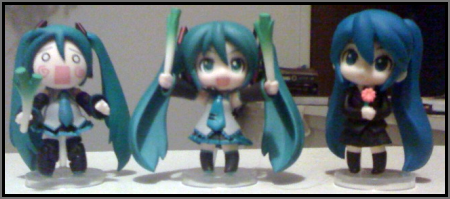
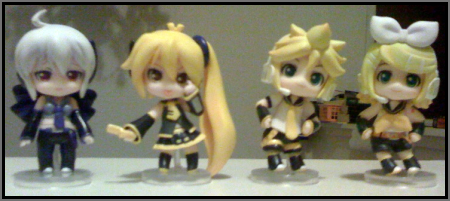
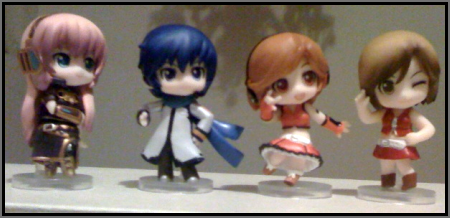
One of my newest obsessions. Newest in that I’ve only started collecting them in the last year or so. My newest obsession feeds the growing otaku growing inside me. This awesome and criminally cute little things are the “nendoroid” line of anime-based figures from Good Smile Company of Japan. This particular group is of the smaller nendoroid petit line and using the Vocaloid characters. Vocaloid is a singing synthesizer application software which has become the rage in Japan and especially those who are very into the anime/manga scene.
These have become the replacement to those damnable Pokemon’s everyone were trying to catch a decade ago. I do believe I’d rather have these than those weird looking critters. So, finally receiving this set in the mail today has made my inner otaku quite happy indeed. >.<

 Through the Shattered Lens