Retro Television Reviews: Jennifer Slept Here 1.11 “Life With Grandfather”


Welcome to Retro Television Reviews, a feature where we review some of our favorite and least favorite shows of the past!  On Thursdays, I will be reviewing Jennifer Slept Here, which aired on NBC in 1983 and 1984.  The entire show is currently streaming on YouTube!

This week’s episode made me cry.

Episode 1.11 “Life With Grandfather”

(Dir by John Bowab, originally aired on April 28th, 1984)

George Elliott’s father, Barney (Milo O’Shea), is coming to visit.  He’ll be staying up in the attic, which upsets Jennifer until Barney actually arrives and she discovers that Barney is a lovable eccentric who loves her movies and spends his time trying to invent new toys.

Unfortunately, the rest of the family is not as thrilled to have Barney around as Jennifer is.  Barney and George have a strained relationship and Joey keeps making excuses not to spend time with his grandfather.  Jennifer is the only one who understands how lonely Barney is but she can’t help him because Barney can’t see her.

Sadly, that changes when one of Barney’s toys explodes in the attic.  Suddenly, Barney can see Jennifer and Jennifer can talk to him.  That’s because Barney is dead.  Jennifer helps Barney come to terms with being dead and she also tells him that he’s not alone because there’s ghosts all over the place.  Barney says that he had so much he still wanted to tell his family and Jennifer assures Barney that his family had a lot that they wanted to tell him.  It’s a surprisingly poignant scene, one that is wonderfully acted by both Ann Jillian and Milo O’Shea.

The episodes jumps forward a few days.  George and Joey are still struggling to come to terms with Barney’s death.  George admits that he was never as close to his father as he wishes he had been and that he has a lot regrets about not getting to tell Barney how much he loved him before he died.  Joey, for his part, goes up to his bedroom and tells Jennifer that he wants to talk to his grandfather.  Joey feels that, since he can talk to Jennifer’s ghost, he should also be able to talk to his grandfather’s ghost.  Jennifer gently explains that Barney has moved on and Joey can’t talk to him anymore but he can continue to love him.

I mean …. MY GOD!  Though this series is admittedly uneven, I’ve enjoyed the majority of the episodes of Jennifer Slept Here that I’ve watched.  But I never thought that this show would bring me to tears.  This was such a sweet and poignant episode and I think it’s one to which everyone watching could relate.  We all have loved ones who we miss and we wish we could speak to.  And sadly, we rarely say everything that we want to say to people while they’re still here.  Joey’s desire to speak to his grandfather is an emotion that we’ve all felt.  But Barney has moved on and the show deserves a lot of credit for not going for the easy solution and having Barney suddenly return to say goodbye to Joey.  Instead, this episode (and Jennifer) emphasized the importance of enjoying the time together that we have and always carrying our love for others in our hearts.

This was a sweet episode and well-acted by the entire cast.  As I’ve said, this is an uneven series but this was a truly good episode.
Love On The Shattered Lens: Romeo and Juliet (dir by Franco Zeffirelli)


Happy Valentine’s Day!

Now that the Oscars and the Sundance Film Festival are over with, it’s time to start a new series of reviews here on the Shattered Lens.  For the rest of February, I will be looking at some films that deal with the universal topic of love.  Some of these films will be romantic.  Some of them will be sad.  Some of them might be happy.  Some of them might be scary.  Some of them might be good.  And some of them might be bad.  In fact, to be honest, I haven’t really sat down and made out a definite list of which films I’ll be reviewing for Love On The Shattered Lens.  Instead, I figure I’ll just pick whatever appeals to me at the moment and we’ll see what happens!

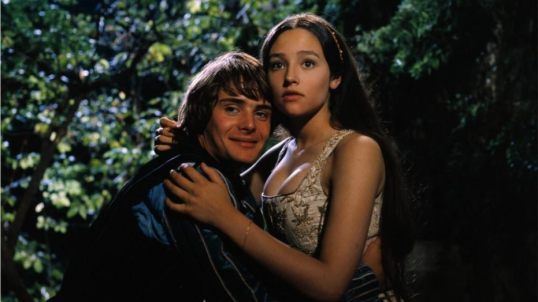
Let’s start things off with the 1968 film version of William Shakespeare’s Romeo and Juliet.

“Oh my God!  Romeo and Juliet are hippies!”

Well, that’s not quite true.  I mean, it is true that Romeo (played by Leonard Whitting) and Juliet (Olivia Hussey) are played by actual teenagers in this version of the classic play.  It’s also true that, even though the film is set in a painstakingly recreated version of 15th century Verona, almost all of the actors have what would have then been contemporary haircuts.  Romeo, Benvolio (Bruce Robinson), and Mercutio (John McEnery) all have longish hair, dress colorfully, and look like they could all be in the same band, covering the Beatles and writing songs about dodging the draft.  Even Tybalt (Michael York) seems a bit counter-cultural in this version.

As played by Olivia Hussey, Juliet comes across as being far more rebellious in this version of Romeo and Juliet than in some of the others.  It’s hard to imagine that Olivia Hussey’s Juliet would have much patience with Juliets played by Norma Shearer, Claire Danes, Hailee Steinfeld, or even the version of the character that Natalie Wood played in West Side Story.  Olivia Hussey’s Juliet is always one step away from running away from home and hitch-hiking to the free Rolling Stones concert at the Altamont Speedway.  Like the audience that the film was intended for, Romeo and Juliet both know that their parents are out-of-touch and that their friends are only temporary.  Embracing love and pursuing all that life has to offer is what matters.

Was this the first film version of Romeo and Juliet to make explicit that the two characters had consummated their marriage?  I imagine it was since it was apparently also the first version of Romeo and Juliet to feature on-screen nudity.  That’s quite a contrast to the largely chaste 1936 version, in which Norma Shearer and Leslie Howard both seemed determined to keep a respectable distance from each other.  Leonard Whiting and Olivia Hussey have an amazing chemistry together.  They’re the two prettiest people in Verona and they just look like they belong together.  From the minute they meet, you believe not only that they would be attracted to each other but that they’re also meant to be lovers.

Of course, we all know the story.  The Capulets and the Montagues are rival families.  Juliet is a Capulet.  Romeo is a Montague.  Juliet’s cousin, Tybalt, kills Romeo’s friend Mercutio.  Romeo kills Tybalt.  Juliet fakes her death.  Romeo commits suicide.  Juliet wakes up and does the same.  The Prince shows up and yells at everyone.  This film version moves around some of the events and it leaves out a few scenes but it actually improves on the play.  For instance, poor Paris (Roberto Bissaco) doesn’t die in this version.  Seriously, I always feel bad for Paris.

Throughout it all, director Franco Zeffirelli emphasizes the youth of the characters.  It’s not just Romeo and Juliet who are presented as young.  The entire Montague and Capulet feud is largely portrayed as being just a silly turf war between two competing high school cliques.  When Tybalt and Mercutio have their fateful duel, it starts out largely as a joke and, when Tybalt kills Mercutio, it comes across as if it was an accident on Tybalt’s part.  Tybalt appears to be just as shocked as anyone, like a scared kid holding a smoking gun and trying to explain that he didn’t know it was loaded when he pulled the trigger.  When Mercutio curses both the Capulets and the Montagues, it’s all the more powerful because Mercutio is undoubtedly wondering how the duel could have so quickly gone from playful taunting to a fatal stabbing.  The entire conflict between the Montague and the Capulets is a war that makes no sense, one in which the young are sacrificed while the old retreat to the safety of their homes.

Romeo and Juliet was a hit in 1968 and it’s still an achingly romantic film.  Whiting and Hussey generate more chemistry in just the balcony scene than Leonardo Di Caprio and Claire Danes did in the entirety of Baz Luhrmann’s version of the tragic tale.  Along with being a box office hit, it was also a critical hit.  The Academy nominated it for best picture, though it lost to Oliver!

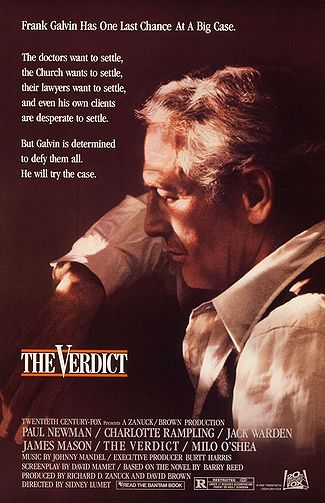
Lisa Watches An Oscar Nominee: The Verdict (dir by Sidney Lumet)


Verdict1

Speaking of the good, old-fashioned star power of Paul Newman, The Hustler and Butch Cassidy and the Sundance Kid were not the only films to receive an oscar nomination as the result of his charisma.  There’s also The Verdict, a 1982 best picture nominee that would probably be forgotten if not for Paul Newman’s performance.  However, since Paul Newman did play the lead role in The Verdict and he did give an amazing lead performance, The Verdict was nominated for best picture and, 33 years later, it ended up on TCM where I just watched it.

That’s the power of good acting.

Paul Newman plays Frank Galvin, a Boston-based attorney.  At one time, Frank was a lawyer at an elite firm.  But he has since fallen on hard times.  Now, he’s the type of attorney who crashes funerals and hands out his card.  He spends his spare time at his favorite bar, playing pinball and telling long jokes while stumbling about in a drunken haze.  In many ways, Frank represents everything that people hate about personal injury attorneys but, since he’s played by Paul Newman, you know that he’s going to turn out to be a good guy.

Frank only has one friend left in the world, his former mentor Mickey (Jack Warden).  Looking to help Frank out, Mickey sends Frank a medical malpractice suit.  A woman at a Catholic Hospital was given an anesthetic during child birth that has led to her now being brain dead.  Both the woman’s family and the Archdiocese are looking for a settlement.  The family needs the money to pay for her medical care.  The Archdiocese just wants the case to go away.  All Frank has to do is accept whatever settlement deal is offered…

However, something has changed for Frank.  He’s visited the comatose woman and, looking at her trapped in a vegetative state, he’s decided that the hospital needs to be held responsible for its mistake.  He rejects the settlement and takes the case to court, looking for both justice for the victim and redemption for himself.

That’s easier said than done, of course.  The Archdiocese has hired Ed Concannon (James Mason, perfectly cast), one of the best and most powerful attorneys in Boston.  Ed has a huge legal team working on the case.  Frank has Mickey.  As well, the Judge (Milo O’Shea) makes little effort to hide his contempt for Frank.

Probably the only bright spot in Frank’s life is that he’s met a woman.  Laura (Charlotte Rampling) meets him in a bar and soon, they’re lovers and Frank is confiding in her about the case.  What he doesn’t suspect is that Laura herself is a spy, hired by Concannon.

It looks like all is lost but then Frank discovers that there is one nurse (Lindsay Crouse) who might be willing to tell the truth about what happened at the hospital…

In many ways, The Verdict is a predictable film.  From the minute we first meet him, we know that Frank is going to be redeemed.  From the minutes that we hear about the case, we know who we’re supposed to root for and who we’re supposed to hiss.  Just about every courtroom cliché is present, right down to a surprise witness or two…

But no matter!  The Verdict may be predictable but it works.  As he proved with 12 Angry Men, Director Sidney Lumet knew how to make legal deliberations compelling and the entire film is full of small but memorable details that elevate it above its simplistic storyline.  As a director, Lumet gets good performances from his cast and, as a result, this is a film where the hero is flawed and the antagonists aren’t necessarily evil.  Even the Bishop of the Archdiocese of Boston (who, in most films, would have been a cardboard villain) is given a scene where he’s allowed to show some humanity.

And, of course, Paul Newman is great in the role of Frank.  When we first meet Frank, he looks and sounds terrible.  Indeed, it’s strange to see Paul Newman playing a character who is essentially such a loser.  (Even Eddie Felson in The Hustler had an appealing swagger about him.)  It’s during the scenes where Frank considers the woman in a coma that Newman starts to reveal that there’s more to Frank than what’s on the rough surface.  By the end of the film, Frank may be a hero but Newman doesn’t play him as such.  He’s still has that alcoholic rasp in his voice and his eyes still betray hints of insecurity and a fear that, at any minute, he’s going to screw up and mess everything up.  It’s a great performance, one for which Newman received a nomination for best actor.

Speaking of star power, Bruce Willis also shows up in The Verdict.  He’s an extra who appears as an observer in the courtroom.  He’s sitting a few rows behind Paul Newman.  (He’s also sitting beside Tobin Bell, the Jigsaw Killer from the Saw films).  It’s probably easiest to spot Willis towards the end of the film, when the verdict is read.  Bruce breaks out into a huge grin and almost looks like he’s about to start clapping.  Bruce only gets about 10 second of screen time but he acts the Hell out of them!

Thanks to Paul Newman, The Verdict is a memorable and entertaining film.  Be sure to watch it the next time it shows up on TCM.