Anime You Should Be Watching: Memories


“Memories… memories are not to be toyed with!” — Heinz

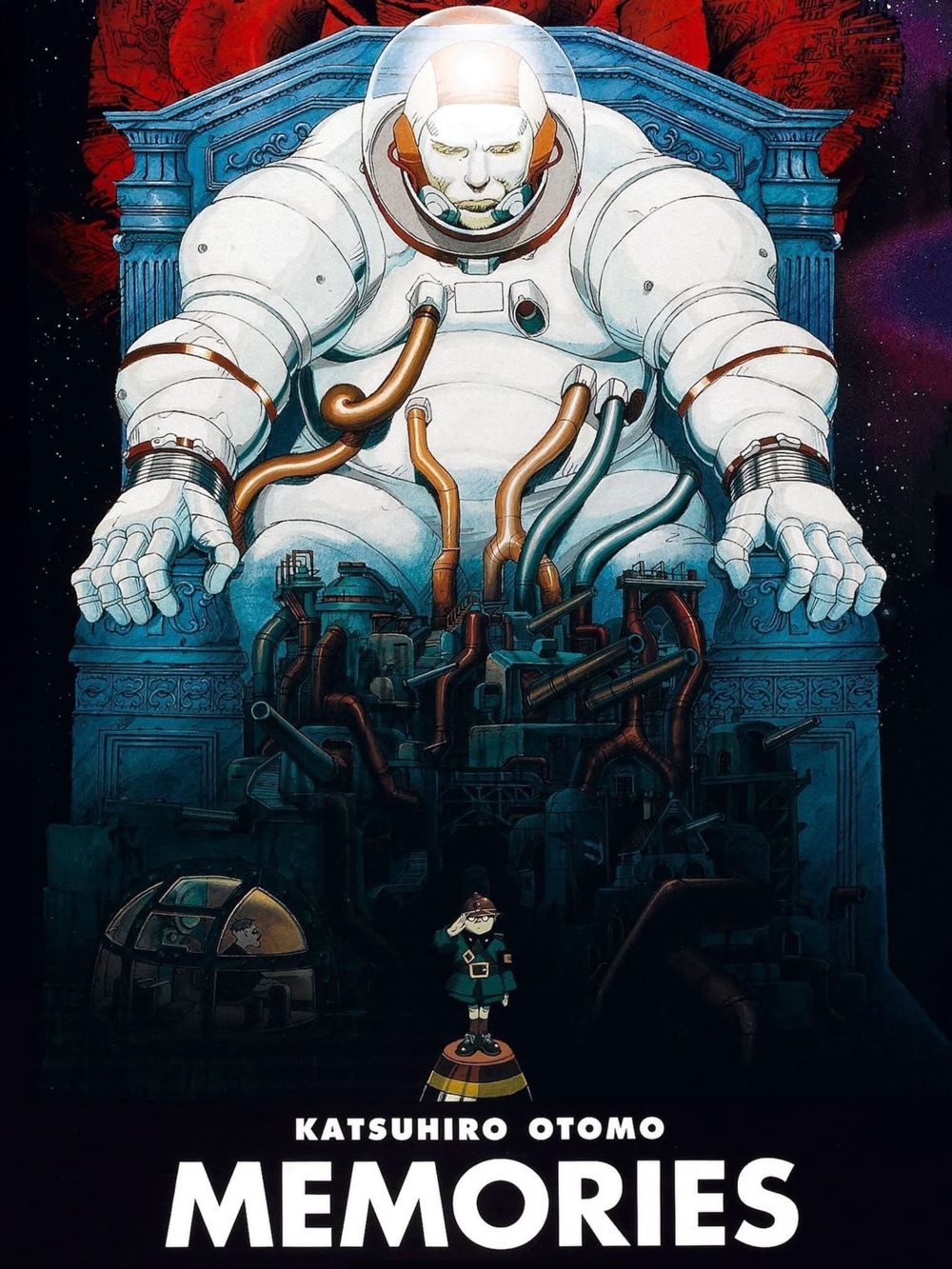
Memories is a mid‑90s anime anthology that feels like a snapshot of how wild and experimental the medium could be when a bunch of heavy hitters got to play in the same sandbox. It’s made up of three separate stories—“Magnetic Rose,” “Stink Bomb,” and “Cannon Fodder”—that don’t connect plot-wise but circle around similar ideas: how technology intersects with memory, systems, and human weakness. The end result is uneven in spots but consistently interesting, and when it clicks, it’s honestly outstanding.

“Magnetic Rose” is the clear showpiece. Directed by Kōji Morimoto and written by Satoshi Kon, it follows a deep-space salvage crew that investigates a distress signal and discovers a derelict structure haunted by the lingering memories of a famous opera singer. The visual approach blends cold, utilitarian sci‑fi hardware with crumbling, ornate interiors, so it feels like the crew is trespassing inside someone’s decaying mind as much as an abandoned ship. The way the environment morphs and lies to the characters, folding past and present together, already hints at the kind of reality‑slipping storytelling Kon would later become famous for.

The sound design and score really push this one over the top. Yoko Kanno leans into big, emotional, opera‑flavored cues that give the segment a tragic, almost theatrical sweep rather than just standard genre tension. Instead of simply backing up jump scares or space thrills, the music amplifies the grief and obsession at the heart of the story, so it plays less like straightforward sci‑fi horror and more like a ghost story built out of longing and denial. The characters themselves are drawn pretty broadly—they mostly function as recognizable types (the seasoned veteran, the younger hothead, the crew just doing their job) rather than deep, fully explored people—but that simplicity keeps the short moving and leaves room for the atmosphere to breathe. In practice, the combination of visuals, sound, and escalating psychological pressure makes “Magnetic Rose” feel rich and layered even without a lot of explicit character backstory.

After that, Memories swerves sharply into “Stink Bomb,” a dark comedy directed by Tensai Okamura. The premise is almost absurd on its face: a lab worker accidentally turns himself into a walking biohazard and slowly becomes the epicenter of a massive crisis. The tone is much lighter, even cartoonish, but there’s a sharp satirical edge underneath. Most of the jokes come from watching institutional systems totally fail to understand or handle what’s happening, ramping up their response in increasingly overblown ways while the poor guy at the center of it all has no idea how dangerous he’s become. It’s a fun, briskly paced piece that lets the animators go wild with chaos and destruction.

That said, “Stink Bomb” is also the segment that feels the most limited conceptually. Once the central gag is in place—this one ordinary guy unintentionally leaving disaster in his wake while officials keep making things worse—the short mostly riffs on variations of that idea. The animation stays lively and the satire lands, and there are flashes of real bite in how it portrays bureaucracy and military decision‑making. But compared to the emotional and thematic density of “Magnetic Rose” or the chilling world‑building of “Cannon Fodder,” it leaves less to chew on once the credits roll. It’s enjoyable, just not as haunting.

“Cannon Fodder,” directed by Katsuhiro Otomo himself, is the quietest but in some ways the most unsettling of the three. It takes place in a city whose entire existence revolves around firing gigantic cannons at an enemy no one ever actually sees. Everything—from education to labor to family routines—is oriented toward that single, unexamined purpose. Visually, it stands apart from the rest of the film: the designs are rougher and more stylized, drawing on European comic and industrial influences rather than sleek anime polish. The big stylistic flex is the way the segment is staged to feel like one continuous movement, with the “camera” drifting through streets, factories, and cramped apartments, watching people go through their day.

There isn’t much conventional plot here, and that’s intentional. The story follows workers and a single family long enough to show how thoroughly the ideology of constant war has soaked into everyday life. Kids learn artillery math at school; adults talk about shell trajectories like it’s the weather. Because the short avoids big twists or overt exposition, it hits more like a living political cartoon: the point is how normalized the whole nightmare has become. Some viewers might find the slower, observational rhythm a bit dry or abstract, especially coming after two more immediately engaging segments. But if the mood clicks, “Cannon Fodder” leaves a lingering, uneasy aftertaste that fits the anthology’s preoccupation with systems and dehumanization.

Stepping back, the three shorts show off just how flexible this medium can be. You get operatic space horror, satirical disaster comedy, and austere anti‑war parable in a single package. There is no explicit framing device tying them together, and the shifts in tone are dramatic, so the film doesn’t feel “smooth” in the way a more unified narrative would. That can be a downside if you’re expecting a cohesive movie rather than a curated set of pieces. On the other hand, that variety is a big part of the appeal: each segment has its own personality and agenda, and the anthology structure lets them coexist without compromise.

On a technical level, Memories holds up surprisingly well. The hand‑drawn animation retains a level of texture and physicality that still looks great today, and the layouts and background work in all three segments are consistently strong. “Magnetic Rose” in particular could be screened alongside other top‑tier anime films from the era and not feel out of place. “Cannon Fodder” still feels formally bold because of its faux‑continuous-shot approach and its distinct visual tone. If anything has aged, it’s more about pacing—modern viewers used to ultra‑fast editing and constant exposition might find some stretches slower than expected—but the film rewards anyone willing to lean into its rhythms.

In terms of accessibility, Memories isn’t the most beginner‑friendly anime film. The first segment leans into psychological horror and tragedy, which can be intense if you’re mostly used to lighter or more straightforward sci‑fi. The comedic whiplash of “Stink Bomb” right after might feel tonally off if you’re still processing the emotional punch of “Magnetic Rose.” And “Cannon Fodder” asks you to be okay with a more metaphor‑driven, open‑ended piece rather than a neatly resolved story. That mix means the anthology is more likely to resonate with viewers who are already interested in anime as a cinematic form and are curious to see different approaches pushed side by side.

What really makes Memories feel important, though, is the cluster of talent involved and what they went on to do. Katsuhiro Otomo brings the weight of Akira and uses this film as a space to experiment with scale and structure. Kōji Morimoto’s work here sits right in the trajectory of his later, more explicitly experimental projects. Satoshi Kon’s script for “Magnetic Rose” reads almost like a prototype for the identity‑fracturing stories he’d later build entire films around. Tensai Okamura and Yoshiaki Kawajiri bring a sensibility for action and genre that gives “Stink Bomb” its bite, and Yoko Kanno is already showing the range and emotional intelligence that would make her one of anime’s most beloved composers. Even if you stripped away the historical context, the film would still be worth watching—but knowing what these creators went on to do makes it feel like catching a moment just before a lot of big ideas fully explode.

Taken as a whole, Memories plays like a compact tour through different corners of what anime could do in the 1990s when it wasn’t worried about franchising or playing it safe. It’s not flawless, and not every segment will work equally well for every viewer, but the high points are strong enough that the anthology earns its reputation. For anyone interested in the evolution of anime as an art form—especially on the sci‑fi and psychological side—it’s absolutely worth the time, both as a film in its own right and as a window into a formative creative era.
Oh my God! 6 More Chilling Classics: The Cold, Dr. Tarr’s Torture Dungeon, The Legend of Big Foot, Oasis of the Zombies, Slashed Dreams, and Track of the Moon Beast


It’s a lonely Saturday here at the TSL Bunker.  Leonard Wilson is at a theater in the city, watching Chernobyl Diaries.  My sister, the Dazzling Erin, has abandoned me to go shopping for ingredients so she can make something later tonight for our family’s annual memorial day get together tomorrow and our cat, Doc, is too busy sleeping at the foot of my bed to pay much attention to me   Probably even as I sit here typing this, Leon the Duke is watching season 3 of Lost and how I envy him!  The Trash Film Guru has escaped to the grindhouse. Necromoonyeti is discovering new music, Pantsukudasai is undoubtedly meeting with his enigmatic anime connection, Semtex Skittle is playing Diablo Something-Or-Another, and SenorGeekus is off spreading the gospel of Jack Kirby.  Even Arleigh is off somewhere else, watching a war movie no doubt.

Yes, I’ve been left here alone in my section of the Bunker, which I’ve decorated by utilizing a combination of Catholic iconography, Hello Kitty, and pink wallpaper.  I should be working on getting caught up because I am running behind on meeting my quota for the month.  However, instead of writing about what’s currently playing in a theater near you, I find myself once again distracted by my continuing mission to watch and review every single film included in Mill Creek’s 50 Chilling Classics Boxset.  Fortunately, I’m happiest when I have a mission.  Here are reviews of 6 more of the Chilling Classics that I’ve sat through.

The Cold (dir by Bill Rebane)

First released in 1984, The Cold is yet another odd little morality tale from Wisconsin-based filmmaker Bill Rebane.  Three mysterious millionaires invite nine people (and just try to keep them all straight) to a secluded mansion that looks suspiciously like an EconoLodge.  The nine guests are informed that if  they spend a few nights at the “mansion” and face their greatest fears, they’ll win a million dollars.  Of course, everyone agrees to do that but how could they have imagined that their fears would include a giant spider that shows up in soup bowl, a shark that shows up in a swimming pool (Agck!  That would be my fear right there), rats, and people who wander around hallways while wearing white sheets.  Of course, it all ends with a twist that you’ve already guessed and then the film introduces another twist that you’ve already guessed.

This is the third Rebane film that I’ve come across in the Chilling Classic Boxset (the previous two being The Alpha Incident and The Demons of Ludlow).  Rebane is one of those odd directors whose uneven films are genuinely inept and yet occasionally show a flash of equally genuine imagination.  The Cold is a complete and total mess that features bad acting (after 5 minutes, I’d had enough of the slow-witted girl with the bad Southern accent), bad dialogue (“You can’t come in here.  I’m nude.” “Don’t worry, I’ve had a vasectomy”), and a truly incoherent style of editing.  Rebane punctuates the action by including random snatches of old timey music and boy did that get irritating fast.  And yet, once you start watching, it’s impossible to look away.  You simply have to watch to convince yourself that what you’re seeing isn’t just a dream.  Plus, the film includes not only an endless disco sequence but a narrator who admits that he can’t really follow the story either.

Dr. Tarr’s Torture Dungeon (dir by Juan Lopez Moctezuma)

This Mexican film from 1972 is based on an Edgar Allan Poe short story and, despite the poor picture quality that we’ve come to expect from anything put out by Mill Creek, it is one of the most visually interesting films to be found in the Chilling Classics boxset.  A newspaper reporter visits a sanitarium in order to investigate the revolutionary form of therapy practiced by Dr. Maillard (Claudio Brook).  As Maillard explains (and sh0ws), the inmates are essentially allowed to roam freely through the asylum and live under whatever delusions make them happiest.  However, it quickly becomes obvious that Dr. Maillard is insane himself and his asylum is part of a bigger plot to rule the world.  The plot makes little sense and it quickly becomes pretty clear that it’s not meant too.  Director Juan Louis Moctezuma was a collaborator of the famed surrealist Alejandro Jadorowsky and it quickly becomes obvious that he’s more interested in putting as many odd and surreal images on-screen as possible and, on that level, he succeeds.  For whatever the film’s narrative failings, it’s fascinating to just sit and look at some of the images that appear on-screen.  Claudio Brook gives a wonderfully over-the-top performance that perfectly compliments the film’s visuals.

The Legend of Big Foot (dir by Harry Winer)

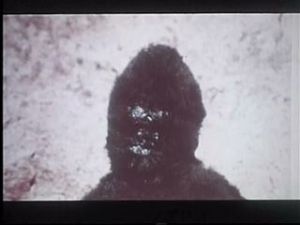
In this documentary from 1976, a wildlife expert named Ivan Marx rambles on and on about Big Foot while unrelated stock footage plays out on-screen.  It’s just as exciting as it sounds.  Seriously, I try to make it a point to stick with any film I start watching, no matter how boring it may turn out to be, but the Legend of Big Foot severely tested my patience.  Some of the animals in the stock footage are cute, though.  Regardless of what he may be discussing at any particular moment during the film, Marx delivers his narration in the most dramatic way possible and that provides a few laughs as well.

Oasis of the Zombies (dir. by Jess Franco)

In this 1981 Eurocine film, a group of unlikable people come across a lost Nazi treasure in the middle of the African desert.  Unfortunately for them, the Nazis are still there, standing guard.  Of course, the Nazis have now all been transformed into zombies!  As far as Nazi zombie films are concerned, Oasis of the Zombies isn’t as scary as Shock Waves and it’s not as much fun as Zombie Lake.  What it is, however, is a Jess Franco film which means that the film features actors in tacky outfits, poorly dubbed dialogue, a zoom lens that just won’t quit, and a few oddly surreal (and occasionally nightmarish) visuals.  This is really a pretty shoddy film but it’s enjoyable if you’re a fan of Franco’s “unique” style of filmmaking.

Slashed Dreams (dir. by James Polaskof)

This film was originally released in 1974, under the title Sunburst.  It was obviously not meant to be a horror film (though it was clearly meant to appeal to the exploitation market) but instead, it was a painfully sincere, annoyingly naive, and, ultimately, rather offensive attempt to make an important statement about the need to drop out of society and “do your own thing.”  However, Robert Englund shows up for the film’s final 10 minutes so, at some point in the 80s, Sunburst was re-released, retitled, and resold as a horror film.

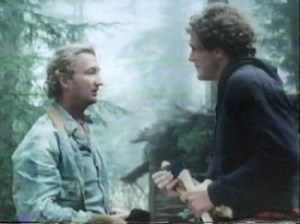
Anyway, this 74 minute film is about two perky and attractive college students (Peter Hooten and Katharine Baumann, both of whom give good performances) who decided to go visit their first Michael who has dropped out of society and is currently living in a cabin out in the middle of the woods.  The majority of the film is an endless montage of scenes of Hooten and Baumann hiking through the wilderness while a singer named Roberta Van Dere warbles away on the soundtrack, singing some of the most annoyingly 70s folk songs ever written.  I’m sad to say that I got one of them, Animals Are Clumsy Too, stuck in my head.  Once they finally reach the cabin, they discover that Michael is off wandering about.  They decide to wait around for Michael to show up which leads to them being spotted by two inbred hicks who proceed to rape Baumann before running off.  The next morning, Michael shows up and hey, he’s Robert Englund!  Michael hears what has happened and, instead of going to the police or, at the very least, getting Baumann to a hospital,  he tells her that she just needs to “push the demons out” and get on with living.  Which, by the way, is complete bullshit.  It’s one thing to discover strength you previously didn’t realize you had as the result of something terrible, it’s another thing to seriously expect a woman to shrug it off after a day or two or to consider rape to be a character-building exercise as this film seems to.  Say what you will about I Spit On Your Grave, at least that film understood that rape is an unforgivable violation and more than just a bad thing that might happen in the woods.  I swear, just when I think that I can’t hate the late 60s and early 70s anymore than I already do, I see a film like this.

Track of the Moon Beast (dir. by Dick Ashe)

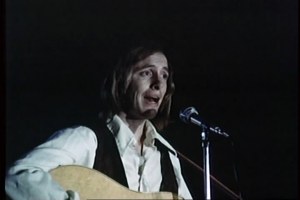
When it comes to bad movies from the 70s, I prefer the likes of 1976’s Track of the Moonbeast to Sunburst/Slashed Dreams.  This films takes place in New Mexico and tells the story of Paul (Chase Cordel), a slow-talking mineralogist who gets a chunk of moon rock lodged into his brain.  As a result, he turns into a gigantic lizard and goes around killing people.  His only hope appears to be his old friend, the stoic Profession Johnny Longbow (Gregorio Sala) who knows all sorts of indian lore.  He also knows how to make stew and early on in the film, he gives a world-weary monologue about what ingredients he puts in his stew.  (Onions, mostly).  Anyway, this is an awful, awful film that’s full of bad acting, bad special effects, and dumb dialogue.  It’s also a lot of fun and it features the guy pictured below singing a song called California Lady that got stuck in my head almost as quickly as Animals Are Clumsy Too.  I loved Track of the Moon Beast.

So, out of these six, I would definitely recommend Track of the Moon Beast and Dr. Tarr’s Torture DungeonThe Cold and Oasis of the Zombies should be watched only by people who are already familiar with the work of Bill Rebane and Jess Franco.  Legend of Big Foot might be amusing if you’re intoxicated and Slashed Dreams is the one to definitely avoid.

6 More Chilling Classics: Jesse James Meets Frankenstein’s Daughter, Scream Bloody Murder, Silent Night Bloody Night, Sisters of Death, War of the Robots, and Werewolf in a Girl’s Dormitory


For the past few months, I’ve been attempting to watch and review every film to be found in Mill Creek’s 50 Chilling Classics box set.  Here’s are 6 quick reviews of the latest few “chilling classics” that I’ve found the time to watch.

1) Jesse James Meets Frankenstein’s Daughter (Dir by William Beaudine)

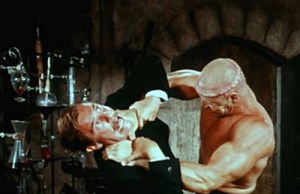
This 1966 western/horror hybrid is just about as stupid as you think it is but it’s also a lot of fun if you’re in the right mood.  Notorious outlaw Jesse James (John Lupton) attempts to hold up a stagecoach but, in the process, his hulking partner Hank (Cal Bolder) is serious wounded.  Some helpful peasants direct Jesse and Hank to the mysterious German doctor who happens to live in a nearby dark and scary house.  That doctor is Maria Frankenstein (Narda Onyx) and she’s been conducting experiments to bring dead Mexicans back to life.  Imagine her joy when the nearly dead Hank shows up at her laboratory.  Anyway, Maria performs a brain transplant on Hank and once Hank comes back to life, she informs him that his new name is “Igor.”  Yes, she does.  That plot description pretty much tells you everything you need to know about the movie but I vaguely enjoyed vaguely paying attention to it.  Maria’s German accent is hilariously overdone, the Frankenstein laboratory is full of pointless electrical things, and a character dies halfway through the film just to later show up again with no explanation.  It’s that type of movie.

2) Scream Bloody Murder (dir. by Marc Ray)

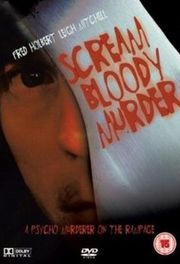
So Matthew (played by Fred Holbert) is a disturbed young man who murders his father with a tractor and loses a hand in the process.  He’s sent off to a mental asylum for a few years and while there, he’s given a sharp and potentially deadly hook as a replacement for his hand.  Seriously, why would you give a weapon like that to a mental disturbed person who has just murdered his own father?  That’s just one of the many mysteries that goes unexplored in 1973’s Scream Bloody Murder, an occasionally watchable slice of entertainment that is ultimately too slow and predictable to really be effective.  Once Matthew is released from the asylum, he goes on the expected murder spree and goes all Collector-like on a prostitute named Vera (played by Leigh Mitchell, who also plays Matthew’s doomed mother in a clever bit of Oedipal casting).  Mitchell and Holbert both give surprisingly good performances and director Marc Ray comes up with a few visually inventive scenes of mayhem but, for the most part, this film never quite lives up to the excessive promise of its premise.

3) Silent Night Bloody Night (dir. by Theodore Gershuny)

Filmed in 1972 and subsequently released in 1974, Silent Night Bloody Night is a real treat, an atmospheric thriller that has a wonderfully complicated plot that will keep you guessing.  On Christmas Eve, Jeff Butler (James Patterson) comes to an isolated town to arrange the sell of his grandfather’s home.  As we discover through some wonderfully dream-like flashbacks, Jeff’s grandfather died nearly 40 years ago when he was set on fire in his own home.  With the help of local girl Diane (Mary Woronov), Jeff investigates his grandfather’s death and discovers that the town is full of secrets and people who are willing to kill to maintain them.  Director Theodore Gershuny uses the low budget to his advantage and the sepia-toned flashbacks are truly disturbing and haunting.  Ultimately, Silent Night Bloody Night feels like a dream itself and the mystery’s solution is less important than the journey taken to reach it.

4) Sisters of Death (dir. by Joseph Mazzuca)

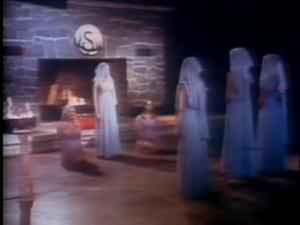
Technically, this isn’t the best film to be found in the Chilling Classics box set but it’s still one of my personal favorites.  The 1977 film opens with a very baroque sorority initiation that ends with one of the sisters being killed in a game of Russian Roulette.  A few years later, the surviving sisters are invited to an isolated and lavish estate where it turns out that the dead girl’s father (well-played by Arthur Franz) is looking for revenge.  This film is predictable and a lot of the plot depends on people refusing to use any common sense but Sisters of Death is such a fun little melodrama that I can’t complain too much.  The film plays out like a surprisingly violent Lifetime movie and it all ends on a wonderfully cynical note.

5) War of the Robots (dir. by Alfonso Brescia)

Whatever you do, don’t watch War of the Robots alone.  Seriously, you need somebody there — preferably several people — so you can take turns making snarky comments and rude jokes.  Otherwise, you’ll just be stuck watching this amazingly bad science fiction film from 1978 and wondering how much more of it you can take.  Set in the generic future, War of the Robots tells the story of what happens when two human scientists are kidnapped by a bunch of robots.  Capt. John Boyd (Antonio Sabato) is sent to get the scientists back and the end result?  A war of the robots.  Or something like that.  This is one of those films where it’s difficult to really pay that much attention to what’s happening on-screen.  However, it’s worth seeing just for the chance to spot the wires that are enabling the model spaceship to hang over the “alien” landscapes.  Naturally, since this film was made in the 70s, everyone wears space suits with really wide lapels.

6) Werewolf in a Girls Dormitory (dir. by Paolo Heusch)

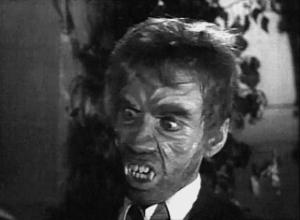
First released in 1961, Werewolf in a Girls Dormitory is an Italian/Austrian co-production.  It was originally titled Lycanthropus and while Werewolf In A Girls Dormitory is a lot more memorable, it also makes this film sound like a lot more fun than it actually is.  This slow and oddly somber film tells the story about a series of murders that occur at a school for delinquent girls.  The school’s newest teacher is the obvious suspect but then again, the killer might just be a werewolf.  I liked the look of this film — the film is lit to emphasize shadows and it gives the whole thing a very noir-like feel — but, much like Scream Bloody Murder, this movie was just too slow to really be effective.

So, out of this batch of 6, I would definitely recommend that you track down and see Silent Night Bloody Night and Sisters of Death.  I would also definitely suggest that you do your best to avoid War of the Robots.  As for the other 3, they’re all better than The Wicker Tree.