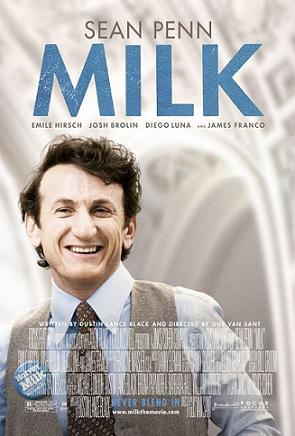
Shattered Politics #83: Milk (dir by Gus Van Sant)


Milkposter08

For the past three weeks, I have been in the process of reviewing, in chronological order, 94 films about politics and politicians.  It’s a little something that we call Shattered Politics.

And while I’ve had a lot of fun doing it, it does worry me a bit that I may have made the Shattered Lens into a far more cynical site to visit.  That’s largely because I don’t trust politicians or the government in general and, despite the fact that we started off with Abraham Lincoln and Mr. Smith Goes To Washington, the majority of the films that I’ve reviewed have reflected that fact.

So, in order to combat that cynicism, I’m going to recommend a film from 2008 that, despite being a biopic about a politician, is actually rather inspiring.  I am, of course, talking about the 2008 best picture nominee, Milk.

Milk tells the story of Harvey Milk who, in 1977, became the first openly gay man to be elected to a major public office.  Now, just consider that.  Up until 38 years ago, nobody who was openly gay had been elected to public office.  Nowadays, the idea of an out gay man or a lesbian running for public office is only shocking to a dwindling minority of homophobes.  Even down here Texas, which everyone up north always smugly assumes to be so intolerant, nobody is surprised when a gay or a lesbian not only runs for office but wins as well.  Sheriff Lupe Valdez has served as sheriff of Dallas Country for over ten years and, though she’s been controversial, none of that controversy has concerned her sexuality.  Meanwhile, Annise Parker has served three-terms as mayor of Houston, making Houston the biggest city in America to have an openly gay mayor.

However, before Lupe Valdez could be sheriff or Annise Parker could be mayor, Harvey Milk had to serve on the San Francisco Board of Supervisors.

Milk follows Harvey (Sean Penn, who won an Oscar for his performance) and his much younger boyfriend, Scott (James Franco) from the moment they first meet in New York to when they moved to San Francisco in 1970.  We see how Harvey first found fame as a neighborhood activist and how he challenged both the political and gay establishment of San Francisco in his campaigns for political office.  When he finally wins a seat on the Board of Supervisors, he does so at the cost of his relationship with Scott.  He enters into another relationship with the self-destructive Jack (Diego Luna), which ends tragically.

By winning office, Harvey becomes a spokesman for gays everywhere.  When a sinister state senator (Denis O’Hare) attempts to pass a bill that would forbid gays from teaching school, Harvey leads to opposition.  And, while Harvey’s career continues to rise, the career of another supervisor — Dan White (Josh Brolin) — plummets.

Elected at the same time as Harvey, Dan is an uptight former cop.  Though he and Harvey originally strike a somewhat awkward friendship (Harvey is the only supervisor to come to the christening of Dan’s child), Dan soon comes to resent Harvey.  (At one point, Harvey suggests that Dan might be closeted and Brolin’s tightly coiled performance certainly implies that Dan is repressing something.)  Eventually, Dan shoots and kills both the mayor (Victor Garber) and Harvey.

Though the film ends in violence and anger, it also ends with hope.  Though Harvey may be dead, the activists that he inspired are there to carry on.

Because the film was directed by a gay man, written by a gay man, and tells the story of a gay man, Milk is often dismissed, even by critics who liked it, as just being a gay film.  But, actually, it is a film that should inspire anyone who has ever felt like they’ve been pushed into the margins of our national culture.  By the film’s end, Harvey Milk has emerged as not just a gay hero but as a hero to anyone who has ever been told that their voice does not matter.  When Harvey says, repeatedly, “You’ve got to give them hope,” it’s hope for all of us.
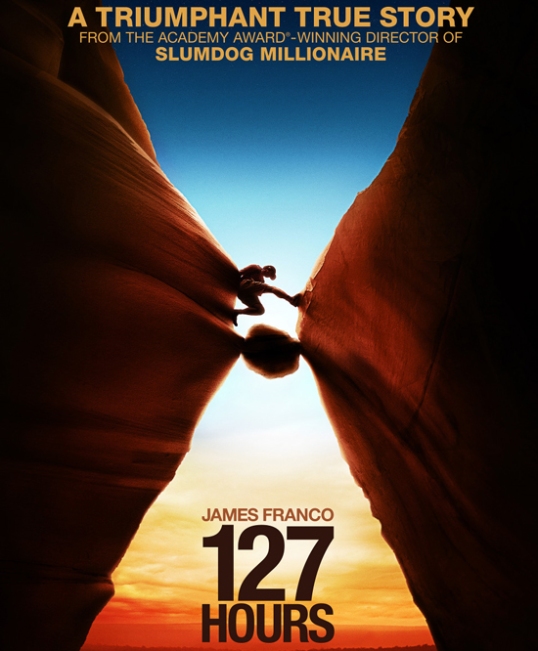
Film Review: 127 Hours (directed by Danny Boyle)


Last Friday night, my friend Jeff and I went down to the Plano Angelika and saw Danny Boyle’s new film, 127 Hours

I have to admit that I was a little bit uneasy about seeing this film.  First off, it’s a movie based on the true story about a mountain climber who spent 5 days trapped in a narrow canyon.  I am intensely claustrophobic, to the extent that I’ve had panic attacks just from finding myself trapped in a crowded grocery store aisle.  (Seriously, why does everyone in the world have to go shopping for La Choy Sweet and Sour sauce at the same time I do?)   Secondly, the trapped climber eventually escaped by using a dull knife to saw off his right arm.  I mean, ewwwwww! 

But I knew I had to see the film for three reasons.  Number one, it stars James Franco who I’m kinda in love with.  Number two, Danny Boyle is one of my favorite directors.  And, finally, 127 Hours is probably going to be nominated for best picture.  So, I worked up my courage and I tried not to think about the various news reports about audience members passing out while watching the film, and I went to the movie.  And I’m glad I did because 127 Hours is one of the best films that I’ve seen in quite some time.

James Franco plays Aron Ralston, a cocky but likable guy who decides to spend the weekend hiking across some place called Blue John Canyon.  (Sorry, I’m not really an outdoorsey type of girl.)  He tells no one of his plans and the only people who know he’s even at the canyon are two girls that he meets while there.  The girls have gotten lost in the canyon and they accept Aron’s help in finding whatever grand archeological thing it is that they’re looking for.  (See previous apology.) 

I have to be honest here.  As I watched these two girls go off with a perfect stranger, a part of me wanted to be all like, “Oh, I would never do something as stupid as go off with some stranger I met out in the middle of nowhere.”  But, then again, this isn’t just some stranger.  This is James Franco.  So, I’ll refrain from passing judgment.  I just hope that the girls had their pepper spray with them.

(The two girls, by the way, are played by Kata Mara and Amber Tamblyn.  I loved Joan of Arcadia.  Can you believe they cancelled it for Ghost Whisperer?  Not cool, CBS.)

Anyway, after frolicking in an underground pool, Aron and the girls part company.  They invite him to come to a party the next night.  They tell him to just look for a big, inflatable Scooby Doo.  Aron agrees, walks off, and promptly finds himself trapped in a canyon when a boulder falls on top of him and pins his right arm against the canyon wall.  As quickly as that, Aron goes from being  a carefree adventurer to literally being a prisoner, isolated and alone.  As Franco screams for help, Boyle pulls the camera upward from Aron until eventually he’s a barely noticeable speck surrounded by a barren (and otherwise unpopulated) desert.  It’s a moment that you know is coming but it’s still shocking and devastating because it stands in such stark contrast to the film’s first 20 minutes when both Boyle and Franco filled each scene with a sense of constant motion.  Suddenly, everything has stopped and we’re as trapped as Aron.

The rest of the film is pretty much a one-man show.  We watch as Aron spends the next five days fighting to just survive.  He tries to chip away at the rock with a knife (yes, that knife).  He talks to his camera, keeping a diary and leaving messages for his family.  He fights off hungry ants and tries to conserve his water.  He even manages to invent a pretty neat little pulley system to try to move the rock.  Finally, he starts to hallucinate, seeing everything from his family disdainfully watching his predicament to a gigantic inflatable Scooby Doo stalking him in the canyon.  And finally, of course, he starts to cut off his arm.

He also finds some time to think about the life he led up to the moment he found himself trapped underneath the rock.  This is where Boyle really shines because, in the hands of most directors, these scenes probably would have been very maudlin and heavy-handed.  However, Boyle presents these scenes in an almost impressionistic style.  We see hints of the life that Aron has led but Boyle never comes out and blatantly says that, up until this point, Aron never been willing to truly connect with others.  We sees scenes of Aron’s ex-girlfriend breaking up with him but we’re never specifically told what led to her leaving him.  And we don’t need to be.  Boyle presents us with the evidence and trusts us to draw the correct conclusion.

I am very proud to say that I watched the entire film without once having a panic attack though I did start to feel a little bit light-headed when Aron really started to get into sawing off his arm.  At this point, I did end up burying my head in Jeff’s shoulder and watching the scene out of the corner of my eye.  At the same time, it’s an oddly exhilarating sequence because we know that the only way Aron will survive is by cutting off his arm and, as a result of Franco’s performance, we really do want Aron to survive.

In retrospect, 127 Hours really is the ultimate guy film in that the film basically celebrates a guy who gets stranded in the desert for five days yet manages to survive without ever once having to ask for directions.  However, as a result of the whole experience, he comes to realize he should have been nicer to his ex-girlfriend which means that chicks like me can enjoy the movie as well.  My main concern is that the film is such a total guy flick that we might see a sudden epidemic of men amputating their limbs in order to show that they can handle it as well as James Franco did.  As we left the theater, I assured Jeff that he didn’t have to chop off his hand just to impress me.  Hopefully, he listened.

James Franco is generating a lot of Oscar buzz for his performance here and he should be.  Franco is one of those performers who is so pretty that it’s easy to forget that he’s actually a pretty good actor.  I thought he deserved a nomination for his performance in Milk.  He deserves the Oscar for his performance here.

Along with a best actor nod for Franco, it seems likely that 127 Hours will also pick up nominations for best picture and best director.  Interestingly enough, Boyle will probably find himself competing with the man he beat two years ago, David Fincher (previously nominated for The Curious Case of Benjamin Button and a probable nominee this year for The Social Network.)  This is somehow appropriate as Danny Boyle has consistently proved himself to be the director that David Fincher is supposed to be and, by being a massively hyped film that lives up to all the praise, 127 Hours is the anti-Social Network.  While The Social Network uses a “true” story as an excuse to judge and ridicule, 127 Hours uses its true story to celebrate humanity, flaws and all.  Whereas Fincher seems to only celebrate film, Boyle celebrates life.

127 Hours.

See it.