Horror Film Review: The Norliss Tapes (dir by Dan Curtis)


1973’s The Norliss Tapes begins with a disappearance.

David Norliss (Roy Thinnes), a California-based journalist, has vanished.  Before he disappeared, he had started work on a book that would have detailed his own adventures investigating the paranormal.  Though Norliss vanishes, he leaves behind several audiotapes in which he discusses some of the frightening things that he has seen.  Searching for clue about Norliss’s disappearance, his editor, Sanford T. Evans (Don Porter), sits down and listens to the tapes.

(Incidentally, Sanford T. Evans is a wonderful name for an editor.  It’s a name that just says, “My father knew Hemingway and I went to the University of Pennsylvania as a legacy.’)

As Evans listens to each tape, we watch the story unfold from Norliss’s point of view.  In this film, we watch as Norliss investigates an incident in which Ellen Sterns Cort (Angie Dickinson) claims that she was recently attacked by her dead husband, James Cort (Nicki Dimitri).  James was an artist who, in his final days, became obsessed with the occult and fell under the influence of the Mademoiselle Jeckiel (Vonetta McGee), a mysterious woman who claimed to appreciate James’s art and who gave him a scarab ring that he insisted on being buried with.

Norliss interviews Ellen and investigates her story.  He’s far more sympathetic to the idea of James having returned from the dead than the local sheriff (Claude Akins) is.  Of course, the sheriff has problems of his own.  Dead bodies keep turning up in his county, their skin gray and their bodies drained of blood.  Hmmm …. I wonder if that could have anything to do with James Cort and his scarab ring….

The Norliss Tapes is a pretty simple film.  Norliss shows up and then basically waits around until James Cort makes an appearance.  The film only runs 72 minutes and it’s very much a pilot for a television series that never went into production,  Apparently, each episode would have featured Stanford listening to a different tape and hearing about David Norliss and a weekly guest star dealing with some sort of supernatural occurrence.  Director Dan Curtis was also responsible for the cult television series, Kolchak: The Night Stalker, and The Norliss Tapes feels very much like a dry run for that show.  The main difference is that Roy Thinnes’s David Norliss is nowhere near as nervous as Darren McGavin’s Carl Kolchak.

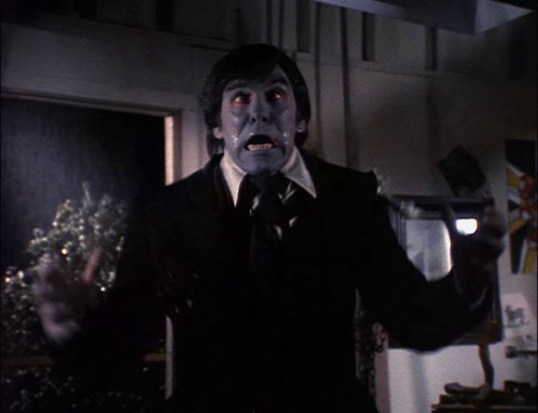
That said, the exact details for what’s going on with James Cort are almost ludicrously complicated.  It turns out that James Cort is not only trying to cheat death but he’s also helping an ancient Egyptian deity invade our world.  It’s best to ignore the nonsense about the Egyptian Gods and instead just focus on how creepy the undead James Cort is.  With his hulking frame, his gray skin, and his nearly glowing eyes, Cort is a truly frightening monster and he’s certainly the most impressive thing about this movie.  What makes Cort such an effective villain is how angry he seems to be.  Whenever he’s on screen, he’s either bursting through a door or chasing someone.  He’s pure nightmare fuel.

The Norliss Tapes never became a series but it did do well in Europe, where it was released in theaters.  The Norliss Tapes still has a cult following, not bad for a failed pilot.  Who knows what other adventures David Norliss could have had?

Horror on the Lens: The Norliss Tapes (dir by Dan Curtis)


The Norliss Tapes (1973, dir by Dan Curtis)

Today’s Horror on the Lens is The Norliss Tapes, a 1973 made-for-TV movie that was also a pilot for a television series that, unfortunately, was never put into production.

Reporter David Norliss (Roy Thinnes) has disappeared.  His friend and publisher, Stanford Evans (Don Porter), listens to the tapes that Norliss recorded before vanishing. (Stanford Evans, it must be said, is a great name for an editor.)  Each tape details yet another paranormal investigation.  (Presumably, had the series been picked up, each tape would have been a different episode.)  The first tape tells how Norliss investigated the mysterious death of an artist who apparently returned from the grave.

For a made-for-TV movie, The Norliss Tapes is pretty good.  It’s full of atmosphere and features a genuinely menaching yellow-eyed zombie monster. The film was directed by Dan Curtis, who was responsible for several made-for-TV horror films and who also created the deathless TV show, Dark Shadows. Curtis also directed a few feature films. Burnt Offerings, for instance, will be forever beloved for its scene of annoying little Lee Montgomery getting crushed by a chimney. If you ever get a chance to listen to the director’s commentary that Dan Curtis recorded for the Burnt Offerings DVD release, you must do so. Curtis comes across as the crankiest man on the planet and it’s actually kind of fascinating to listen to. His irritation when Karen Black keeps asking him if he knows the name of the actor who played the ghostly chauffeur is truly an amazing thing to here. (For the record, the actor’s name was Anthony James, he also had important supporting roles in two best picture winners — In The Heat of the Night and Unforgiven — and yes, he was one of the best things about Burnt Offerings. Karen Black knew what she was talking about.)

But back to The Norliss Tapes!

Admittedly, this is not the first Halloween in which I’ve shared The Norliss Tapes with our readers. Back in both 2015 and 2021, The Norliss Tapes was one of our “horrors on the lens.” Unfortunately, there’s only so many good quality, public domain horror films available on YouTube so, occasionally, a movie is going to show up more than once over the years. But, as long as it’s good film, who cares?

Enjoy The Norliss Tapes!

Embracing the Melodrama Part II #30: The Sweet Ride (dir by Harvey Hart)


The_Sweet_Ride_FilmPosterThe 1968 film The Sweet Ride takes the audience on a ride through Malibu and reminds us all that, in many ways, the 1960s sucked.

The Sweet Ride opens with actress Vicki Cartwright (Jacqueline Bisset) losing her top while swimming in the ocean.  While Vicki panics and tries to figure out how to get back to the beach without anyone seeing her breasts, she’s spotted by a surfer named Denny McGuire (Michael Sarrazin).  Denny hands her a towel and then leads her back to the beach house that he shares with aging tennis player Collie (Anthony Franciosa) and stoned musician Choo-Choo (Bob Denver).

The rest of the film is a 90 minute tour of California beach life in the late 60s.  Despite Collie’s cynical warning against falling in love, Denny does just that, despite the fact that Vicki refuses to tell him anything about her past or even where she lives.  Meanwhile, Collie spends his time hustling on the tennis court and the married Choo-Choo pretends to be gay in an attempt to get out of being drafted.  (Choo-Choo probably could have gotten out of the draft by pointing out that he appears to be 40 years old but the filmmakers decided to have him walk around with a poodle and speak in falsetto.  Just in case you had any doubt that this film was made in 1968…)  It’s a mix of comedy, romance, and drama and it’s features footage of some real bands performing in actual Malibu nightclubs and that’s a good thing for all of us history nerds.

And, since The Sweet Ride was made in 1968, the whole film gets progressively darker as it reaches its conclusion.  Choo-Choo does get drafted and it’s hard to believe he’ll survive a day in Viet Nam.  Collie’s perfect life is revealed to be an empty facade.  Denny realizes that his friends are all immature losers.  And Vicki ends up getting assaulted by a high-power studio executive (Warren Stevens).  It all leads to more violence, disillusionment, and general ennui.

For some reason, The Sweet Ride shows up on FXM fairly regularly.  It’s a strange film because it doesn’t really work and yet it’s also compulsively watchable.  It tries to be about everything and, as a result, it often feels like it’s about absolutely nothing.  And yet, somehow, it remains compelling…

Why is the film compelling despite itself?  It’s not because of the main characters, that’s for sure.  The boys in the beach house are probably some of the least likable film protagonists in cinematic history.  Anthony Franciosa gave some great performances in his career (check him out in A Face in the Crowd and Tenebrae) but Collie is such a smug jerk that you find yourself hoping that someone will just punch him in the face.  Meanwhile, Denny tends to come across like a weak-willed and obsessive stalker and Choo-Choo — well, Choo-Choo often seems to be a character in a totally different movie.  As for Vicki, her character pretty much exclusively exists to be victimized.

Ultimately, I think The Sweet Ride is watchable because it is such an imperfect time capsule.  If I wanted to know what it was like to be alive in the 60s, The Sweet Ride is one of the films that I would watch.  It’s not the best film ever made but it is a chance to look into the past.

(Incidentally, The Sweet Ride was directed by Harvey Hart, who also directed the underrated Shoot.)