Diner (1982, directed by Barry Levinson)


Which member of the Diner gang would you be?

I think that is the question that everyone, or at least every guy, asks themselves after watching Barry Levinson’s debut film.  Most would probably want to say that they’re Boogie (Mickey Rourke), because he’s cool, all the ladies love him, and he makes creative use of a popcorn box at the movies.  Some would probably say that they want to be Fenwick (Kevin Bacon) because he’s smart and sarcastic.  No one wants to be Billy (Tim Daly) or Eddie (Steve Guttenberg), even though we would all want to be their friend.

The truth is that most of us would probably be Shrevie (Daniel Stern), the just-married one who is discovering that being an adult means working an unglamorous job and discovering the rest of the world doesn’t care about your taste in music.  The luckiest of us might be Modell (Paul Reiser), the funny one who doesn’t get a story but who makes a lot of jokes.

Diner was one of the first great hang-out movies.  There is no plot, at least not in the traditional sense.  Instead, it’s about a group of long-time friends who live in Baltimore in 1959.  They grew up together.  They went to high school together.  They’ve been hanging out at the same diner for as long as they can all remember.  And now, they’re at the point in their lives where the world expects them to act like adults and accept all the responsibility that goes along with that.  It’s a film that celebrates their friendship while also acknowledging that some of them are using that friendship as an excuse to not grow up.  They escape into trivia and movies, with one minor character reciting Sweet Smell of Success by memory.  Fenwick drinks.  Boogie gambles.  Even Billy, who doesn’t even live in Baltimore anymore, reverts to his old ways as soon as he returns for Eddie’s wedding and ends up sucker punching someone because of an old high school incident.

The preparations for Eddie’s wedding gives the film what structure it has.  Eddie is marrying the unseen Elyse, assuming she can pass his demanding quiz about the Baltimore Colts.  (That may sound unfair but if you’re from Baltimore, you’ll understand.)  While Eddie gets ready for his wedding, Shrevie’s marriage to Beth (Ellen Barkin) seems to be falling apart and she finds herself tempted to cheat with Boogie, who has his own problems with a local bookie.  Meanwhile, Billy learns that his girlfriend (Kathryn Dowling) is pregnant.

The film is about friendship and the friendships between the men feel real.  Levinson held off on shooting the largely improvised diner scenes until the end of the film, by which time all of the actors had developed their own idiosyncratic relationships with each other.  The heart of Diner is to be found in scenes like the one where Modell tries to ask for someone else’s sandwich without actually coming out and asking for it.  The dialogue in that scene and so many others has the ring of age-old friendship.  Though the film makes it easy to see why Mickey Rourke and Kevin Bacon become movie stars while Tim Daly has spent most of his career on television, the entire cast is still perfect in their roles.  It’s about as strong as an ensemble as you could ever hope to see.  They become the characters and watching the movie, it’s impossible not to see yourself and your friends in their performances.

Barry Levinson has gone on to direct many more films but for me, Diner will always be the best.
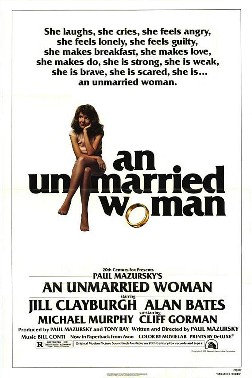
 

Embracing the Melodrama Part II #58: An Unmarried Woman (dir by Paul Mazursky)


Unmarried_womanI have mixed feelings about the 1978 best picture nominee An Unmarried Woman and I really wish I didn’t because this is one of those films that I really want to love.

Erica (Jill Clayburgh, who did not win the Oscar that she deserved for this film) appears to have the perfect life.  She works at an art gallery in New York.  She has smart, sophisticated friends.  She has an accomplished teenager daughter (Lisa Lucas).  She has a beautiful apartment.  Early on in the film, she wakes up and literally dances from her bedroom to the living room and back again.

And, of course, she has a husband.  His name is Martin and he’s a successful stock broker.  Of course, there are hints that everything might not be perfect.  She and Martin are a cute couple but they’re not exactly passionate.  One need only watch Erica carefully wash dogshit off of Martin’s expensive running shoes to tell who is getting the most out of the marriage.  Add to that, Martin is played by Michael Murphy and, as anyone familiar with 70s cinema knows, Murphy specialized in playing well-dressed, outwardly friendly heels.  And, of course, the film is called An Unmarried Woman and the title can’t be true as long as Erica’s married.

So, you’re not exactly surprised when Martin suddenly breaks down in tears and tells Erica that he’s fallen in love with a younger woman and that he’s leaving her.

The rest of the film deals with Erica’s attempts to adjust to suddenly being an unmarried woman and a single mom.  We follow as she struggles to get back her confidence.  The scenes of Erica dealing with her suddenly rebellious daughter really struck home to me, largely because I’m a rebellious daughter of divorce myself.  There’s a few great scenes of Erica turning to her girlfriends for support.  (Importantly, one of Erica’s friends is happily married, as if the film wants to make sure that we understand that not all marriages are as bad as Erica and Martin’s.)  We watch as Erica starts dating again, having a memorable one-night stand with the obnoxious but oddly likable Charlie (Cliff Gorman).  Finally, she ends up dating a rugged, bearded artist (Alan Bates) and she has to decide whether she wants to remain independent or not.

And it’s all amazingly well-acted and fun to watch but I have to admit that I was a little bit disappointed the first time that I saw An Unmarried Woman.  For some reason, I couldn’t bring myself to like it as much as I wanted.  The more I thought about it, the more clear my issue with it became.

As a character, Eric was simply too wealthy.

As I watched Erica struggle with being an unmarried woman, it was hard for me not to compare her struggles with the struggles that my own mom had to deal with after her divorce.  The film, and specifically Clayburgh’s lead performance, got so much right.  But there’s a difference — a huge difference — between an unmarried woman who has an apartment in Manhattan and a dream job at an art gallery and a woman like my mom who worked multiple jobs, spent hours worrying about how to pay the bills, and who had to do all of this while dealing with four stubborn daughters.  And so, whenever I saw Erica talking to her therapist about how upset she was over suddenly being single, there was a part of me that wanted to say, “Try doing it while living in South Dallas and having to deal with a brat like me.”

The second time that I watched An Unmarried Woman, I was able to better appreciate the film.  Now that I knew that Erica’s experiences were not going to be universal, I could focus on Jill Clayburgh’s great performance in the lead role.  I could marvel at how marvelously wimpy Michael Murphy was in the role of Martin.  I could laugh at Cliff Gorman’s comedic performance.  As for Alan Bates as that bearded artist — well, sorry, that still didn’t work for me.  Eventually, I could accept Erica’s perfect apartment and her perfect job but suddenly introducing a perfect boyfriend who also happened to be a passionate and financially successful painter; it all felt like a bit too much.

But, in the end, An Unmarried Woman is a good film and a valuable historical document of its time.  If for no other reason, see it for Jill Clayburgh’s lead performance.