“What you started here today? About to get a whole lot worse.” — Nomada
Hellfire is the kind of mid-budget, throwback action-thriller that knows exactly which bar it’s aiming for—and then mostly clears it with room to spare. Set in 1988 and built around a classic “mysterious drifter wanders into a rotten town” premise, it leans hard into familiar tropes but finds some personality in its cast, pacing, and sense of place. It’s not a game-changer for the genre, but if you’re in the mood for a lean, old-school small-town showdown, it gets the job done more often than not.
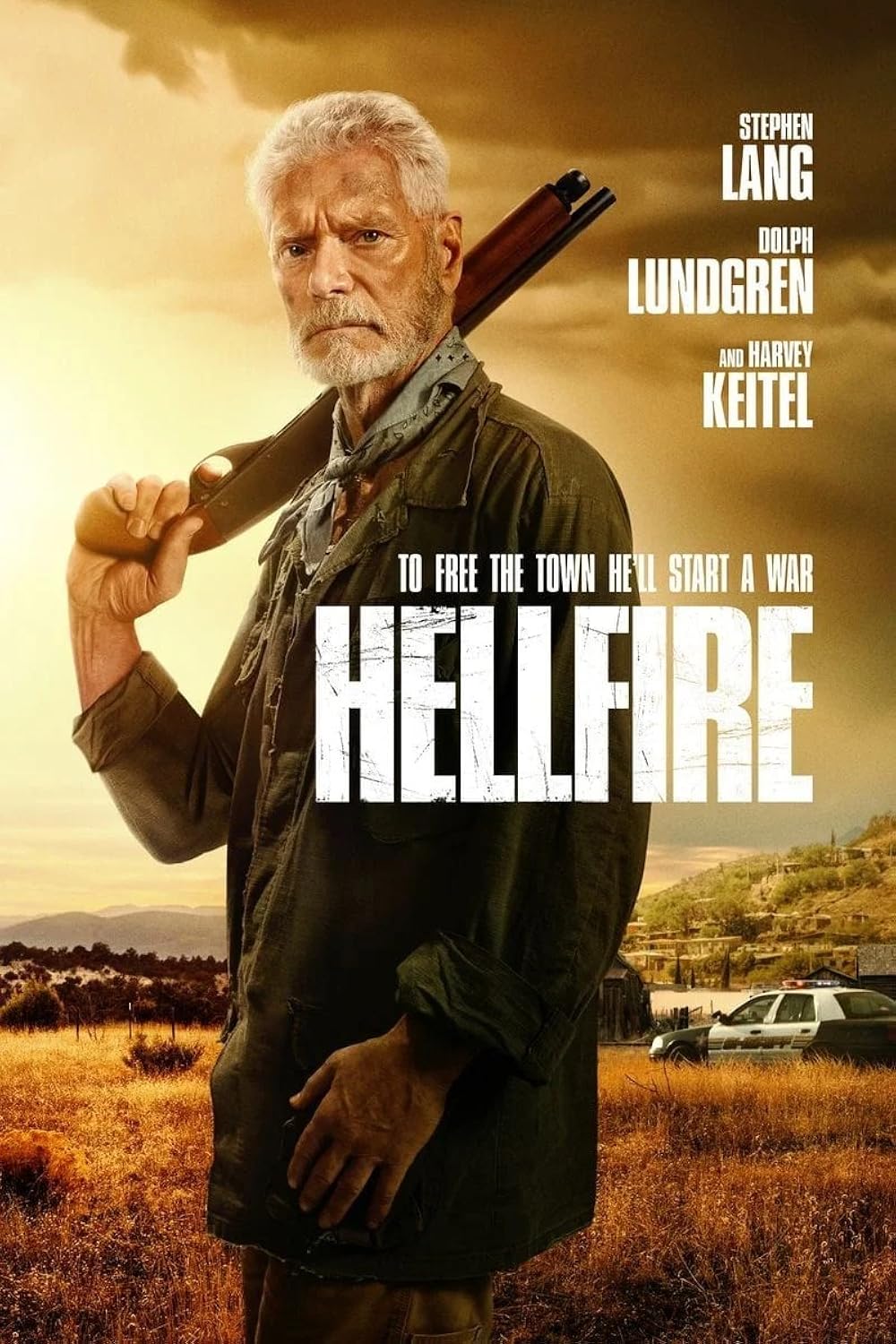
The setup is comfort food for action fans. A nameless drifter, played by Stephen Lang, rolls into the dying Southern town of Rondo, where the locals are quietly suffocating under the control of drug boss Jeremiah Whitfield, a politician-connected crime lord who pretty much owns the place. The bar owner Owen gives the drifter some work and a meal, the sheriff shows up to strongly suggest he move along, and you can basically feel the town holding its breath, waiting for somebody—anybody—to push back. That somebody, obviously, is this guy, who’s soon nicknamed Nomada and revealed to be an ex–Green Beret with a messy past and a higher capacity for violence than his weathered demeanor suggests. The story is straightforward to the point of being telegraphed, but that simplicity is part of its appeal; you always know what lane Hellfire is driving in.
Performance-wise, the movie’s biggest asset is Lang. At this point, watching him settle into the “old guy you really shouldn’t mess with” archetype is half the fun, and Hellfire plays that card well. He doesn’t oversell the trauma angle, but the film gives him just enough flashbacks and quiet beats—like those bath-time war memories—to suggest a guy who’s been stuck in fight mode for decades and doesn’t know what to do with peace. His physicality is still convincing, and director Isaac Florentine is smart about staging the action around what Lang does well, letting him move with purpose instead of pretending he’s 30 years younger. He’s not reinventing the “wandering warrior” type, but he grounds Nomada enough that you buy people trusting him even when they’re terrified. There’s a warmth under the stubble and scars that gives the character a little more dimension than the script strictly requires.
The supporting cast is a mixed bag, but the core players are solid. Harvey Keitel’s Jeremiah Whitfield is exactly the kind of villain you expect in this setup: soft-spoken, smug, and insulated by money and enforcers. He doesn’t get a ton of screen time, but there’s something appropriately gross about how casual he is with other people’s lives, like he’s already factored their suffering into his monthly budget. Dolph Lundgren shows up as the corrupt sheriff Wiley, playing the heavy who’s technically the law but functionally just another thug with a badge. Lundgren brings some weary menace to the role, and there’s a nice little tension in how much he’s genuinely bought into Jeremiah’s world versus how much he’s just too compromised to get out. Scottie Thompson’s Lena, Owen’s daughter, is the emotional anchor; she’s the one with something real to lose, and while the film doesn’t push her arc especially far, she’s likable enough that you care when things go sideways.
On the weaker end, Michael Sirow turns in a caricature performance as Spencer, the entitled and whiny son of Jeremiah, all sneers and petulance that feels like it stepped straight out of a ’80s cartoon villain playbook without any nuance to back it up. Similarly, Johnny Yong Bosch as enforcer Zeke sleepwalks through every scene that isn’t action, delivering a by-the-numbers performance for a character supposed to be the crime boss’ dangerous right-hand man; even in the fights, it’s rote and uninspired, missing the edge that could’ve made Zeke a real threat.
On the character side, Hellfire actually does a bit more groundwork than you might expect from what is essentially a B-movie revenge Western in modern dress. The early stretch spends time letting you feel the town’s exhaustion and fear—bars that are half-empty, people looking over their shoulders, everyone resigned to Jeremiah’s stranglehold. That world-building pays off once the violence kicks in, because it’s clear what’s at stake beyond simple body count or spectacle. The film also tries to deepen Nomada’s backstory, hinting at survivor’s guilt and a lingering sense that he’s been wandering from one moral debt to another, but it never quite connects those dots in a satisfying way. By the time the movie starts circling around for a full-circle emotional payoff, you can see what it’s going for, yet the groundwork feels a little thin, like pages were cut or ideas left half-developed.
Pacing-wise, Hellfire is tighter than its 95-ish-minute runtime might imply, and that’s mostly a compliment. The first half is surprisingly light on action, preferring to simmer instead of boil; you get a few scuffles and tense stand-offs, but Florentine holds back on the big fireworks. When things finally explode—hostages, ambushes, warehouses, the works—the film shifts into a mode that feels like controlled chaos, mixing gunfights, hand-to-hand scraps, and vehicle beats with a clarity that’s increasingly rare in this budget range. The trade-off is that the final act feels a bit rushed, like the movie suddenly remembered it had to tie off multiple arcs and body the main villains within a fairly strict time limit. The last stretch does what you expect it to do, including Jeremiah’s fiery fate, but it doesn’t linger long enough to fully earn the emotional weight it’s shooting for.
The action itself sits in that “serviceable to occasionally inspired” space. Florentine, coming from a background in stunt-heavy genre work, keeps things clean and legible; you always know who’s shooting at whom and from where. The shootouts can get cheesy—there’s a bit of that “nobody can hit anyone until the plot needs it” energy—but there are also flashes where staging and geography line up to deliver genuinely satisfying beats. A warehouse sequence where Nomada protects Lena while taking out multiple attackers is a standout, capturing both his tactical skill and the desperation of the situation. The film clearly favors quality over volume; genre die-hards who want wall-to-wall mayhem might wish for more set pieces, but the ones you get mostly land. If anything, some of the tonal shifts—bouncing from grim brutality to borderline goofy machismo—don’t always mesh perfectly, though that’s also kind of baked into the retro B-movie DNA.
Visually, Hellfire doesn’t reinvent the wheel, but it looks better than a lot of its DTV-adjacent peers. Shot in Arkansas and set in the late ’80s, it leans into dusty small-town Americana: sun-faded storefronts, weathered bars, lonely roads. Ross W. Clarkson’s cinematography keeps things grounded, with an emphasis on practical locations and natural light that makes the town feel like an actual lived-in place rather than a backlot abstraction. The period setting isn’t showy—you’re not constantly being smacked with nostalgia props—but it subtly shapes the world, especially in how isolated and cut-off Rondo feels without modern communication and surveillance everywhere. The score by Stephen Edwards does what it needs to do, nudging tension along without ever becoming a character in its own right.
Where the film stumbles is mostly in how predictable and occasionally clumsy it can be. You can see many of the beats coming from miles away: the town’s breaking point, the betrayals, who will die to motivate whom. There is one darker turn that genuinely catches you off guard, and it helps shake the movie out of its comfort zone for a bit, but the script overall is content to color inside the genre lines. Some dialogue leans on cliché, and a few supporting characters feel like they wandered in from a rougher first draft—the kind of broad sketches you’ve seen a dozen times before. It’s never bad enough to sink things, but it does cap how high Hellfire can climb; this is a movie that’s satisfied with solid rather than special.
Still, taken on its own terms, Hellfire works. It gives Stephen Lang a solid platform to do what he does best, surrounds him with a fun mix of seasoned character actors, and delivers enough muscular, clearly shot action to justify the ticket or rental. The town feels real enough that you actually care whether Nomada cleans it up, and the film respects the basics: clear stakes, likable underdogs, villains you’re happy to see go down in flames. If you go in expecting a tight, modest, R-rated throwback with a few rough edges and a couple of standout moments rather than a new genre benchmark, you’ll probably come away satisfied. It’s generic, sure—but it’s the kind of generic that remembers to give you characters to root for, action you can actually see, and just enough personality to make the ride worth taking.

 Through the Shattered Lens