Horror Film Review: The Seduction (dir by David Schmoeller)


Get to know your neighbors, people!

That’s really the main message that I took away from the 1982 film, The Seduction.  In The Seduction, Morgan Fairchild stars as Jamie Douglas.  Jamie is a anchorwoman for a local news channel in Los Angeles.  She has an older boyfriend named Brandon (Michael Sarrazin).  She has a sex-crazed best friend named Robin (Colleen Camp).  She has a beautiful home in the Hollywood Hills.  She’s doing wonderfully for someone whose main talent is the ability to read what’s on the teleprompter.  Much like Ron Burgundy, she’ll read whatever is put on that teleprompter without even thinking about it.  Some might say that indicates that Jamie is a fairly vacuous character and …. well, they’re right.  She is.

Jamie starts receiving flowers at work and mysterious phone calls from someone named Derek.  Derek (Andrew Stevens) is a fashion photographer.  He’s young.  He’s handsome.  He’s charismatic.  His assistant, Julie (Wendy Smith Howard), is absolutely in love with him.  In fact, Derek would seem to have it all but he’s obsessed with Jamie.  Soon, he’s breaking into Jamie’s house so that he can watch her undress and then confronting her at the mall.  At one point, he shows up in her living room and starts taking pictures of her.  Jamie screams.  Brandon beats him up.  After Derek leaves, Jamie and Brandon go to the police and ask if there’s something that they can do about Derek.  The police say that there are not many options because Derek has not technically broken the law …. uhm, what?  I get that things were different in the 80s but I still find it hard to believe that showing up in someone else’s living ro0om without an invitation and then refusing to leave would have been considered legal back then.  As you probably already guessed, Derek’s obsession soon turns lethal.

Perhaps the weirdest thing about The Seduction is that Derek is basically Jamie’s neighbor but she doesn’t ever seem to realize it.  Watching this film, there were time when I really had to wonder if maybe Jamie was just an idiot.  As well, throughout the film, Jamie reports on an unknown serial killer who is terrorizing Los Angeles.  The killer is dubbed the Sweetheart Killer and, when I watched this film, I wondered if the Sweetheart Killer and Derek were one in the same.  I don’t think that they were but, still, why introduce an unknown serial killer without providing any sort of resolution?  It’s all indicative of just how sloppy the plotting on The Seduction truly was.  That’s especially true of the ludicrous ending of the film.  A murder is committed in Jamie’s hot tub and when Jamie calls the police to report it, she’s put on hold.  Meanwhile, Derek buries the body in Jamie’s backyard and somehow manages to do it without really breaking a sweat or being noticed by anyone.  Derek’s big secret turns out to be not that much of a shock.

Morgan Fairchild’s performance isn’t great but that’s largely because she’s stuck with a character who is never allowed to behave in a consistent manner.  Andrew Stevens is a bit more convincing as Derek, playing him as a photographer who doesn’t need cocaine because he’s already get his obsessive personality keeping up at nights.  Michael Sarrazin, as Brandon, bellows nearly all of his lines and gives a performance that just shouts out, “Why did I agree to do this movie!?”  He’s amusing.  As for director David Schmoeller, he did much better with both Tourist Trap and Crawlspace.

Seriously, though, a lot of the horror and drama in this film could have been avoided by Jamie just getting to know her neighbors.  I’ve been very lucky to have some very good neighbors over the years.  When my Dad passed away, my neighbors Hunter and Hannah checked in on my nearly every day afterwards and let me use their hot tub whenever I wanted to.  Neighbors, they can be pretty special.

The Gumball Rally (1976, directed by Chuck Bail)


When he gets bored in a business meeting, Michael Bannon (Michael Sarrazin) calls his old friend, Prof. Samuel Graves (Nicholas Pryor) and says only one word: “Gumball.”  Inspired by that one word, dozens of racers assemble in New York, all planning on taking part in the Gumball Rally.

What is the Gumball Rally?  It’s a highly illegal race in which teams of two compete to see which team can drive from New York to the other side of the country in the least amount of time.  Bannon and Graves currently hold the record for completing the Gumball Rally in the quickest amount of time and all of the racers are determined to try to claim that record for their own.  Meanwhile, one cop named Roscoe (Norman Burton) is determined to break this race up.  Has there ever been a good cop named Roscoe?  Rosco P. Coltrane probably had more of a chance of stopping them Duke Boys than Roscoe does stopping the Gumball Rally.

If The Gumball Rally sounds familiar, it’s because it’s basically a less star-filled version of The Cannonball Run.  Instead of Burt Reynolds and Dom DeLuise, The Gumball Rally has Michael Sarrazin, Nicholas Pryor, Tim McIntire, and Norman Burton.  Instead of Jackie Chan making his American debut, The Gumball Rally has early performances from Raul Julia and Gary Busey.  Instead of Dean Martin and Sammy Davis, Jr., The Gumball Rally has Steven Keats and Wally Taylor.  You get the idea.  However, the lack of big stars in the cast works to The Gumball Rally‘s advantage.  Whereas you watch The Cannonball Run with the knowledge that there’s no way Burt Reynolds isn’t going to at least come in second, it seems like anyone of the eccentric teams in The Gumball Rally could win the race.

Make no mistake about it, The Gumball Rally is a car chase film, one that was released at the height of that underrated genre’s popularity.  The actors are all likable and almost all of the characters get at least one funny, personality-defining moment but the real stars of The Gumball Rally are the cars and the stunts. That’s not surprising as this film was directed by legendary stuntman Chuck Bail.  This film is full of spectacular crashes and near misses.  (The race’s lone motorcyclist is especially accident-prone.)  Again, the lack of stars in the cast (and the fact that the cast reportedly did most of their own driving) bring an added element of suspense to the stunts.  You watch The Cannonball Run and Smoky and the Bandit secure in the knowledge that Burt Reynolds is never going to crash his vehicle because he’s Burt Ryenolds.  You don’t have that same automatic security when the car is being driven by Michael Sarrazine or Tim McIntire.

It may not be as well known as some of the films that it inspired but, if you like a good car chase (or a good car crash) film, The Gumball Rally is for you.

Monster Chiller Horror Theatre: Deadly Companion (1980, directed by George Bloomfield)


Deadly Companion starts with John Candy sitting in a mental institution and snorting cocaine while happily talking to his roommate, Michael Taylor (Michael Sarrazin).  Michael has been in the institution ever since the night that he walked in on his estranged wife being murdered.  Because of the shock, he can’t remember anything that he saw that night.  When his girlfriend Paula (Susan Clark) comes to pick Michael up, Michael leaves the institution determined to get to the truth about his wife’s murder.  Once Michael leaves, John Candy disappears from the movie.
Michael suspects that his wife was killed by her lover, Lawrence Miles (Anthony Perkins) but there is more to that night than Michael is remembering.  Deadly Companion is a typical low-budget shot-in-Toronto thriller from the early 80s, with familiar Canadian character actors like Michael Ironside, Al Waxman, Kenneth Welsh, and Maury Chaykin all playing small roles.  Michael Sarrazin is a dull lead but Anthony Perkins gets to do what he did best at the end of his career and plays a thoroughly sarcastic bastard who gets the only good lines in the film.

What’s interesting about Deadly Companion isn’t the predictable plot and it’s certainly not Michael Sarrazin.  Instead, what’s strange is that several cast members of SCTV show up in tiny supporting roles, though none of them get as much of a chance to make as big an impression as John Candy.  Deadly Companion is a serious thriller that just happens to feature Candy, Joe Flaherty, Eugene Levy, Catherine O’Hara, and Dave Thomas.  It’s strange to see Michael Sarrazin trying to figure out who killed his wife while Eugene Levy loiters in the background.  It leaves you waiting for a punchline that never comes.

The SCTV people are in the film because it was directed by George Bloomfield, who also directed several episodes of SCTV.  Since this film was made before SCTV really broke into the American marketplace, it was probably assumed that no one outside of Canada would ever find the presence of John Candy in a dramatic murder mystery distracting.  Of course, when Deadly Companion was later released on VHS in the late 80s, Candy and the SCTV crew were all given top billing.

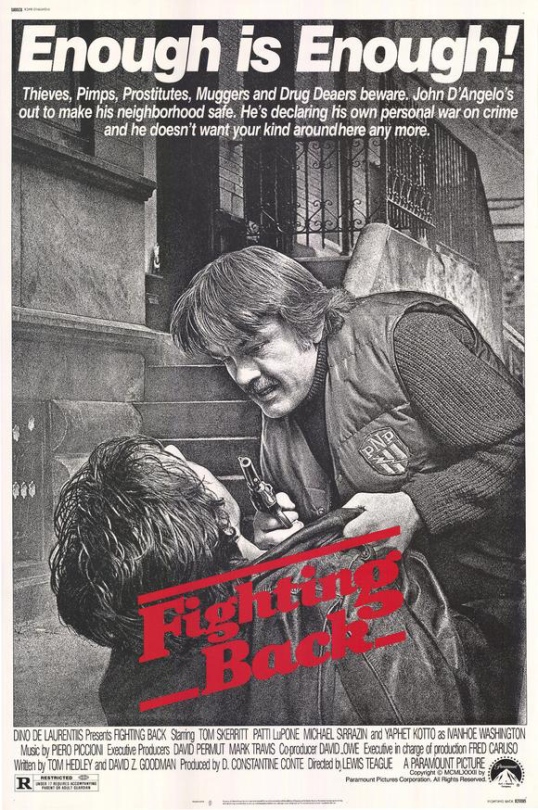
A Movie A Day #38: Fighting Back (1982, directed by Lewis Teague)


fightingbackpost

The time is 1982.  The place is Hell on Earth, also known as Philadelphia.  Crime is out of control and the police are powerless to stop it.  When deli owner John D’Angelo (Tom Skerritt) and his wife, Lisa (Patti LuPone), confront a pimp named Eldorado (Pete Richardson), he rams his car into the back of their car, causing the pregnant Lisa to lose her unborn child.  At almost the exact same time, John’s mother (Gina DeAngles) is mugged by two thugs who chop off her ring finger.

In the grand tradition of Charles Bronson, John decides to fight back.  But he doesn’t go it alone.  With his best friend, a police officer named Vince (Michael Sarrazin), John starts the People’s Neighborhood Patrol.  The PNP is going to clean up Philadelphia, one street at a time.  The media (represented by David Rasche) make John into a celebrity.  The black community (represented by Yaphet Kotto) suspect that John and the PNP are guilty of racial discrimination.  The Mafia wants to bring John over to their side.  John runs for city council but he still has time to drop a grenade in a pimp’s car.

Fighting Back was one of the many urban vigiliante films to come out after the success of Death Wish.  Fighting Back‘s producer, Dino De Laurentiis, also produced Death Wish but made the mistake of later selling the rights to Cannon.  Fighting Back was not the box office success that either Death Wish or its sequels were, even though Fighting Back is actually the better movie.  That’s because Fighting Back was directed by the underrated Lewis Teague.  Teague does a good job of making Philadelphia look like a war zone and the scenes of vigilante justice are enjoyable but, overall, Teague takes a far more ambiguous approach to vigilantism than Michael Winner did when he directed Death Wish.  As vile as Philadelphia criminals may be, John D’Angelo isn’t always that likable himself.  When Kotto accuses John and the all-white PNP of being racially prejudiced, Teague suggests that he has a point.  Tom Skerritt gives a good performance, playing John as a proud, blue collar guy who wants to do the right thing but gets seduced by his newfound celebrity.

Better acted than Death Wish and smarter than The Exterminator, Fighting Back is an underrated vigilante gem.

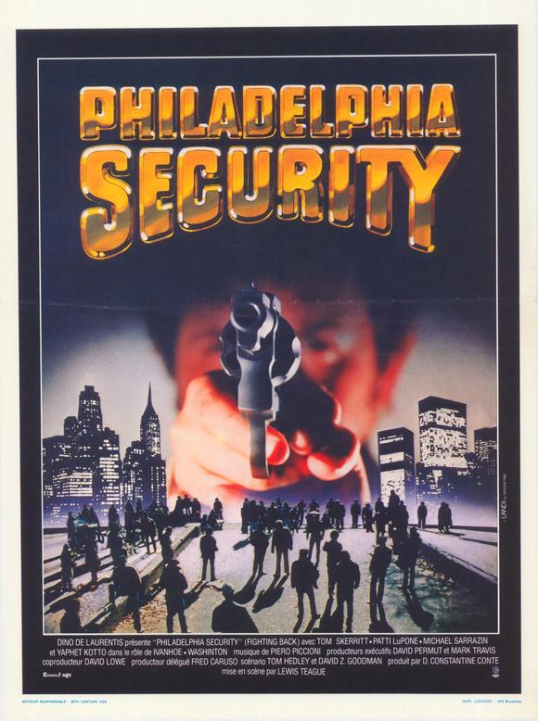
Fighting Back is also known as Philadelphia Security and Death Vengeance.

Fighting Back is also known as Philadelphia Security and Death Vengeance.

Embracing the Melodrama Part II #30: The Sweet Ride (dir by Harvey Hart)


The_Sweet_Ride_FilmPosterThe 1968 film The Sweet Ride takes the audience on a ride through Malibu and reminds us all that, in many ways, the 1960s sucked.

The Sweet Ride opens with actress Vicki Cartwright (Jacqueline Bisset) losing her top while swimming in the ocean.  While Vicki panics and tries to figure out how to get back to the beach without anyone seeing her breasts, she’s spotted by a surfer named Denny McGuire (Michael Sarrazin).  Denny hands her a towel and then leads her back to the beach house that he shares with aging tennis player Collie (Anthony Franciosa) and stoned musician Choo-Choo (Bob Denver).

The rest of the film is a 90 minute tour of California beach life in the late 60s.  Despite Collie’s cynical warning against falling in love, Denny does just that, despite the fact that Vicki refuses to tell him anything about her past or even where she lives.  Meanwhile, Collie spends his time hustling on the tennis court and the married Choo-Choo pretends to be gay in an attempt to get out of being drafted.  (Choo-Choo probably could have gotten out of the draft by pointing out that he appears to be 40 years old but the filmmakers decided to have him walk around with a poodle and speak in falsetto.  Just in case you had any doubt that this film was made in 1968…)  It’s a mix of comedy, romance, and drama and it’s features footage of some real bands performing in actual Malibu nightclubs and that’s a good thing for all of us history nerds.

And, since The Sweet Ride was made in 1968, the whole film gets progressively darker as it reaches its conclusion.  Choo-Choo does get drafted and it’s hard to believe he’ll survive a day in Viet Nam.  Collie’s perfect life is revealed to be an empty facade.  Denny realizes that his friends are all immature losers.  And Vicki ends up getting assaulted by a high-power studio executive (Warren Stevens).  It all leads to more violence, disillusionment, and general ennui.

For some reason, The Sweet Ride shows up on FXM fairly regularly.  It’s a strange film because it doesn’t really work and yet it’s also compulsively watchable.  It tries to be about everything and, as a result, it often feels like it’s about absolutely nothing.  And yet, somehow, it remains compelling…

Why is the film compelling despite itself?  It’s not because of the main characters, that’s for sure.  The boys in the beach house are probably some of the least likable film protagonists in cinematic history.  Anthony Franciosa gave some great performances in his career (check him out in A Face in the Crowd and Tenebrae) but Collie is such a smug jerk that you find yourself hoping that someone will just punch him in the face.  Meanwhile, Denny tends to come across like a weak-willed and obsessive stalker and Choo-Choo — well, Choo-Choo often seems to be a character in a totally different movie.  As for Vicki, her character pretty much exclusively exists to be victimized.

Ultimately, I think The Sweet Ride is watchable because it is such an imperfect time capsule.  If I wanted to know what it was like to be alive in the 60s, The Sweet Ride is one of the films that I would watch.  It’s not the best film ever made but it is a chance to look into the past.

(Incidentally, The Sweet Ride was directed by Harvey Hart, who also directed the underrated Shoot.)