Brad reviews MY OLD MAN (1979) – starring Warren Oates and Kristy McNichol! 


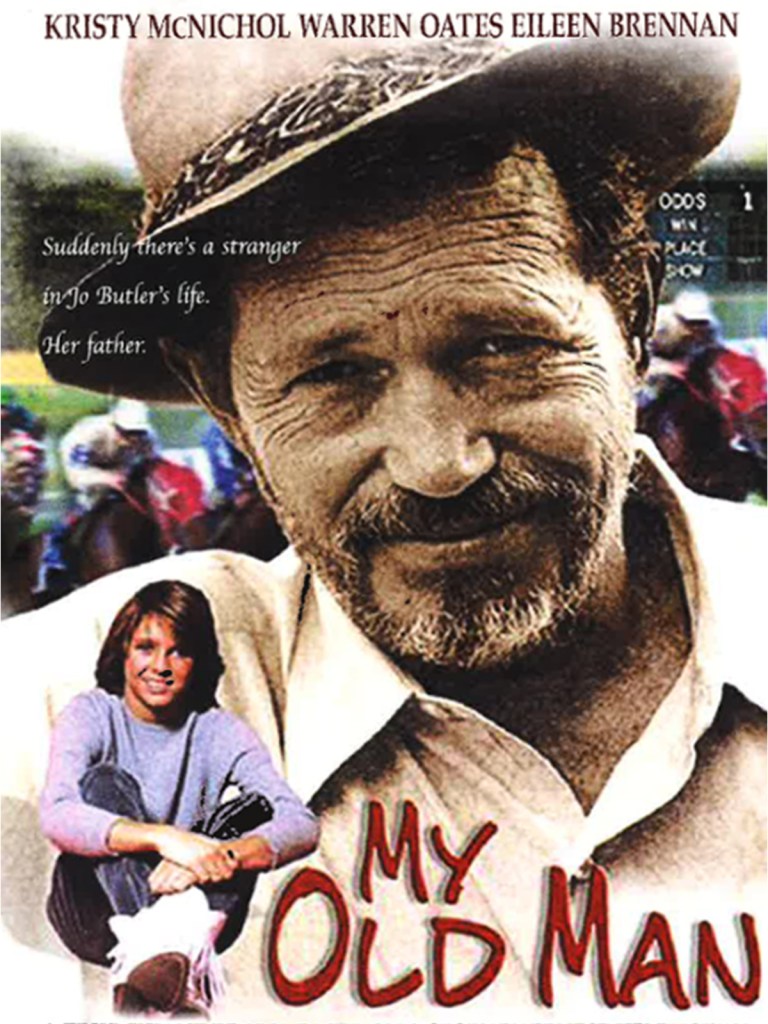
In my continuing celebration of Warren Oates’ birthday, I decided to check out his 1979 TV movie MY OLD MAN, with Kristy McNichol. Based on a 1923 short story from Ernest Hemingway, Oates stars as Frank Butler, an alcoholic horse trainer and compulsive gambler, who goes to see his 16-year-old daughter, Jo (Kristy McNichol) after the death of her mother. In an effort to have some sort of relationship with Jo, Frank asks her to spend the summer with him, where he introduces her to his world of horse racing, as well as his old flame Marie (Eileen Brennan). Things get off to a rocky start, but with time the two start to develop a loving and meaningful relationship. Frank’s notorious bad luck even changes for the better for a while, and he’s able to buy Jo her own racehorse. Unfortunately, just as things are starting to go well, Frank suffers a life threatening injury in the horse stables, and Jo is faced with the possibility of having to take on life without her mother or her father… 

For a 1979 TV movie, I enjoyed MY OLD MAN. I like Warren Oates as the grizzled father who wants a relationship with his daughter but who also has no idea of how to go about it. He’s cranky and not happy to have someone else to answer to, but he also shows just enough vulnerability that we believe that he has a chance to be a caring dad. Kristy McNichol also does a good job as the 16 year old daughter who wants to get to know a dad that she’s only been told about thus far in her life, with most of those things not being very good. For this movie to work, their relationship has to work. I think both Oates and McNichol effectively express their characters’ desires to connect with each other simply because they’re father and daughter and that means something. As the father of a daughter myself, I know firsthand that our bond is truly special and one of the most important things in my life. And I’ll do anything to keep it that way. 

Aside from the central relationship between Frank and his daughter Jo, I also like the relationship between Frank and his old flame, the waitress Marie (Eileen Brennan). Brennan is very good in the role and effectively conveys her character’s strong love for Frank. Frank needs her and even tells his daughter at one point, “No matter what was going on with me, she never lost her respect for me, and she never stopped caring about me. To me, that shows a lot of class.” From my perspective, I know that all of us guys need someone like Marie in our lives. I’m extremely blessed to have my own “Marie,” even if she does go by a different name. I do want to mention one more relationship in the film that’s interesting, and that’s between Frank and his former jockey George, played by a young Michael Jeter. The two have a bad past that rears its head over the course of the film, and Jeter acquits himself quite well acting against the seasoned veteran. 

Overall, I enjoyed MY OLD MAN as it worked its way through its themes of family reconciliation and personal redemption. The last 20-30 minutes wasn’t quite as effective for me when the TV movie melodrama really kicked in. It still had some good moments, but it felt a little more forced once the focus shifted away from the relationships being developed by the central characters. With that said, I watched this movie in celebration of Warren Oates, and he’s just as great as I had hoped. He’s more than enough reason to watch the film even if it’s not perfect. 
I review TRUE CRIME (1999) – starring Clint Eastwood and James Woods!


Here at The Shattered Lens, we’re celebrating Clint Eastwood’s birthday on May 31st. I decided to revisit his 1999 film, TRUE CRIME. 

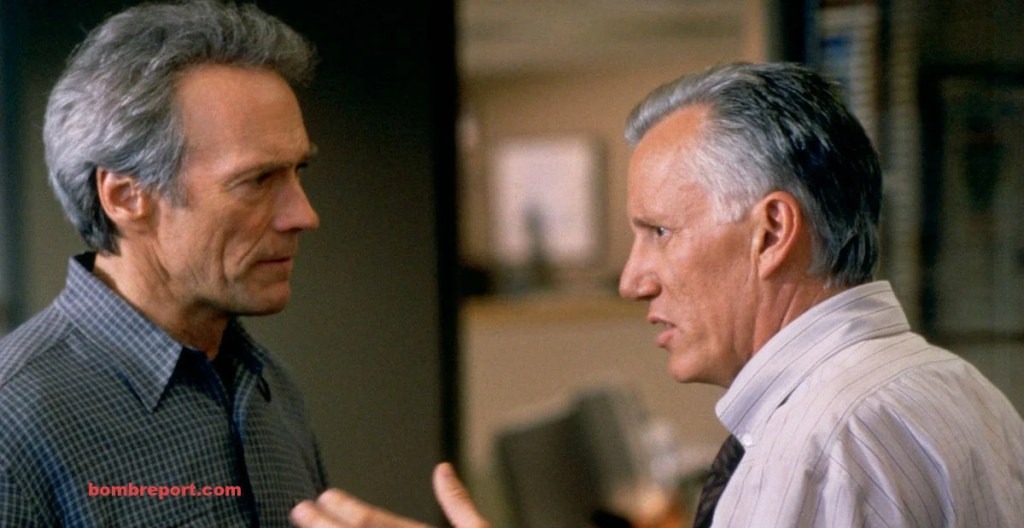
Clint Eastwood directs and stars as ace journalist, Steve Everett, who also happens to be a bad friend, a terrible dad, and an even worse husband. Literally the only thing that he’s got going for him is his “nose,” his ability to sniff out a story where no one else can. Even that has begun to fail him, mostly due to his recents bouts with alcoholism, which he seems to somewhat have a handle on at the time of this story. When a young, beautiful colleague tragically passes away in an auto accident, Steve is given her previous assignment to cover the execution of convicted murderer Frank Beechum (Isaiah Washington). Not the kind to write a human interest “puff piece” like the Oakland Tribune is wanting, Everett begins digging into the past and pretty soon that nose of his starts telling him that Beechum is a victim of circumstantial evidence. Despite his editor Bob Findley’s (Denis Leary) objections, he’s able to convince his newspaper boss Alan Mann (James Woods) to let him dig deeper into the story. As he tries to juggle his myriad personal problems with his growing belief in Beechum’s innocence, Everett is also facing a clock that is ticking down to the midnight execution. Will he be able to find the crucial piece of evidence that will set Beechum free?

TRUE CRIME appears to be somewhat of a forgotten Clint Eastwood film. I saw it at the theater when it came out in 1999, but it was not financially successful, only bringing in $16 Million at the box office. Regardless of that, I still love the film. It’s certainly not perfect. It’s probably too long, Beechum is probably too angelic after being “born again,” and the resolution may be a little unrealistic, but I still enjoyed every second of it. One of the coolest things about Clint Eastwood is his willingness to play such flawed men on screen, yet we still love him. He’s great in this film! Anyone who’s read much of my work knows that my love of actor James Woods goes back to being in junior high and renting his movies BEST SELLER and COP. It’s such a treat seeing the legendary pair on screen together even if Woods’ role is sort of a glorified cameo. Woods is hilarious in his limited screen time. My last shout out is to Isaiah Washington as the innocent man who’s about to be put to death. After all these years and appeals, he’s accepted his fate, but the scene where he tells Everett his story and Everett tells him that he believes he’s innocent is so powerful. Add to that Washington’s scenes with his wife and daughter, and I was very much emotionally invested in this film. Washington’s performance was key to the film working, and he’s great!

Overall, TRUE CRIME is a film that takes its sweet time, but it ultimately tells a tense, engrossing story that ratchets up the tension to 10 prior to its last second resolution. I consider it very underrated and highly recommend it. I’ve included the trailer below:

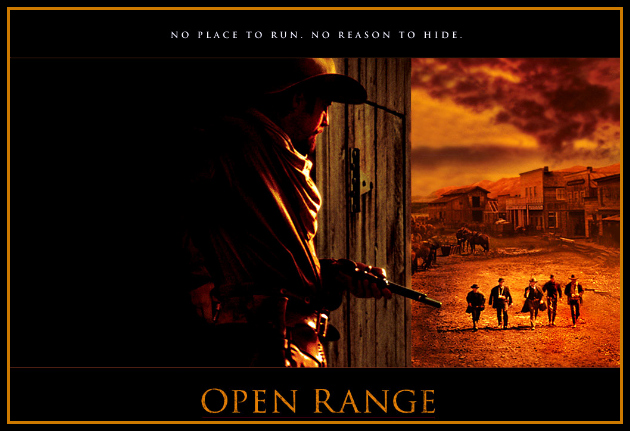
Review: Open Range (dir. by Kevin Costner)


2003 marked a sort of a small comeback for Kevin Costner both as a director and as an actor. The work in question was the very well-done Western, Open Range. Open Range was a moderately budgeted film which has more in common with Costner’s first directorial work, Dances with Wolves than his last big-budget flop, The Postman.

The film was an adaptation of the Lauran Paine novel, The Open Range Men, and it captures much of the themes found in the novel. This was probably due to the fact that screenwriter Craig Storper didn’t deviate from the novel’s basic story. There were no superfluous action sequences and gunfights to ratchet up the action. Everything about Open Range was about the gradual and inevitable final confrontation between the “free-grazers” and the “barbed-wire” men. The free-grazers were played by Kevin Costner and Robert Duvall as Charles Waite and Boss Spearman, respectively. On the other side of the conflict was Michael Gambon playing Denton Baxter, the ruthless land-baron whose attempt to keep the free-grazers from grazing on his land also hides another agenda. Caught in-between these two strong-willed groups were the people in the town Baxter pretty much controls through his “town marshal” (played with fake bravado by James Russo) and the herd helpers under Boss Spearman’s employ.

The theme of freedom to roam the open country versus the rights of a landowner echoes throughout the film. Set in the latter end of the 19th-century, Open Range shows the clash of the more natural ways of the Old West slowly eroding to be replaced by the more industrial, monopolistic practices that became prevalent during the 1880’s, also known in US History as the Gilded Age. Even the personalities of the conflicting characters mirror this theme as the free-grazers only want to use the land as it has been used for years upon years and thats sharing between all men of the West. The land-baron has other ideas in mind and everything boils down to him owning everything around him, even if it means using ruthless tactics to gather even more property.

Open Range also has a bit of modernism in its subplot of Charley Waite’s growing attraction to the sister of the town doctor and the same sister’s well-rounded characterization. It’s not often that a traditional Western shows women in a very positive light instead of the usual submissive and stay-at-home characters of Western’s past. This could also be attributed to the wonderful, underrated performance by Annette Bening who plays Sue Barlow, the doctor’s sister and Charley Waite’s love interest. Bening doesn’t play Sue as the traditional Western female. She also doesn’t go overboard and turn Sue into a 20th-century feminist. She instead plays the character as someone who knows her place in the world, but also one who is strong-willed and willing to stand for what is right.

Open Range was a wonderful throwback to what made such modern Westerns like Unforgiven and Tombstone such a success both for traditionalists and new fans. Kevin Costner’s direction was very low-key. Allowing the story to tell itself at its own pace until the final confrontation. The final gunfight in the end gets a lot of well-earned attention from critics and fans. The entire sequence takes at least 10-15 minutes from start to finish. The fight itself was done in a realistic fashion. There was no sharpshooter dead-eyes in this film, but individuals who had skill but still missed. It was a fight where it wasn’t who was the fastest, but who was the calmest under fire. There’s also a suddenness to the brutality in the final gunfight that demystifies the old-style Western shootouts of past. Some complained that the film was very slow and took too long to get to the “good stuff”, but I actually thought the gradual pacing of most of the film’s length gave the final confrontation even more impact. Costner seem to have learned the lesson all good directors know: less means more.

Open Range won’t go down as a great piece of film making. It surely won’t go down as one of the best in history. What Open Range did accomplish was putting the Western back to its epic and majestic roots, but at the same time keeping the intimacy of a character-driven story. In time, Open Range would probably go down as one of the underrated gems of the last decade and find a place next to its closest comparison, Unforgiven, as one of the best Westerns of the new era.