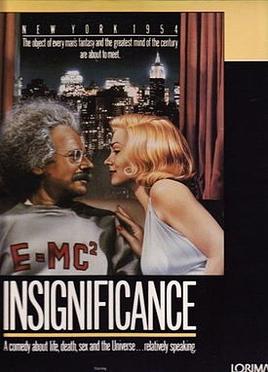
The 1985 film, Insignificance, opens in New York City in the 1950s.
On the streets of New York, a crowd has gathered to watch as the Actress (Theresa Russell), a famous sex symbol, is filmed standing on a grate while wearing a white dress. Beneath the street and the Actress, a fan has been set up and the crowd of onlookers cheers as the Actress’s skirt is blown up around her hips, again and again. Standing in the crowd, the Actress’s husband, the Ballplayer (Gary Busey), watches and shakes his head in disgust. After the scene has been shot, the Actress hops in a taxi while the Ballplayer chases after her. A very famous man is in town and the Actress is on her way to pay him a visit.
In a nearby bar, the Senator (Tony Curtis), drinks and talks and sweats. Though it may not be obvious from looking at him, the Senator is a very powerful man. He’s leading an investigations into subversives who may be trying to bring down the United States government. He may look like a small-time mobster but the Senator can make and destroy people on a whim. He’s come to New York on a very specific mission. He and his goons are planning on pressuring another famous man into testifying before the Senator’s committee.
Though they don’t know it, both the Actress and the Senator are planning on dropping in on the same man. The Professor (Michael Emil) is a world-renowned genius. When we first see him, he is sitting alone in a hotel room and looking at a watch that has stopped at 8:15. The public may know the Professor for his eccentricities but, in private, he is a haunted man. The Professor’s work was instrumental in the creation of the first atomic bomb. And now, with both the U.S. and Russia stockpiling their atomic arsenals and the world seemingly on the verge of war, the Professor fears that his work will be the end of humanity.
Though none of the characters are actually named over the course of the film, it should be obvious to anyone with even a slight knowledge of American history that the four main characters are meant to be versions of Marilyn Monroe, Joe DiMaggio, Joe McCarthy, and Albert Einstein. Insignificance imagines a meeting between these four cultural icons and really, it’s not difficult to imagine a scenario in which they all could have met. Joe DiMaggio actually was present during the filming of the subway grate scene from The Seven Year Itch and most accounts record his reaction as being not that different from what’s portrayed in Insignificance. Albert Einstein was suspected of having communist sympathies and several scientific figures (including many who worked on the Manhattan Project) were investigated during the McCarthy era. Finally, Marilyn Monroe was often frustrated by her “dumb blonde” image and said that she found Albert Einstein to be a very attractive man. When she died, a biography of Einstein was reportedly found on her nightstand.
In the film, the Senator pressures The Professor to appear before his committee. It’s not long after the Senator leaves that the Actress arrives. The Actress announces that she’s fascinating by the theory of relativity and, using balloons, toys, and a flashlight, she proceeds to demonstrate the theory for the Professor. The befuddled Professor is impressed. The Actress informs the Professor that he’s at the top of her list. Meanwhile, downstairs in another hotel room, the Senator is met by a prostitute who bears a resemblance to the Actress. The Ballplayer sits in the hotel bar, tearing up a picture of the Actress and wondering why their marriage is failing.
Because this film was directed by Nicolas Roeg, the film is full of seemingly random flashbacks. We see the Senator as an altar boy, trying to impress a smiling priest. We see the Ballplayer getting yelled at by his domineering father. We see the Actress, growing up poor and being ogled, at first by the young boys at an orphanage and later by Hollywood execs. Meanwhile, The Professor continually sees the destruction of Hiroshima. His visions are apocalyptic and, towards the end of the film, he even gets a glimpse into a possible future of atomic hellfire. It’s a film about fame and cultural transition, a film where people look to celebrities for hope while doomsday comes closer and closer.
Or something like that. To be honest, I wanted to like Insignificance more than I actually did. As is typical with so many of Nicolas Roeg’s films, Insignificance has an intriguing premise but the execution is a bit uneven. There are moments of absolute brilliance. Theresa Russell and Gary Busey both give perfect performances and the film’s final apocalyptic vision will haunt you. And then there are moments when the film becomes a bit of a slog and the dialogue starts to get a bit too pretentious and on-the-nose. Michael Emil has some good moments as the Professor but there are other moments when he seems to be lost. Meanwhile, Tony Curtis gives such a terrible performance as The Senator that he throws the entire film off-balance. Curtis bulges his eyes like a madman and delivers his lines like a comedian doing a bad 1930s gangster impersonation.
That said, Insignificance is still an interesting film. It’s uneven but intriguing. Though the film may take place in the 50s and may deal with a quartet of historical figures, it’s themes are still relevant in 2020. People still tend to idealize celebrities. Politicians still hold onto power by exploiting fear. The possibility that everything could just end one day is still a very real one. Insignificance is a film worth watching, even if it doesn’t completely work.

 Through the Shattered Lens