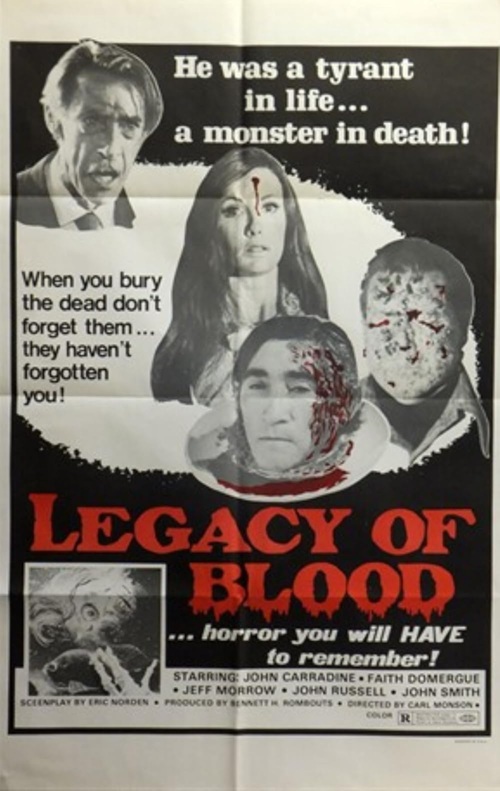
October Hacks: Blood Legacy (dir by Carl Monson)


a.k.a. Blood Legacy

In this 1971 film, John Carradine briefly plays Christopher Dean, a wealthy man who hated his family and his servants.  He dies before the film actually begins but we do get to see him in flashbacks and we also hear his voice at the reading of his will.  Dean leaves a fortune to his children and his servants, but he does so only on the condition that they spend a week at Dean’s estate.  If anyone dies or leaves the estate, they will lose their inheritance and the money will be split amongst those who stayed and/or survived.  You can see where this is leading, right?

This is actually a promising premise and it’s easy to imagine how it could have inspired an American version of Mario Bava’s Bay of Blood, where one person is killed by another just for that killer to then be killed by someone else until eventually, there’s no one left.  Unfortunately, while the characters are all unpleasant and greedy, none of them are as memorable as anyone in Bava’s classic shocker.  They’re all generic jerks and, as such, it’s hard to have much of a reaction when they start dying.  The film does feature several familiar B-movie stars.  Jeff Morrow and Faith Domergue (both of whom were in This Island Earth) appear as brother and sister.  Richard Davalos (who played James Dean’s brother in East of Eden) has an eccentric role.  Western character actor Rodolfo Acosta plays the sheriff who eventually takes an axe to the forehead.  B-movie veteran Buck Kartalian plays Igor, the butler.  (His name is actually Igor!)  Some of the members of the cast were good actors but few of them are particularly good in this film.  I did appreciate the weird energy of Buck Kartalian.  John Carradine doesn’t do much but he does deliver his lines with the proper amount of contempt.

The film does have a few vaguely interesting kills.  Bees are used as a weapon at one point.  A head is found in a refrigerator and Richard Davlos says, “This is just like a horror movie.”  Wow, Richard, thanks for sharing!  There’s a big twist ending but it really not that impressive of a twist.

Probably the most interesting thing about Blood Legacy is that it’s essentially a remake of Andy Milligan’s The Ghastly Ones. (Director Carl Monson had a habit of ripping off other films.  In 1973, he remade Roger Corman’s Little Shop of Horrors.  Monson called his remake Please Don’t Eat My Mother.  The film starred Buck Kartalian.)  Blood Legacy was originally released under the title Legacy of Blood but Milligan was so annoyed at being ripped-off that he later made his own remake of The Ghastly Ones and decided to give it the same title as Carl Monson’s rip-off.  Monson changed his film’s title and distributed it under the names Will To Die and Blood Legacy so that it wouldn’t be confused with Andy Milligan’s Legacy of Blood.  It makes sense.  Why would anyone want their Andy Milligan rip-off to be confused with an actual Andy Milligan film?
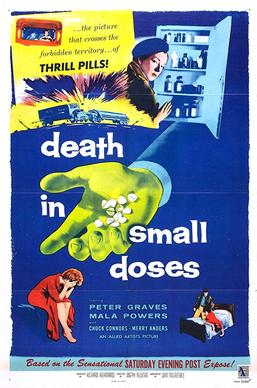
30 More Days of Noir #10: Death in Small Doses (dir by Joseph M. Newman)


Ah, speed.

I have to admit that I always find films about amphetamines to be fascinating because I take them for my ADD.  I’ve been taking Dexedrine since I was in middle school and it has always amused me how people who don’t have ADD seem to think that the meds will give you super powers.  For instance, every season of Big Brother, there’s people online who get outraged over certain houseguests taking Adderall.  “She had an unfair advantage!” someone will say, “Because she’s taking Adderall!”  What can I say?  People who don’t have ADD just don’t get it.  Yes, if you have ADD, the meds can help you focus but it’s not like they’re going to give you any sort of special power that’s not available to any other person.

(I will admit that there is a slight difference between me on my meds and me off my meds.  Actually, my family says that there’s a huge difference but I think they’re exaggerating.  It is true that I’m a lot more focused when I take my Dexedrine.  My mind wanders a bit less than usual and I’m also usually in better control of my frustrations.  When I take my meds, I can finish any project.  When I don’t take them, I can talk about finishing any project.)

Dexedrine focuses me but apparently, it does the opposite for those who don’t have ADD.  The 1957 film, Death in Small Doses, features a truck driver named Mink Reynolds who, despite not having ADD, pops too many capsules and ends up playing really loud music and trying to force a waitress to dance with him.  He also hallucinates seeing a car and then grabs a knife and tries to kill another truck driver.  To be honest, that seems a bit extreme to me.  In fact, I’d almost argue that Mink’s behavior would indicate that the filmmakers really didn’t know much about amphetamines.  Making things even stranger is that Mink is played by Chuck Connors, who was a remarkably inexpressive actor.  Watching Connors, with his stone face, trying to dance and jump around is an interesting experience.  Mink is supposed to be a jazz-crazed, speed-abusing hepcat but instead, he comes across like an animatronic mannequin.  You can almost hear the gears shifting whenever he has to move across the screen.

Mink’s fellow truck driver is Tom Kaylor (Peter Graves), a seemingly upright man who is usually seen wearing a tie and who looks like he would be more comfortable working behind a desk than driving a truck.  Of course, that’s because Tom is actually an FBI agent!  He’s working undercover, pretending to be a truck driver so that he can smash a ring of drug dealers!  Of course, the problem here is that everything about Peter Graves’s screen presence shouts out, “Narc!”  With his square jaw and his perfect haircut and his stiff but authoritative delivery of his dialogue, he seems like he was created in a lab that specifically set out to develop the most stereotypical FBI agent imaginable.  There’s not a single rough edge to him and it’s hard to buy that the other truck drivers wouldn’t see straight through him.

While Tom tries to bust the ring, he also finds time to possibly fall in love with two different women, both of whom seem as if they might know more than they’re letting on.  Amy (Merry Anders) is the waitress who has developed a drug habit of her own.  Val (Mala Powers) owns the boarding house when Tom and Mink live.  Can Tom trust either one of them?  And will Tom not only undercover the identity of the head of the drug ring but also survive long enough to bring the dealers to justice?

So, here’s the thing.  During its worst moments — i.e., whenever Chuck Connors is jumping all over the place and talking about how much he loves his friend “benny” — this is a campy and rather silly film that makes Reefer Madness look subtle by comparison.  However, during its best moments, this is a tough and entertaining noir that features good performances from Merry Anders and Mala Powers.  Both Anders and Powers manage to transcend the film’s sillier moments and they actually bring a charge of reality to the story.  And while director Joseph M. Newman may not have known much about drugs, he did know how to shoot a fight scene.  Making good use of its desolate locations (the truck drivers spend a lot of time driving through the desert) and setting many of the film’s best moments at night, Newman overcomes some of the script’s weaker moments.  In the end, it makes for a rather uneven but entertaining viewing experience.  Despite the film’s cluelessness about drugs and the miscasting of both Graves and Connors, this lesser-known noir is worth tracking down.

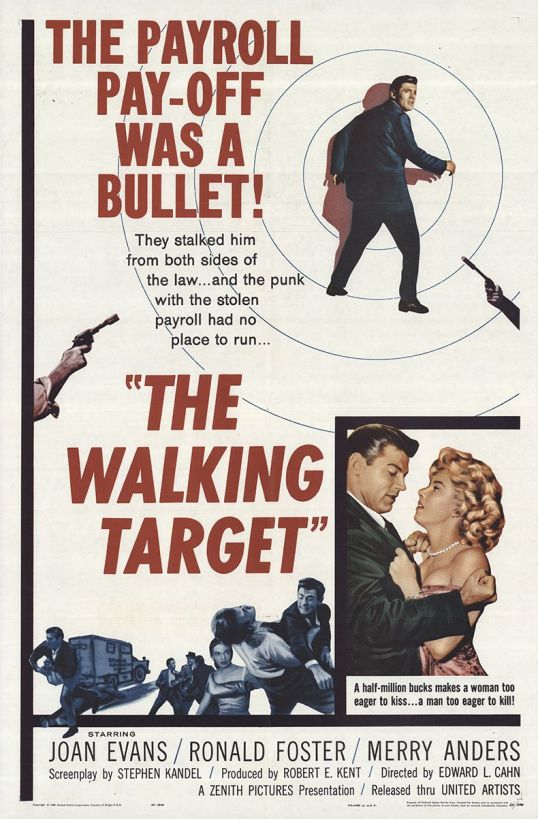
30 More Days of Noir #9: The Walking Target (dir by Edward L. Cahn)


In this 1960 noir, Nick Harbin (Ronald Foster) is a walking target!

That’s because he’s just been released from prison.  As the only survivor of a gang that pulled off a daring payroll robbery, Nick has done his time and he’s ready to get on with his life.  He even got himself an education while he was behind bars.  He’s decided to reform and no longer be the angry criminal that he once was.

But first, there’s a little matter of some money.

Only Nick knows where he buried the loot from the robbery.  Everyone wants it.  The press wants to know because it’ll make a great story.  A nosy detective wants to know because he’s convinced that Nick hasn’t changed his ways.  Susan (Merry Anders), who used to be involved with one of Nick’s criminal associates, wants to know because she’s only in it for the cash.  Susan’s current boyfriend, Dave (Robert Christopher) wants to know because …. well, again, it all comes down to greed.  Greed is also what’s motivating a local gangster to provide backing for Susan and Dave in their quest to find the money.  Dave is even willing to send Susan to seduce Nick.

However, all Nick wants to do is find the money and then split it with Gail (Joan Evans).  Gail is the widow of one of the robbers and Nick wants to do the right thing for her.  Of course, Nick is himself kind of in love with Gail.  Can Nick get the money, find love with Gail, and avoid slipping back into his criminal ways?  It won’t be easy.  Life is never easy when you’re….

THE WALKING TARGET!

Okay, that was a little bit melodramatic on my part but then again, it’s a melodramatic film.  Everyone is constantly plotting and double-crossing.  Appropriately, it all leads to a battle in the desert as modern-day outlaws prove themselves to be no more trustworthy than their vintage ancestors.

The Walking Target is a low-budget noir, one that clocks in at only 70 minutes and which, as a result, doesn’t waste much time when it comes to jumping into its story.  That’s one good thing about these B-movies.  They had neither the budget nor the time for red herrings.  As a result, you pretty much know what you’re going to get before the movies even begins.  The Walking Target features all of the usual tough dialogue and morally ambiguous characters that you would expect to see in a noir.  Merry Anders is an adequate femme fatale, though I do wish that Susan had been a smarter character.  (Nick sees through her way too easily.)  The film opens with the prison’s warden telling Nick that, even though he’s done his time, he’ll always be a no-good crook and that’s the perfect way for a noir to open.  Unfortunately, the film’s cinematography doesn’t really have the right noir look.  There aren’t enough shadows and the film often looks like it could just be an episode of an old TV show.  I guess that’d due to the budget but it really does keep the film from making the transition from being good to being great.

The Walking Target is a diverting-enough film.  I liked Ronald Foster’s uneasy performance as Nick and it was enjoyable to watch everyone plotting and scheming.  The Walking Target is currently available on Prime and I recommend it to anyone looking for a good, if lesser-known, B-noir.

Stage Fright: THE HYPNOTIC EYE (Allied Artists 1960)


gary loggins's avatarcracked rear viewer

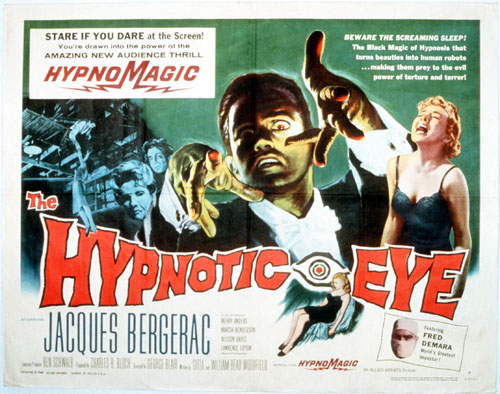
The Hypnotic Eye (1960) Directed by George Blair Shown: Lobby card

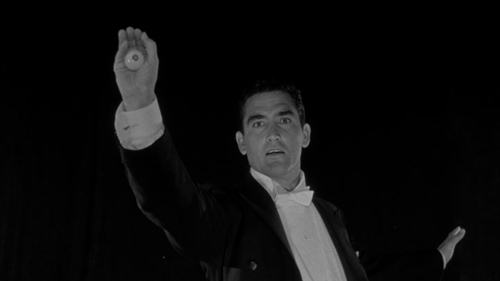
Evil hypnotists have been a movie staple since Svengali first mesmerized Trilby in 1911, but THE HYPNOTIC EYE is in a class of its own. This demented little tale is sufficiently creepy enough to overcome its meager budget limitations, and features the Ice Queen of Horror, Allison Hayes, in the pivotal role of Justine, assistant to master trancemaker Desmond.

hypno2

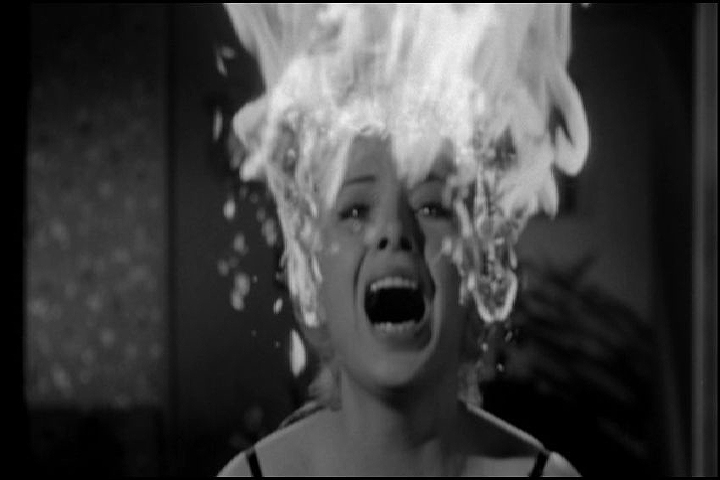
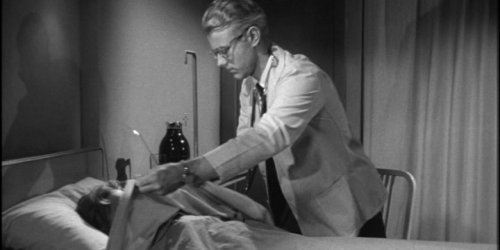
We start with an opening shot of a woman, thinking she’s washing her hair, sticking her head directly into the flame of a stove pilot. That’ll get your attention! A series of horrible self-mutilations have left a dozen beautiful women disfigured and the police scratching their heads. Detective Dave Kennedy discusses the bizarre cases with police psychologist Phil Hecht: “One of them stuck her face in the blade of an electric fan. Thought it was a vibrator. Another one sliced her face with a straight razor. Thought it was a lipstick brush”.

hypno3

Dave’s girlfriend Marcia…

View original post 447 more words

Embracing The Melodrama #17: The Shame of Patty Smith (dir by Leo A. Handel)


The Shame of Patty Smith

“The story you’re about to see is true.  It’s happening right now.  The subject is illegal abortions.” — The narrator (Barney Brio) at the beginning of The Shame of Patty Smith (1962)

I began this series on embracing the melodrama by taking a look at one of the most anti-abortion films ever made, 1916’s Where Are My Children?  It, therefore, seems only appropriate that the first melodrama that I review from the 1960s should be a film that argued for the right to legal and safe abortion eleven years before the Supreme Court’s historic Roe v Wade decision, 1962’s The Shame of Patty Smith.

As with many a great melodrama, this film features a narrator.  He informs us that Patty Smith (played by an instantly sympathetic actress named Dani Lynn) is an “average girl with an average life and average dreams.”  One night, while she’s out on a date with Alan (Carlton Crane), she is attacked and raped by three thugs in leather jackets who speak like they’ve wandered over from the set of High School Confidential.  Afterwards, Alan tells her, “Three against one … there wasn’t much I could do…still, it was horrible to watch.”  He follows this up by advising her to “Try to forget about the whole thing.”

When Patty discovers that she’s pregnant, Alan refuses to speak to her and the stress causes her to make so many mistakes at her job that she ends up getting fired.  Not wishing to tell her religious parents what has happened, Patty goes to sympathetic Dr. Miller (J. Edward McKinney) and tells him that she simply cannot have a child.  Dr. Miller tells her that he sympathizes with her situation but, legally, he cannot help her.  All he can do is offer to help her put the baby up for adoption after she gives birth.

With the help of her roommate Mary (Merry Anders), Patty starts to search for a doctor who will perform the illegal procedure.  She manages to find one reputable doctor but he explains that he will need 600 dollars in cash because he could quite literally end up in jail for helping her.  Patty does not have that type of money.

Growing increasingly desperate, Patty eventually does find someone to help her.  This “doctor” (who, the narrator informs us, is actually a former pharmacist) works out of a massage parlor.  From the minute that Patty is picked up by one of the doctor’s associates to the moment that she finally steps into the pharmacist’s filthy operating room, The Shame of Patty Smith takes on the feel of a true nightmare.  For the final 30 minutes or so of the film, the screen is filled with such seediness that you literally feel the need to take a shower after watching it.  Director Leo A. Handel directs these scenes as if he were making a horror film (and, in many ways, he was) and Dani Lynn’s sensitive and frightened performance make these scenes all the more disturbing and tragic.

The Shame of Patty Smith is a real surprise.  Largely based on the title and the fact that Something Weird Video included The Shame of Patty Smith as part of a double feature with You’ve Ruined Me, Eddie!, I assumed that this would be your typical low budget melodrama.  I figured that it might be good for a few laughs and that it might have a few moments of unintentional clarity.

Instead, it turns out that The Shame of Patty Smith is a serious-minded, well acted, and thought-provoking look at one of the most important issues facing America today.  One reason that I found Patty Smith to be such a fascinating film was the fact that it was made before Roe v. Wade.  I think sometimes we hear a term like “back alley abortion” so many times that the words run the risk of losing their ominous power but Patty Smith, in detail that is chilling precisely because it is presented in such a matter-of-fact way, actually takes us into the back alley.  Those of us who were born long after the Roe V. Wade decision are often too quick to take for granted the idea that abortion has always been legaland safe and that it always will be.

A film like The Shame of Patty Smith serves to remind us of how things once were and how they very well could be again.

Patty Smith