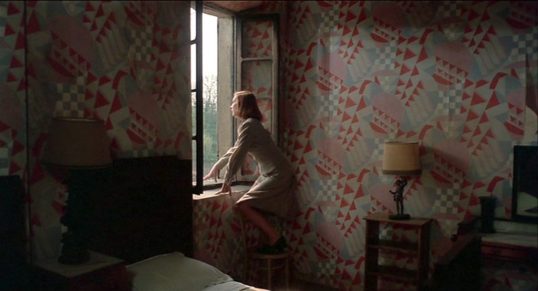
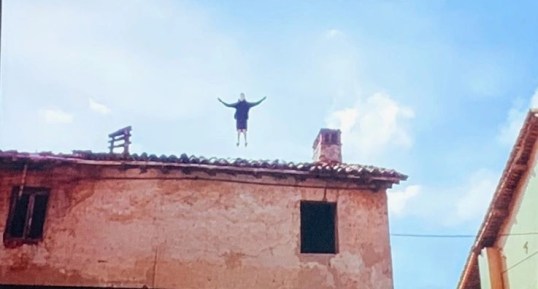
On-Stage With The Lens: Medea (dir by Mark Cullingham)


In 431 BC, the Greek playwright Euripides premiered his latest play, Medea.  The story of a woman scorned who deals with her anger by murdering her ex-husband’s soon-to-be wife, future father-in-law, and finally her own children, Medea has lived on as one of Euripides’s most-performed plays.  Three actresses have won Tony awards for playing Medea on Broadway, setting the record for the most Tonys won for playing the same role.

Medea is a play that is open to a lot of interpretations.  Quite a few stagings of the play present Medea as being a sympathetic character, a victim of a misogynistic culture who was driven to extremes by the men around her.  I can see that argument and it is true that the play does emphasize that all the men in Medea’s life treat her terribly.  Creon plots to send Medea into exile so that his daughter can marry her husband.  Medea’s smarmy husband, Jason, says that he has no choice but to marry a princess because Medea is only a “barbarian,” fit to be his mistress but not his wife.  In many ways, Medea is a sympathetic character.  But, for me, all of that sympathy goes out the window as soon as she murders her children.  The fact that, in most stage versions of the play, the Gods then help her to escape makes her even less sympathetic in my eyes.  (Needless to say, it certainly doesn’t do much for the reputation of the Greek Gods.  Then again, one gets the feeling that even the ancient Gods didn’t particularly like their Gods.)

In 1983, Zoe Caldwell won a Tony for playing Medea.  (Interestingly enough, in this production, the Nurse was played by Judith Anderson, who also won a Tony for playing Medea, in 1947.)  A performance at the Kennedy Center was filmed for PBS.  The production, with its minimalist sets and atmosphere of growing dread, captures the nightmarish intensity of the story.  Zoe Caldwell gives a riveting performance as Medea, alternating between wild-eyed madness and subtle manipulation.

As the most horrific of the Greek plays, Medea is a production that just feels right for the Halloween season.  Here is Zoe Caldwell in 1983’s Medea.

4 Shots From 4 Films: Special Pier Paolo Pasolini Edition


4 Shots From 4 Films is just what it says it is, 4 shots from 4 of our favorite films. As opposed to the reviews and recaps that we usually post, 4 Shots From 4 Films lets the visuals do the talking!

101 years ago, on this date, Pier Paolo Pasolini was born in Italy.  His controversial films and his mysterious death continue to inspire debate to this very day.  Both the man and his works were full of intriguing contradictions.  Pasolini was an atheist who made one of the best Biblical films ever made.  He was a communist who made films that celebrated individual freedom and who had little use for the upper class liberals who made up much of the European counterculture of the 1960s.  In the end, he was an artist unafraid to challenge all assumptions, whether they were found on the right or the left.  His final film, Salo, was the most controversial of his career.  It was also projected to be the first part of a trilogy, though those plans were ended by Pasolini’s murder.

It’s time for….

4 Shots From 4 Pier Paolo Pasolini Films
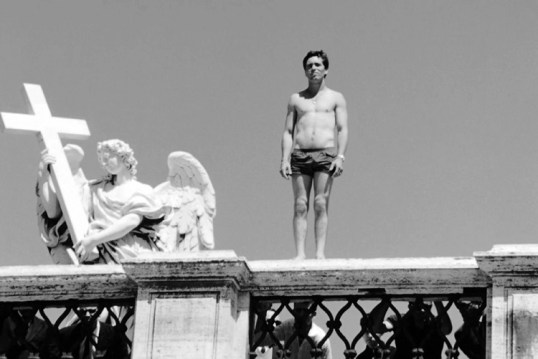
Accatone (1961, dir by Pier Paolo Pasolini, DP: Tonino Delli Colli)
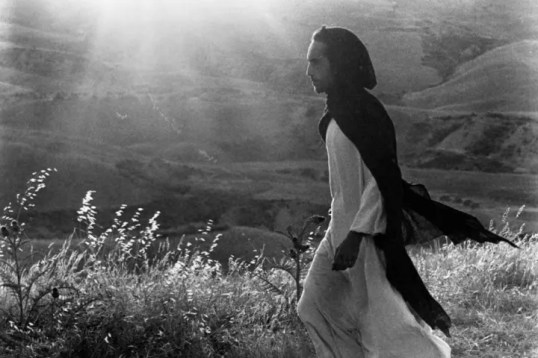
The Gospel According To St. Matthew (1964, dir by Pier Paolo Pasolini, DP: Tonino Delli Colli)
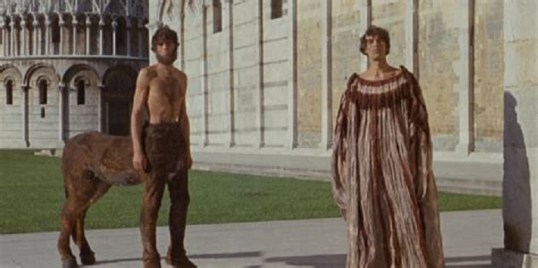
Teorema (1968, dir by Pier Paolo Pasolini, DP: Giuseppe Ruzzolini)

Medea (1969, dir by Pier Paolo Pasolini, DP: Ennio Guarnieri)