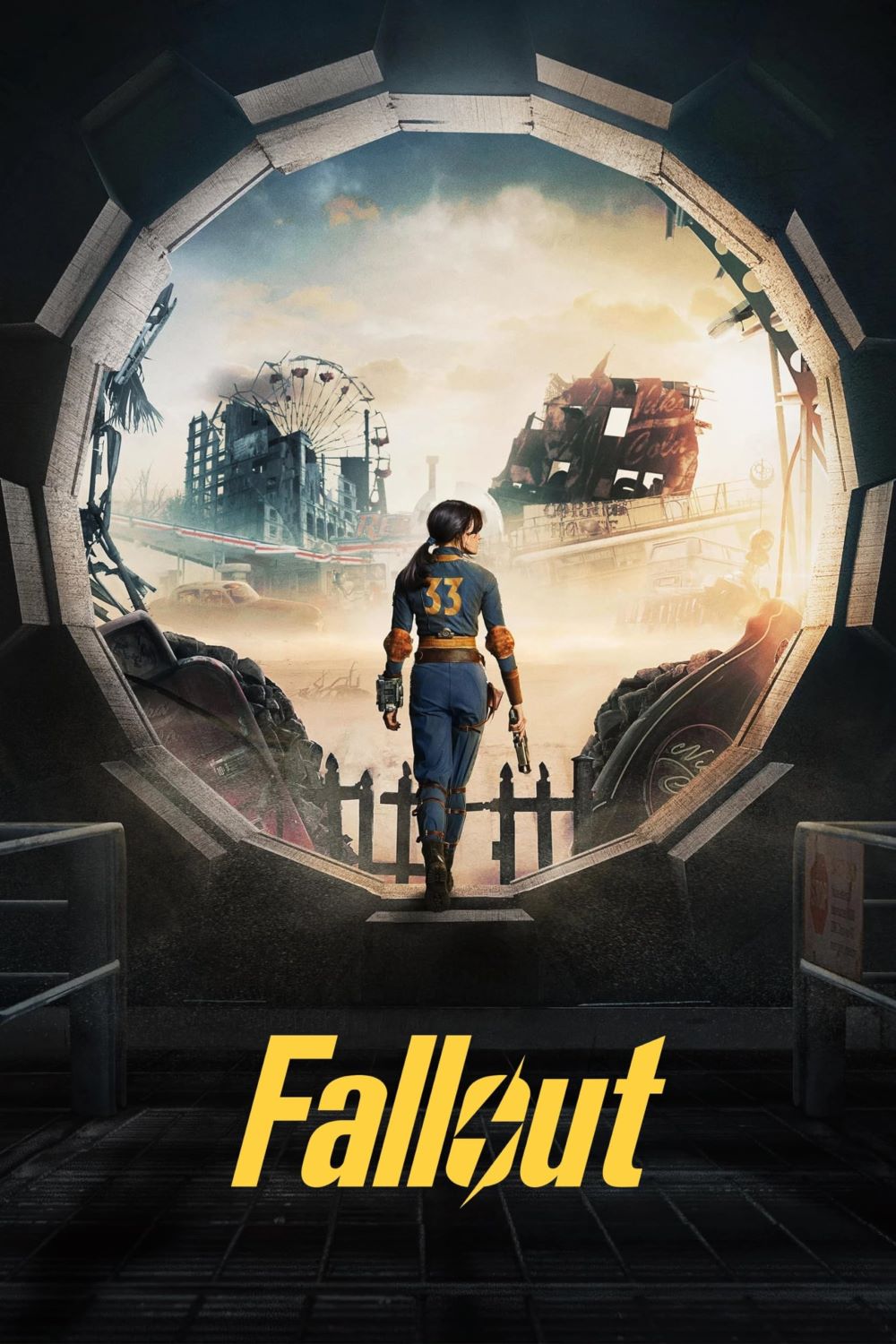
“War never changes. You look out at this Wasteland, looks like chaos. But here’s always somebody behind the wheel.” — The Ghoul
Fallout’s first season lands like a mini-nuke: messy around the edges, but undeniably powerful and surprisingly fun. It’s one of those adaptations that feels comfortable being both a love letter to the games and its own weird, often hilarious beast.
Set a couple of centuries after nuclear war, Fallout drops viewers into a retro-futurist wasteland where 1950s aesthetics collide with irradiated horror and corporate evil turned up to eleven. The show splits its focus between three main threads: Lucy, a bright-eyed vault dweller forced to leave her underground utopia; Maximus, an eager but insecure squire in the Brotherhood of Steel; and The Ghoul, a bounty hunter whose past life as a pre-war actor slowly bleeds through his charred exterior. The decision to juggle these perspectives is smart, because each storyline scratches a different itch: Lucy carries the emotional core and fish-out-of-water comedy, Maximus gives the militaristic, power-armor fantasy with a side of satire, and The Ghoul supplies the hard-boiled noir edge and moral ambiguity. The result is a season that rarely feels static; even when one plotline stalls a bit, another kicks in with fresh energy.
The tone is one of the show’s biggest strengths. Fallout leans hard into pitch-black humor without ever completely undercutting the stakes, which is harder to pull off than it looks. Limbs fly, heads explode, dogs get eaten, and yet the show keeps finding a way to make you laugh at the absurdity without turning the apocalypse into a joke. The violence is graphic and frequent, but it usually serves a purpose: to remind you that this world is brutal, even when the characters are cracking wise or bartering over chems. If the games felt like wandering into a deranged theme park built on the ruins of civilization, the series captures that same feeling of “this is horrible, but also kind of hilarious.” That balance, more than any specific lore reference, is what makes it feel like Fallout rather than just another grimdark sci-fi show.
Performance-wise, the casting is pretty inspired. Ella Purnell plays Lucy with this mix of optimism, naivety, and stubborn decency that could easily have been grating, but instead becomes the emotional anchor of the whole season. She brings just enough steel to the character that her idealism feels like a choice, not a default setting. Aaron Moten’s Maximus is a slower burn, and early on he risks fading into the background as “generic soldier guy,” but the more the show digs into Brotherhood politics, insecurity, and the pressure to be “worthy” of power armor, the more interesting he becomes. Walton Goggins, though, more or less walks away with the show. As The Ghoul, he’s vicious, funny, and weirdly tragic, and the flashbacks to his pre-war life give the season some of its most compelling dramatic beats. There’s a sense of continuity in his performance between the slick actor he was and the monster he becomes that keeps the character from feeling like a one-note cowboy caricature.
Visually, Fallout looks a lot better than a streaming adaptation of a video game has any right to. The production design leans into practical sets and tactile props where possible, and it pays off. Power armor has real heft, the vaults look lived-in rather than just glossy sci-fi hallways, and the wasteland feels like a place where people actually scrape out a living instead of just a CGI backdrop. The show has fun with the franchise’s iconography—Nuka-Cola, Pip-Boys, Vault-Tec branding, goofy radios—but it rarely pauses to point and wink too hard. The design team clearly understands that Fallout is basically “atomic-age corporate optimism weaponized into apocalypse,” and that theme is baked into everything from costumes to billboards rotting in the sand. Even the creature designs, like the mutated critters and ghouls, walk that line between unsettling and cartoonishly over-the-top, which fits the overall tone.
On the writing side, the structure of the season feels very much like an RPG campaign. Episodes often play like individual “quests” that build toward a bigger mystery: Lucy stumbling into a bizarre settlement, Maximus dealing with Brotherhood politics, The Ghoul chasing a lead that intersects with both of them. That quest-chain structure gives the first half of the season a propulsive, almost episodic energy, and it’s one reason the show is so watchable. At the same time, this approach has trade-offs. Sometimes character development feels a bit checkpoint-driven—people change because the story needs them to for the next “quest,” rather than as a smooth emotional progression. You can occasionally see the writers nudging the pieces into place, especially as the season barrels toward the finale.
Fallout sits in an interesting sweet spot when lined up against another prestige video game adaptation like HBO’s The Last of Us. Instead of treating the games as a sacred script that must be recreated line for line, it treats the Fallout universe as a shared sandbox—a tone, a style, a set of rules—rather than a fixed storyline that must be obeyed. Where The Last of Us is largely a faithful retelling of Joel and Ellie’s journey, Fallout seems far more interested in asking, “What else can happen in this world?” instead of “How do we restage that iconic mission?” It borrows the franchise’s black-comedy vibe, retro-futurist Americana, and corporate dystopia, then builds mostly original plots and character arcs on top.
That choice immediately gives the writers room to play. They’re not constantly checking themselves against specific missions, boss fights, or famous cutscenes; they’re free to jump around the timeline, invent new factions or townships, and reframe old ideas in ways that a beat-for-beat adaptation could never manage without sparking outrage. This approach also lets Fallout add to the lore instead of just reanimating it in live action. Because it’s not locked into recreating a particular protagonist’s path, the show can explore corners of the wasteland that were only hinted at in the games, complicate existing factions, or take big swings with backstory and world history. That kind of freedom inevitably creates some continuity friction for hardcore fans, but it also keeps the series from feeling like a lavish, expensive recap of something players already experienced with a controller in hand. Where The Last of Us excels by deepening and humanizing a story many already know, Fallout thrives by expanding its universe sideways, treating the source material as a toolbox rather than a template—and that makes it feel more like a genuine new chapter in the franchise than a live-action checklist.
Thematically, the show has more on its mind than explosions and fan-service, which is nice. Fallout keeps circling back to questions about corporate power, the illusion of safety, and how far people will go to preserve their own little slice of control. Vault-Tec’s smiling fascism is a blunt but effective metaphor for real-world systems that promise protection while quietly planning for everyone’s demise. The Brotherhood of Steel, meanwhile, becomes a vehicle for exploring militarized religion, hierarchy, and the dream of “owning” technology and knowledge. None of this is subtle, but Fallout isn’t a subtle franchise to begin with, and the series has enough self-awareness to let its satire stay sharp without slowing everything down for speeches. When it hits, it feels like the writers are asking, “Who gets to decide what’s worth saving when everything’s already gone?”
Where the season stumbles most is consistency. The pacing isn’t always smooth; some mid-season episodes are stacked with memorable set pieces and character moments, while others feel like they’re mostly there to set up endgame twists. The finale, in particular, is likely to be divisive. On one hand, it ties several plot threads together, drops a couple of bold lore swings, and sets up future seasons with a few big, crowd-pleasing reveals. On the other hand, it rushes emotional payoffs and leans heavily on explaining rather than letting certain developments breathe. The shift in tone in the last episode is noticeable enough that some viewers may feel like they suddenly switched to a slightly different show. It’s not a deal-breaker, but it does mean the season ends with more “wow, that was a lot” than a clean emotional landing.
As an adaptation, this freedom-to-expand strategy pays off by appealing to longtime fans and welcoming newcomers without getting bogged down in purist debates. Fans of the games will catch tons of details, locations, and tonal echoes that feel like affectionate nods rather than empty easter eggs. At the same time, the show isn’t just re-skinning existing game plots, which is a good call. It feels like a side story in the same universe rather than a strict retelling. That said, the lore choices late in the season—especially around the broader timeline and certain factions—are bound to spark arguments. If someone is deeply attached to the canon of the older games, some of the retcons and reinterpretations might play like a slap in the face. If someone is more relaxed about canon and just wants an entertaining, coherent story in that world, the show will probably land much better.
The writing of individual scenes shows a lot of care, especially in the way humor and dread coexist. Some of the best moments aren’t the big action beats but the small conversations: a strange, tense chat in a ruined diner, a piece of pre-war media resurfacing at the worst possible time, or a casual bit of wasteland banter that suddenly turns threatening. The dialogue sometimes leans too modern for the retro setting, but the rhythm feels natural enough that it rarely jars. When the show is firing on all cylinders, it nails that specific Fallout flavor: characters staring at incomprehensible horror and responding with a joke, a shrug, or a desperate sales pitch.
If there’s one area where the season could improve going forward, it’s in fleshing out the secondary cast and giving certain arcs more emotional weight. Some supporting characters are memorable and sharply drawn, while others feel like they exist mainly to be lore-delivery devices or cannon fodder. The world feels rich enough that it can absolutely sustain more side stories and slower, character-focused detours. A little more breathing room for relationships—whether friendships, rivalries, or romances—would help the big twists land harder and keep the show from occasionally feeling like it’s sprinting from spectacle to spectacle.
Overall, Fallout’s first season is a strong, confident debut that understands what made the games stand out without being slavishly beholden to them. It’s funny, brutal, stylish, and surprisingly character-driven for a show that spends so much time reveling in bloodshed and nuclear kitsch. The missteps in pacing and the polarizing choices in the finale keep it from being flawless, but they also signal a series willing to take risks rather than play it safe. For viewers who enjoy genre TV with personality, and for gamers who have been burned by adaptations before, this season is absolutely worth the trip into the wasteland. It doesn’t just survive the jump to live action; it stomps into it in full power armor, flaws and all.
 Through the Shattered Lens