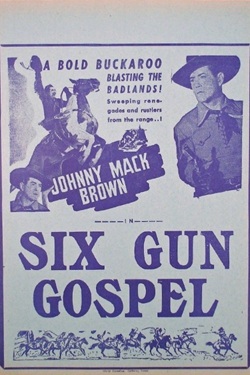
 Marshals Nevada Jack McKenzie (Johnny Mack Brown) and Sandy Hopkins (Raymond Hatton) are sent to the frontier mining community of Goldville to determine who is responsible for hijacking all of the gold that should be coming out of the town. Not surprisingly, it’s all the work of another dastardly saloon owner (Kenneth MacDonald) who is planning on stealing all the gold, chasing off all the settlers, and then selling their land to the railroad company. While Sandy goes undercover as the town’s new preacher, Jack agrees to ride shotgun on a gold shipment, along with with Dan Baxter (Eddie Drew). Dan is in love with Jane Simms (Inna Gest), the daughter of honest miner Bill Simms (Kernan Cripps).
Johnny Mack Brown made a countless number of westerns for several different production companies but it seems like they always featured a crooked saloon owner and a plan to sell the land to a railroad company. Luckily, nobody watches these movies for the plots and that was probably true even when they were first released. People watch these movies for the nostalgia value of watching a movie where it’s good vs evil and good always triumphs without leaving any sort of lingering doubt about whether or not the heroes did the right thing. Johnny Mack Brown is as authentic on a horse and carrying a gun as he ever was and there’s a scene where he manages to get a gun despite being tied up that’s pretty cool. The appeal of Johnny Mack Brown was that he always seemed like he could do the things that he did in the movies in real life as well. Raymond Hatton provides comic relief, pretending to know the hymns being sung by his congregation and providing some songs of his own. There’s enough gun fights and horse chases to provide nostalgic happiness for fans of the genre and that’s the important thing.
 Through the Shattered Lens