30 Days of Noir #26: Behind Green Lights (dir by Otto Brower)


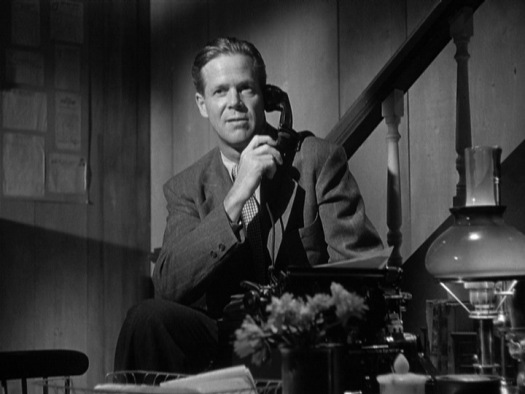
The 1946 film, Behind Green Lights, takes over the course of one night at one police station.

When tough-but-fair Police Lt. Sam Carson (William Gargan) shows up for work, he discovers that a car has been haphazardly parked in front of the station.  Inside the car is bullet-ridden body of Walter Bard, a somewhat notorious private investigator.  If the brazenness of the crime wasn’t already enough to indicate that there’s more going on here than just a detective following the wrong lead, it is soon discovered that Bard was acquainted with Janet Bradley (Carole Landis), the daughter of a reform-minded mayoral candidate.  As Janet explains it to Lt. Carson, Bard was blackmailing a friend of hers.  Janet admits that she had a gun with her the last time that she saw Bard but she swears that she didn’t murder him.

Corrupt newspaper publisher Max Calvert (Roy Roberts) views Janet’s father as being a potential rival and he immediately starts to pressure Lt. Carson to make an arrest in the case.  Not convinced of Janet’s guilt, Carson refuses.  Meanwhile, the crooked coroner (Don Beddoe) comes across evidence that could change the entire case but, as a favor to Calvert, tries to cover it up….

But that’s not all.  It’s a very busy night at the precinct.  Not only does Carson have to deal with the murder and all of the political fallout, he also has to deal with an escapes prisoner and a collection of snarky crime reports who spend all of their hanging out at the station house and waiting for a big story to drop.

Largely set in one location and featuring a cast made up of fast-talking, quick-witted cynics, Behind Green Lights sometimes feel more like a play than a film.  (One could easily imagine it taking place in the same cinematic universe as The Front Page.  Call it the MacArthur/Hecht Cinematic Universe, or MHCU for short.)  Though the film only has a running time of 64 minutes, it manages to pack a lot of twists and turns into that hour.  For the most part, it all works.  The mystery is intriguing, the cast is made up of properly tough character actors, and the tragic Carole Landis is well-cast as a character who could be an innocent victim or a dangerous femme fatale.  The film and her performance will keep you guessing.  (It has been written that Landis, a talented actress who never quite got the roles that roles that she deserved, was heart-broken when Rex Harrison refused to divorce his wife and marry her.  Two years after the release of Behind Green Lights, she was found dead at the age of 29.  The official ruling was suicide, though members of Landis’s family dispute that.)

Behind Green Lights may be a minor noir but it’s still an entertaining one.  And it can be viewed for free on YouTube!  Just remember, when doing an online search, that the film is called Behind Green Lights and not Behind the Green Door.  Don’t make the same mistake that I did!


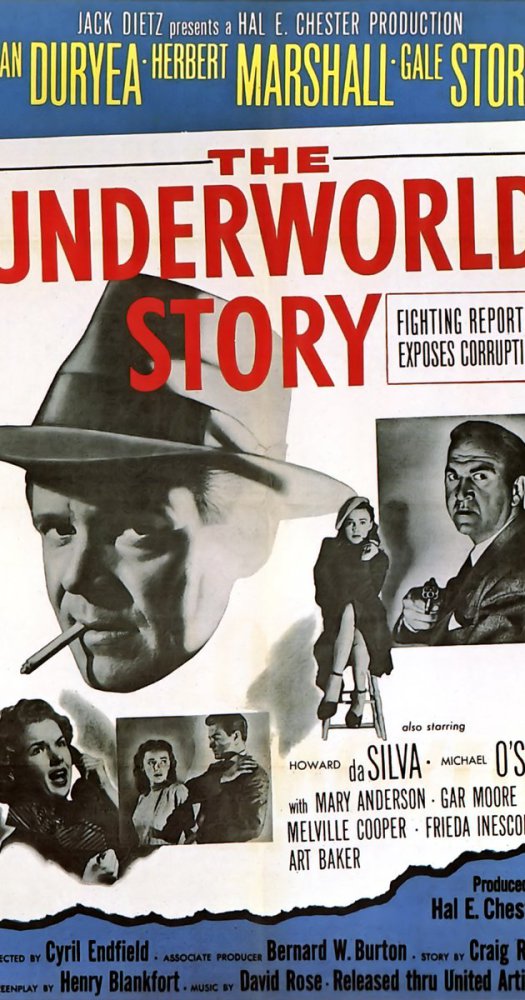
Heel with a Heart: Dan Duryea in THE UNDERWORLD STORY (United Artists 1950)


gary loggins's avatarcracked rear viewer

Hollywood’s favorite heel Dan Duryea got a rare starring role in THE UNDERWORLD STORY, a 1950 crime drama in which he plays… you guessed it, a heel! But this heel redeems himself at the film’s conclusion, and Duryea even wins the girl. Since that girl is played by my not-so-secret crush Gale Storm , you just know I had to watch this one!

The part of muckraking tabloid journalist Mike Reese is tailor-made for Duryea’s sleazy charms. He’s a big-city reporter who breaks a story about gangster Turk Meyers spilling to the D.A., resulting in the thug ending up murdered on the courthouse steps in a hail of bullets. DA Ralph Monroe (Michael O’Shea )  puts the pressure on Mike’s editor, and Reese becomes persona non grata in the newspaper game. Seeing an ad for a partner at a small town newspaper, Mike gets a $5,000 “loan” from crime boss Carl…

View original post 451 more words

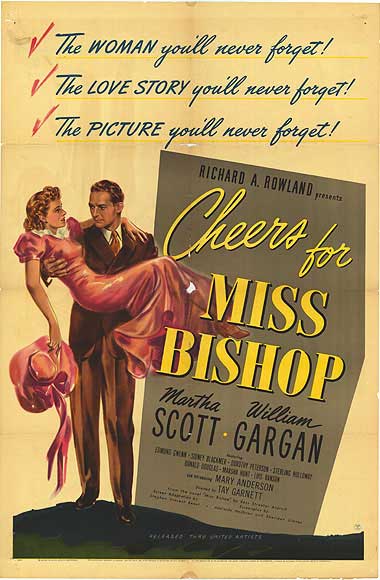
The Fabulous Forties #30: Cheers for Miss Bishop (dir by Tay Garnett)


cheers1

The 30th film in Mill Creek’s Fabulous Forties box set is the 1941 melodrama, Cheers For Miss Bishop.  Cheers For Miss Bishop is a bit like an Americanized version of Goodbye, Mr. Chips.  The story of Cheers For Miss Bishop, largely told via flashback, deals with a retired teacher who never quite got what she wanted out of life but still had a profound impact on all of her students.

The film opens with elderly Miss Bishop (played by Martha Scott) alone in her house.  The time is the 1930s and Miss Bishop is nearing retirement and somewhat bitter over ending her years having never married.  Prominent businessman Sam Peters (William Gargan) comes to the house and they start to recollect.  We flashback to the 1880s, when Miss Bishop was preparing to go to college and Sam was just the local grocery boy.  Sam was in love with Miss Bishop and, it’s suggested, that she loved him as well.  But she was determined to go to college whereas Sam was determined to go straight into business.

With the support of the kindly Prof. Corcoran (Edmund Gwenn, giving a performance that pretty much epitomizes what we mean when we call someone a kindly professor), Miss Bishop got a job teaching English at Midwestern College.  She was a popular teacher, one who not only inspired her students but who was also willing to stand up for them.  Eventually she met and became engaged to a local lawyer, Delbert Thompson (Don Douglas).  However, her heart was broken when Delbert ran off with another woman.  Years later, she fell in love with another professor (Sidney Blackmer), with the only problem being that he happened to be married.

But that’s not all that Miss Bishop had to deal with.  She also ended up adopting and raising Hope (Marsha Hunt) after Hope’s mother died in childbirth.  As she got older, she became frustrated when the younger college administrators demanded that she adapt with the times.  Miss Bishop also had to deal with her frequent romantic rival and cousin, the impulsive Amy (Mary Anderson).

Amy, I should mention, was my favorite character in Cheers For Miss Bishop, even though I don’t think that was the film’s intention.  Some of that is because Mary Anderson totally embraced the melodramatic potential of her character, often going totally over-the-top in a way that still seemed perfectly natural.  But there’s also the fact that Amy, as opposed to the often painfully inhibited Miss Bishop, had no boundaries.  She knew what she wanted and she went for it, without apology.  Amy may not have been a big role but she still dominated every scene that she appeared in.  Amy demanded attention and good for her!

That said, the title of the film is Cheers For Miss Bishop and not Cheers For Amy.  Ultimately, it’s a tribute to Miss Bishop and to teachers everywhere.  It’s an extremely predictable and sentimental film but it does what it does fairly well.  Occasionally, I got frustrated with Miss Bishop as a character (she was always so prim, proper, and respectable!  Plus, there’s a scene where she gives a student from North Carolina some trouble about his accent, saying that he needs to take her English class and, if you know how I feel about actors from up north trying too hard to sound like they’re from the South, you can imagine how I felt about that scene) but Martha Scott gave a good performance.  In the end, it’s a sweet little movie.  And you can watch it below!