Late Night Retro Television Review: CHiPs 4.20 “Dead Man’s Riddle”


Welcome to Late Night Retro Television Reviews, a feature where we review some of our favorite and least favorite shows of the past!  On Mondays, I will be reviewing CHiPs, which ran on NBC from 1977 to 1983.  The entire show is currently streaming on Prime!

This week, the CHiPs team investigates an accident and a guest star gives a really terrible performance.

Episode 4.20 “Dead Man’s Riddle”

(Dir by Michael Caffey, originally aired on May 10th, 1981)

An accident in the mountains causes three cars to explode and one driver to die.  Since the dead driver was a captain with the Los Angeles fire department, the MAIT Team is sent out to recreate the accident and to try to figure out what happened.  They know that at least three cars were involved in the accident.  One driver died.  One driver is in the hospital.  And the other driver appears to be missing.  Getraer suspects that the accident could be due to people racing each other in the mountains.

What makes this episode odd is the casting of Joanna Kerns as psychiatrist Colleen Jacobs.  She’s assigned to the MAIT Team.  She actually drives through the mountains frequently and she even gets involved in racing sometimes.  In fact, she saw one of the cars right before the accident!  At first, she doesn’t bother to share this with anyone.  Instead, she just sits in the background with a guilty look on her face.  Finally, Jon Baker — in an unmarked car — tricks her into trying to race him.  That’s when she finally confesses….

….and faces absolutely no consequences!  Oh sure, Getraer gets a little annoyed and says that it would have been helpful if Dr. Jacobs had been honest from the start.  But Dr. Jacobs is allowed to continue to work with the MAIT Team.  Even though she intentionally withheld evidence from investigators, she’s not charged with obstruction.  Ponch tells her that she’s getting a chance to redeem herself which I don’t think is police policy.  No one comments on the fact that, even though she was worried that she may have previously caused a fatal accident, she still tried to race Baker.  Does no one care that, at the very least, she appears to have no impulse control?

Making things even stranger is that Joanna Kerns gives one of the worst performances that I have ever seen as Dr. Jacobs, delivering half of her lines as if she’s struggling not to laugh.  Even when she’s admitting her fear that she may have been responsible for the accident, she still seems like she’s on the verge of breaking out into laughter.  It’s very odd.

Speaking of odd,  an eccentric old man named Max (Owen Brooks) claims that he saw a UFO before the crash.  (Dr. Jacobs laughs when she repeats this.)  It turns out that he just saw a hubcap flying through the air.

In the end, it’s proven that the captain was not at fault in the accident.  That’s all that anyone really seems to care about.  I assume that Dr. Jacbos and Baker then proceeded to race each back to Los Angeles.

Late Night Retro Television Review: Highway to Heaven 3.14 “All That Glitters”


Welcome to Late Night Retro Television Reviews, a feature where we review some of our favorite and least favorite shows of the past!  On Thursdays, I will be reviewing Highway to Heaven, which aired on NBC from 1984 to 1989.  The entire show is currently streaming on Tubi and several other services!

This week, a conman seeks refuge in a church.

Episode 3.14 “All that Glitters”

(Dir by Michael Landon, originally aired on January 7th, 1987)

There’s a fire raging in the city and elderly homeowners are being forced to evacuate.  “Father” Jonathan and “Father” Mark open up an abandoned church so that the people have some place to stay while the fires are burning.  Good for them and also good for this show for finally acknowledging Catholicism.

Also hiding out in the church and disguised as a priest is Charley Trapola (John Pleshette), a con artist who, despite his criminal profession, actually has a good heart.  Charley has a briefcase with him, one that is full of money.  A group of criminals want the briefcase back but, at least initially, they know better than to try anything in the church.  Instead, they decide to wait for Charley to come out.  Inside the church, Charley gets to know Wanda (Didi Conn), a shy but kind-hearted woman who goes to Confession every day.

This episode was okay.  Usually, when Jonathan and Mark go undercover as clergyman, they’re portrayed as being wishy-washy Episcopalians or vaguely liberal Methodists so I was happy that they were Catholic for this episode.  John Pleshette and Didi Conn were both well-cast as this episode’s guest stars.  They eventually made for a very sweet and likable couple.  My main issue with this episode is that it tried to do a bit too much.  Not only did we have Charley being chased by the gangsters but we also had Wanda dealing with her shyness and Mark and Jonathan dealing with the people were seeking shelter and looking for their loved ones.  This episode — and not that weird marriage counseling episode — would have benefitted from an extra hour.  As it was, it just felt a bit overstuffed.  As well, this is another episode in which Jonathan reveals early on that he’s angel and, oddly enough, Charley has no hesitation about believing him.  I always prefer the episodes where Jonathan doesn’t reveal who he really is.  When Jonathan reveals that he’s an angel, it almost seems like cheating.  The show is always more effective when people decide to open up their hearts on their own as opposed to doing so because they feel they’ve been ordered to.

There’s an odd scene where the three thugs break into the church and pull a gun on Jonathan.  After Jonathan gives them fair warning about “the boss,” the main thug attempts to shoot Jonathan.  Needless to say, the bullets don’t have any effect on an angel.  However, a sudden blue lights fills the church and suddenly, the three men are apparently zapped out of existence.  Jonathan later jokes that he’s not sure where the three men are but that they probably aren’t happy.  So, did the three men go straight to Hell?  Are they dead?  I understand the logic behind the scene but it’s not really something you expect from a show where the main theme is usually that everyone has a chance for redemption.

Next week, Dick Van Dyke plays a homeless puppeteer …. uh oh.  This sounds like it could a little bit cringey …. well, we’ll see.


Late Night Retro Television Review: Highway to Heaven 2.11 “The Monster Part II)


Welcome to Late Night Retro Television Reviews, a feature where we review some of our favorite and least favorite shows of the past!  On Thursdays, I will be reviewing Highway to Heaven, which aired on NBC from 1984 to 1989.  The entire show is currently streaming on Freevee and several other services!

This week, the story of Julian and Scotty continues!

Episode 2.11 “The Monster Part II”

(Dir by Victor French, originally aired on December 11th, 1985)

This week’s episode of Highway to Heaven begins where last week’s episode ended.

Julian (Jeff Kober) has been charged with attempting to murder Rachel McCullough (Annabella Price) and the whole town is ready to convict him because he has a birthmark on his face and a bratty kid named Ridley (Peter Billingsley) claims that he saw Julian push Rachel.  Rachel, having hit her head, is in a coma and not expected to survive.  Julian is pressured to accept a plea bargain but he protests that he’s innocent and that he loves Rachel.  He would never had hurt her, no matter what the ignorant townspeople believe.

Only Jonathan and Scotty (James Troesch) believe that Julian is innocent.  After Jonathan saves the depressed Scotty from drowning in his swimming pool, Scotty agrees to put off suicide so that he can defend Julian at his trial.  Scotty does so from his motorized wheelchair and, as he explains to the jury, he knows what its like to be treated a certain way because you look different.  With ease, Scotty demolishes Ridley’s testimony and puts the smug prosecutor in his place.  All of the reporters in the courtroom are shocked when Julian is acquitted but the prosecution really didn’t have a case, beyond Julian having a birthmark on his face.  Scotty gets back together with his wife (Margie Impert) and Rachel not only wakes up but she wakes up with her sight restored.  Despite Julian’s fear, Rachel loves him even more when she can see his face.

Awwwwwww!

(Where is Mark during all this?  He doesn’t show up until the final few minutes, probably because Victor French was busy directing this episode.)

Even if one sets aside that this episode is nearly 40 years old, it still feels old-fashioned.  This is the type of courtroom drama where the trial watchers gasp at each piece of testimony.  As far a courtroom procedurals go, this episode went more for melodrama than realism but that’s to expected with this show.  It was heartfelt and earnest and Jeff Kober gave a touching performance as Julian.

Probably the most interesting thing about this episode was the number of times Jonathan got mad at people.  He got mad at Julian’s original lawyer.  He got mad at Scotty for trying to drown himself.  He called Scotty’s wife a “jerk” to her face.  He gave the prosecutor a dirty look during the latter’s opening statement.  He even got annoyed with Julian’s overly protective mother (Ann Doran).  Jonathan may be an angel but this episode suggests that even angels lose their patience.

Late Night Retro Television Review: CHiPs 2.1 “Peaks and Valleys”


Welcome to Late Night Retro Television Reviews, a feature where we review some of our favorite and least favorite shows of the past!  On Mondays, I will be reviewing CHiPs, which ran on NBC from 1977 to 1983.  The entire show is currently streaming on Freevee!

This week, the second season begins.

Episode 2.1 “Peaks and Valleys”

(Dir by Phil Bondelli, originally aired on Sept. 16th, 1977)

The second season premiere of CHiPs brings some changes.

Most noticeably, the theme song has been redone and now, instead of being driven by the horn section, it now features a bass-driven disco beat.  From the minute the new version of theme song begin, you know that you’re watching a show that was filmed in the heart of the 70s.

Secondly, the second season premiere is considerably less gritty than any of the episodes that aired during the first season.  If the first season concerned itself with showing the day-to-day duties of the members of the California Highway Patrol, from the mundane to the occasionally exciting, the second season announces from the start that it’s about fast cars, fast motorcycles, and slow motion crash footage.

Ponch is considerably more competent in this episode than he ever was during the first season.  For his part, Getraer no longer seems to dislike Ponch as much as he did just a few months ago.  No mention is made of Ponch being on any sort of departmental probation.  Now, Ponch is as professional and competent as Jon Baker.

Finally, the California High Patrol now has a new chief mechanic.  Harlan Arliss (played by Lou Wagner) is short, sarcastic, and wears a tie along with his white mechanic coat.  Arliss is not impressed with the way Baker and Ponch treat their motorcycles, though he seems to reserve most of his ire for Baker.  (“Your tire pressure is low!”)  Arliss may seem like he is overly critical but he also keeps a really cute dog at the garage.

That said, some things remain the same.  As always, Baker finds himself feeling unappreciated.  The episode opens with a camper the crashes in slow motion.  The driver, Bob Niles (a bearded Troy Donahue), suffers a spinal injury as the result of someone moving him after the accident.  Niles can’t remember exactly who moved him and it appears that Baker, Ponch, and the Highway Patrol might get sued.

Then Baker burns his hand saving a man from a burning vehicle.  And a little child shoots a toy gun at Baker.  And then two rednecks call in a fake emergency so that they can shoot up a police car.  Is it any surprise that both Baker and Ponch are tempted to quit the force and take a job selling used cars for Baker’s high school friend, Stan Bosca (Richard Gates)?

Fortunately, Bob does get his memory back and remember that it was a bunch of construction workers who moved him.  So, it sucks for those well-intentioned workers (hello, lawsuit!) but at least Baker and Ponch are off the hook.  And, after seeing how sleazy the used car business is, Baker and Ponch decide to remain on the force and go disco dancing instead!

Actually, Ponch dances.  Baker watches and smile awkwardly.  It’s interesting that the majority of the episode is centered around Baker having an existential crisis but it all ends by highlighting Ponch on the dance floor. If nothing else, it proves that the people behind the show understood that Wilcox was the actor while Estrada was the one with the big personality.

I enjoyed this episode.  The scenery was nice.  The show made good use of slo mo of doom when Niles crashed his vehicle.  The dog was cute.  And the opening theme song was so catchy that I’m still hearing it hours after watching the show.  With this episode, the second season got off to a good start.

Back To School Part II #3: Lord Love A Duck (dir by George Axelrod)


Lordloveaduck

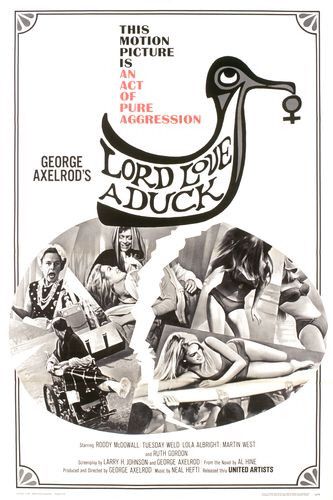
For my third Back to School review, I watched the 1966 satire, Lord Love A Duck!

Hey hey hey!

I have to admit that, because I’m writing this review in a hurry and because the D and the F key are located right next to each other, I keep accidentally calling this film Lord Love A Fuck.  Somehow, that seems appropriate because Lord Love A Duck is a very odd and subversive little movie that deals with people who are largely motivated by lust and I’m pretty sure that, at one point, Roddy McDowall is seen saying, “Fuck off!” but, of course, we don’t actually hear him say it.  But seriously, Lord Love A Duck is a weird movie.

Hey hey hey!

Roddy McDowall plays Alan Musgrave, a student at a “progressive” high school in California.  Roddy was about 37 years old when he played a high school senior and he doesn’t look like a teenager at all but somehow, it’s appropriate.  After all, Alan is no ordinary teenager!  He’s smarter than everyone else.  He’s wittier than everyone else.  He’s more clever than everyone else.  He’s also totally obsessive and willing to do just about anything to get what he wants.  And you can be sure of one thing: whenever Alan does something borderline insane, you’ll hear a group of singers harmonizing, “Hey hey hey!” in the background.

Hey hey hey!

See, it’s happening already.  It doesn’t matter what Alan’s doing.  He could be kicking a skateboard in the way of a romantic rival.  He could be interrupting the graduation ceremony with a tractor.  He could be going to prison for life.  No matter what it is, it will always be accompanied by:

Hey hey hey!

Anyway, Alan is in love with the innocent, sweet, and constantly flirtatious Barbara Anne Greene (Tuesday Weld).  In fact, almost everyone in the film is in love with (or, at the very least, turned on by) Barbara.  The only person who doesn’t seem to be in love with Barbara is her mother (Lola Albright), a former-beauty-turned-cocktail-waitress whose world-weary cynicism seems to offer a depressing hint of what’s in store for Barbara once she gets older.

Hey hey hey!

But everyone else loves Barbara.  Especially Alan!  In fact, Alan is so in love with her that he swears that he’s going to make sure that she gets everything that she wants.  When she needs 12 cashmere sweaters so that she can join an exclusive girl’s club, Alan helps her to convince her father (Max Showalter) to pay for them.  When Barbara needs a job after dropping out of school, Alan helps her get one as a secretary for the high school’s progressive principal (Harvey Korman).  When Barbara decides she wants to marry the boring but respectable Christian youth leader, Bob (Martin West), Alan keeps Bob’s mother (Ruth Gordon) so drunk that she doesn’t get a chance to reprimand her son for falling in love with a girl from a divorced family.  (As Bob’s mother explains it, she doesn’t believe in divorce.  “We don’t leave our husbands.  We bury them.”)  Eventually, a movie producer decides that he wants Barbara to star in his beach films but Bob says no.  No wife of his is going to be a movie star!  So, of course, Alan decides to murder Bob so that Barbara can again have what she wants…

Hey hey hey!

Lord Love A Duck is a manic comedy that satirizes everything that mainstream audiences in 1966 would have held sacred.  Teenagers, conservatives, liberals, love, hate, murder, justice, marriage, divorce, morality, sex, religion, television, movies — it’s all thoroughly ridiculed in this film.  (It’s not surprising that the film’s director also wrote the script for The Manchurian Candidate, a satire disguised as a thriller.)  To be honest, it’s probably a little bit too manic for its own good.  At times, the film run the risk of becoming exhausting.  But then there’s even more times when the film is absolutely brilliant.

Hey hey hey!

Speaking of absolutely brilliant, Lord Love A Duck makes brilliant use of Roddy McDowall’s eccentric screen presence but, even better, it features one of Tuesday Weld’s best performances.  Weld was a talented actress whose performances often revealed that a fragile soul is often the price that is payed for great beauty.  (There’s no greater insecurity than wondering whether people are responding to who you are or to how you look.  Would you still care if I was ugly is not a question we’re supposed to ask but it’s one that we’ve all wondered.)  It would have been far too easy to make Barbara either totally innocent or totally manipulative.  Wisely, the film does neither.  Barbara may occasionally be manipulative but she always means well.  It’s not her fault that everyone around her is either idiotic or insane.

Hey hey hey!

Though Lord Love A Duck is obviously a time capsule of the culture of mid-60s, it’s also a film that remains relevant even today.  Culturally, we’re still obsessed with fame, youth, and beauty.  In many ways, the satire of Lord Love A Duck still feels more extreme that anything that any contemporary filmmaker would dare to attempt.  I can only imagine what audiences in 1966 thought as they watched this subversive teen film.

Hey hey hey!