Late Night Retro Television Review: Hunter 1.18 “Fire Man”


Welcome to Late Night Retro Television Reviews, a feature where we review some of our favorite and least favorite shows of the past!  On Thursdays, I will be reviewing Hunter, which aired on NBC from 1984 to 1991.  The entire show is currently streaming on Tubi and several other services!
This week, things are getting hot!

Episode 1.18: “Fire Man”

(Dir Tony Mordente, originally aired May 11th, 1985)

Somebody in Los Angeles has got a military-grade flamethrower and is using it to set fires all over the city.

When a homeless man perishes in a burning warehouse, Hunter and McCall get involved. Their first suspect is a nervous man named Jack Lachman (William Russ, giving a better performance than the material probably deserved), who always seems to show up in the crowds that gather to watch the flames. Jack swears he’s innocent and that the arsonist is instead a former Special Forces operative with whom he served in Vietnam.  Jack also claims that the arsons are connected to a war crime that Jack and his fellow soldiers covered up.

Also getting involved is Matt Gold (Mark Schneider), a reporter determined to get the story and unconcerned about whether he messes up the investigation in the process. At first, McCall thinks Matt is harmless. Hunter does not. Not surprisingly, Hunter turns out to be right: the media gets in the way of solving and preventing crimes.

This episode was all about visual style. The plot wasn’t terribly complicated, but the shots of the arsonist setting his fires were disturbing, as were the images of the flames quickly consuming anything they touched. The scene in which the arsonist takes out a witness was disturbingly violent, even by Hunter’s standards. At the same time, the song that seemed to play whenever the arsonist appeared quickly got old.

As violent as the episode got, there was something reassuring about Hunter and McCall once again stopping the bad guy and saving the city—and doing it while trading quips. It’s a scary world out there, this episode seemed to be saying, but luckily we’ve got Hunter and McCall to take out the trash.

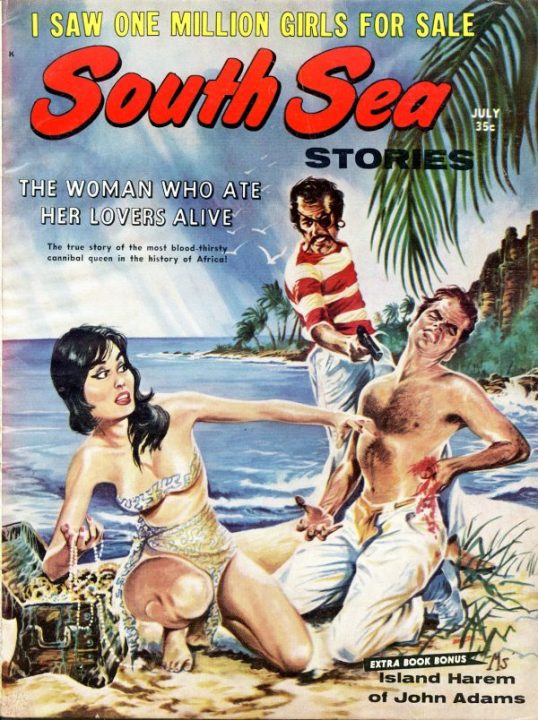
 

The Covers of South Sea Stories


From 1960 to 1964, South Sea Stories brought its readers the latest in sordid, tropical drama.  South Sea Stories was actually a revival of a pulp magazine that had briefly been published in 1939.  It was very much a men’s magazine, with a mix of adventures stories and centerfolds.  The covers left little doubt that the tales of the South Sea Stories weren’t for those seeking a relaxing vacation.  Instead, South Sea Stories was all about smugglers, wild animals, and women in sarongs.

For anyone currently dreaming of taking a tropical vacation right now, here are a few of the covers of South Sea Stories.  All of these covers look, to me, like they were done by Mark Schneider but I can only definitely confirm that the first three were his work.

by Mark Schneider

by Mark Schneider

by Mark Schneider

Unknown Artist

Unknown Artist

Unknown Artist

Unknown Artist’

Unknown Artist

Unknown Artist

I think this final cover is actually from the original 1939 run but I just had to include it because of the dead body floating in the surf.

Artist Profile: Mark Schneider (1919 — 1982)


Born and, with the exception of four years spent in Texas, raised in Pennsylvania, Mark Schneider’s interest in art was evident from a young age.  He started his formal training when he was 16 years old and, a year later, he would win an art contest sponsored by the magazine, Open Road For Boys.  After graduating high school, he moved to New York City and studied at the Art Students League while seeking work as a commercial artist.  He quickly found employment in the growing comic book industry, working on titles like Keen Detective Comics and Detective Eye Comics.

His career was interrupted by the attack on Pearl Harbor.  He enlisted in the U.S. Army, saw combat in Europe and Northern Africa, and served through the entirety of World War II, reaching the rank of sergeant.  After the war, he returned to New York and returned to work as a commercial illustrator.  It was after the war that he painted the pulp covers for which he’s probably best known.  Working for magazines with titles like Sir! For Me, Schneider’s covers often featured manly men and beautiful women in exotic settings or combat scenes.

Here’s a small sampling of his work:

The three Schneider covers below remind me that it’s been a while since I’ve been on a tropical vacation.  Maybe this summer!


Or maybe I’ll just say home.  Those vacations look dangerous.