Musical Film Review: The Commitments (dir by Alan Parker)


First released in 1991 and based on a novel by Roddy Doyle, The Commitments is the story of a manager with a dream and a band with a chip on its collective shoulder.

Living in working class Dublin, Jimmy Rabbitte (Robert Arkins) dreams of managing a band.  He’s a fan of old school soul and rock and roll music, the type that was played by black artists in the American South.  Jimmy feels that the Irish have a special connection to that music because, as he explains it, “the Irish are the blacks of Europe.”  (I think one could argue that the black people living in Europe are the blacks of Europe but we’ll go with it.  I understand Jimmy’s argument, even if it is the sort of thing that would send social media into a tizzy if it were made today.)  Jimmy puts an ad in the paper and discovers that there are a lot of aspiring musicians in Ireland and very few of them know much about soul music.  Even Jimmy’s father (a delightful Colm Meaney) seems to believe that he could be a part of the band.  In the end, Jimmy puts together the band himself, recruiting an unlikely collection of friends and barely know acquaintances.  He finds a lead singer in the talented but unruly Deco Cuffe (Andrew Strong), a pianist in the religious Steven (Michael Aherne), a saxophonist in Dean Fay (Felim Gormley), a guitarist in Outspan Foster (Glen Hansard), and three back-up singers in Bernie (Bronagh Gallagher), Imelda (Angeline Ball), and Natalie (Maria Doyle).  He also finds a mentor in trumpeter Joey “The Lips” Fagan (Johnny Murphy), an American who claims to have played with everyone who is anyone and who names the band The Commitments.  They’re a working class band and one that doesn’t always mix well with each other.  Deco’s gets on everyone’s nerves from the start but, as Dean puts it at the unemployment office, he’s much happier being a saxophonist on the dole than a plumber’s assistant on the dole.

There’s a raw energy to The Commitments, as both a film and a band.  Both the film’s comedy and its music comes from a very real pain.  No one in the film is rich.  No one has been given much of a chance by British society.  Deco may be obnoxious but he also epitomizes the wild spirt of someone who refuses to be tamed by society.  Jimmy Rabbitte may occasionally be a bit in over his head but it’s hard not to admire his refusal to surrender.  From the minute the band comes together, it’s obvious that they’re not going to last.  Nearly every gig ends in disaster and Joey, despite his knowledge of soul, is a bit rigid in his demands of the band.  When Dean improvises, Joey acts as if it’s the end of the world that Dean would rather play jazz than soul.  Joey sees jazz as being elitist.  Dean sees it as being a way to express his own artistic vision.  The wonderful thing about The Commitments is that they’re both allowed to be right.

The band might not last but the film leaves you happy that they still had their moment.  The Commitments is a film that feels alive, not just with artistic desire but with the anger of people who have been pushed to the side by the establishment.  For a while, the band gives them a chance to express that anger and, afterwards, it’s gratifying to see that the majority of the members still carry the legacy of The Commitments with them, with some members continuing to pursue music and others returning to their everyday lives in Dublin.  It’s a good film, one that celebrates both music and humanity.
 

The Unnominated #11: The General (dir by John Boorman)


Though the Academy of Motion Picture Arts and Sciences claim that the Oscars honor the best of the year, we all know that there are always worthy films and performances that end up getting overlooked.  Sometimes, it’s because the competition too fierce.  Sometimes, it’s because the film itself was too controversial.  Often, it’s just a case of a film’s quality not being fully recognized until years after its initial released.  This series of reviews takes a look at the films and performances that should have been nominated but were, for whatever reason, overlooked.  These are the Unnominated.

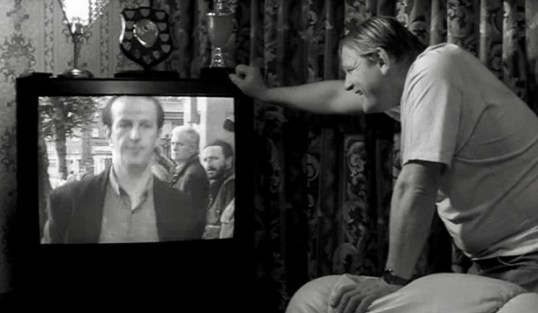
Directed by John Boorman, 1998’s The General tells the story of Martin Cahill.

Martin Cahill (Brendan Gleeson) was a Dublin-based crime lord, a thief by trade who never made any apologies for his profession.  The film opens with the end of Martin Cahill’s life.  Leaving his suburban home, he’s sitting behind the steering wheel of his car when a young man runs up and shoots him in the face.  Cahill’s car rolls forward while his wife (Maria Doyle Kennedy) screams for help.  Cahill has been assassinated in front of his family and the reaction of the local police is to celebrate until Cahill’s oldest nemesis, Inspector Ned Kenney (Jon Voight), announces that they have nothing to cheer about.  The film leaves it somewhat ambiguous as to who shot Cahill, though it heavily suggests that he was shot by the IRA, both because of their mistaken belief that he was moving drugs into the neighborhood but also because of his refusal to share his profits with them.

The film flashes back and we watch as Martin Cahill, a rebellious young man who stole to impress girls and to get a shot back at the establishment, grows up to become Martin Cahill, the crime lord that the papers nickname The General.  Cahill is a professional thief and he’s fairly honest about it.  When his government-controlled flat is torn down, Cahill camps out on the site in a tent, refusing to leave because the location of the new building is to close to the police station.  He says he’d rather be moved to a richer part of town.  It’s better for his work.  As portrayed by Brendan Gleeson, Cahill is a fascinating and complex character, a ruthless criminal who is also devoted to his pigeons, his children and both his wife and his girlfriend (Angeline Bail).  (Fortunately, for Martin, his wife and his girlfriend know about each other and are good friends.)  He’s the type of crime lord who will test a man’s loyalty by nailing him to a pool table and then take him to the hospital afterwards.  “Sorry, Martin,” another associate says after Martin shoots him in the leg to make a fake break-in look authentic.  It’s hard not to like the film’s version of Martin Cahill, an intelligent and ultimately honest man who understands the importance of allowing his enemies to believe him to be a buffoon.  He may be a criminal but he considers it to be an honest living, unlike the government officials who force unwanted laws and exorbitant taxation on the citizenry  Director John Boorman certainly seems to like Cahill, which is interesting as Boorman was actually the victim of one of Cahill’s robberies.  (Boorman recreates the robbery in the film.)

The film went unnominated at the Oscars, which were dominated that year by Shakespeare in Love and Saving Private Ryan.  Brendan Gleeson definitely deserved a nomination for his charismatic performance as Martin Cahill.  Equally worthy of a nomination was Seamus Deasy’s black-and-white cinematography, which gives the film the dream-like feel of a half-remembered legend.  (The version of the film that’s on Tubi features desaturated color.  It’s actually an effective look for the film’s story but I still prefer the black-and-white original.)  Neither was nominated and, indeed, Brendan Gleeson would have to wait until 2023 to finally receive his first Oscar nominations for The Banshees of Inisherin.

The General (1998, dir by John Boorman, DP: Seamus Deasy)

Previous entries in The Unnominated:

  1. Auto Focus 
  2. Star 80
  3. Monty Python and The Holy Grail
  4. Johnny Got His Gun
  5. Saint Jack
  6. Office Space
  7. Play Misty For Me
  8. The Long Riders
  9. Mean Streets
  10. The Long Goodbye

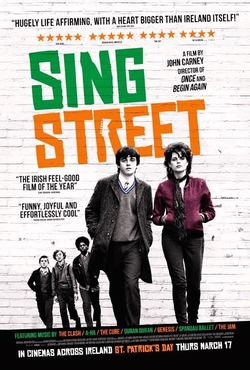
Playing Catch-Up: Sing Street (dir by John Carney)


sing_street_poster

The Irish musical comedy drama romance (that’s a lot of genres to take in, I know) Sing Street was one of the great and most sadly overlooked films of the previous year.  Fortunately, it’s on Netflix now and I seriously recommend that you watch it.  I watched it last night and I absolutely loved it.

Well, actually, it took me a while to realize that I loved it.  When the movie first started, I was kinda like, “Well, that’s cute and sweet but it’s not exactly blowing me away…”  It tells the story of a 15 year-old boy named Conor (Ferdia Walsh-Peelo) who is growing up in Dublin in the early 80s.  His father (Aidan Gillen) and his mother (Maria Doyle Kennedy) are constantly fighting and Conor suspects that they’re on the verge of separating.  His older brother, the charismatic but bitter Brendan (Jack Reynor), has dropped out of college and moved back home.  Brendan spends his days stoned and talking about music.

Because the family is short on money, Conor has been transferred to a free school, Synge Street.  It’s a far rougher school than what Conor is used to.  Bullies target him as soon as he arrives.  Meanwhile, the principal, Brother Baxter (Don Wycherly), has taken a somewhat disturbing interest in his newest student.  When Conor can’t afford to buy the black shoes that he’s required to wear to school, Baxter forces him to spend the school day in his socks.

Perhaps the only positive in Conor’s life is Raphina (Lucy Boynton), a 16 year-old who lives across the street from the school.  Raphina is an aspiring model with an older boyfriend and plans to move to London.  Conor tells Raphina that he’s in a band and that he wants her to star in a music video.  To Conor’s surprise, Raphina agrees.

Now, Conor just has to get a band together…

Sing Street was directed by John Carney, the same man who previously gave us the wonderful Once and the somewhat-less-wonderful-but-still-good Begin Again.  Much like those previous two films, Sing Street is a deliriously romantic and rather bittersweet little film, one in which love and emotion are expressed through song.  As a director, Carney has a real skill for capturing the excitement of creation.  The scenes in which Conor and his friend Eamon (Mark McKenna) work on their songs are just as enthralling as the scenes of Raphina and Conor falling in love.

And the music itself is wonderful.  While the soundtrack never quite reaches the heights of Once, it is a definite improvement over Begin Again.  The songs are all catchy and enjoyable but, even more importantly, they sound like the songs that actually would have been written by a talented but confused 15 year-old who has just started his own band.  There’s an aching sincerity to Sing Street‘s songs and they stay with you.  They remind you of how wonderful it is to know that you have your entire future ahead of you.

As I said, I didn’t realize how good Sing Street was until I had nearly reached the end of the movie.  Sing Street is one of those low-key films that kind of sneaks up on you.  At first, you think that you’re just watching another well-made coming of age film and then suddenly, you’re in tears.  You’re hoping that Raphina will make it to London and that Conor will find some sort of happiness.  The film ends on a somewhat ambiguous note but, in the end, you realize you really don’t need to know the exact details of what happened to Raphina and Conor in the future.  Instead, what’s important is that they had this wonderful experience when they were young.  Regardless of what happens to them in the future, you’re happy that they had the experience.

The whole film is undeniably well-acted but I want to make special mention of Jack Reynor, who brings a wounded dignity and rueful humor to the role of Brendan.  He dominates his few scenes and you find yourself happy that, regardless of how messed up the rest of his family may be, Conor has a brother like Brendan.

As I said at the start of this review, Sing Street is on Netflix.  And you should definitely watch it.

http://www.youtube.com/watch?v=C_YqJ_aimkM

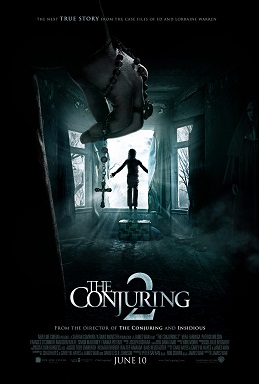
Film Review: The Conjuring 2 (dir by James Wan)


Conjuring_2

The Conjuring 2 will scare the Hell out of you.

Seriously, I’ve seen a lot of horror films, including the first Conjuring (which I absolutely loved).  I’ve seen ghosts, vampires, demons, werewolves, psycho killers, and threats in the shadows.  I’ve seen cats jump out of closets.  I’ve seen ghostly faces suddenly appear in the darkness.  I’ve heard screams and chants and howls.  I’ve seen limbs severed in every possible way.  I’ve seen a lot of cinematic horror and, as a result, I tend to feel that there is nothing that can scare me.

Well, it turns out that’s not true because The Conjuring 2 scared the Hell out of me.

In many ways, The Conjuring 2 tells a familiar story.  Once again, the film begins with an opening crawl that informs us that what we’re about to see is based on a true story.  Once again, a loving but chaotic family is being haunted by evil spirits and the Church has asked paranormal investigators Ed and Lorraine Warren to investigate.

The setup may sound familiar but director James Wan manages to keep the scares compelling.  Over the past few years, Wan has emerged as one of our greatest genre filmmakers.  Whether he’s directing an Insidious film or the latest Fast & Furious installment, James Wan knows how to hold an audience’s attention and how to make the potentially predictable compelling.  In The Conjuring 2, Wan creates and maintains such an atmosphere of dread that even the expected scares (bumps in the dark, voices in the shadows, slamming doors, and faces suddenly appearing in the background) take on an ominous intensity.  From the very first shot, Wan leaves the audience with a profound feeling of unease.  I was not alone in covering my eyes during a few scenes.  I was also not alone is occasionally looking around the darkened theater, just to make sure that there weren’t any ghosts creeping up on me.

That said, we all already know that James Wan is a master of horror.  We know that he can tell a ghost story and, from the minute we saw the first trailer, we all knew that The Conjuring 2 was going to be scary.  What sets The Conjuring 2 apart is the same thing that made the first Conjuring so special.  (For that matter, it’s the same thing that made Wan’s Furious 7 so special.)  Wan fills the screen with horror and spectacle but he also finds the time to celebrate his character’s humanity.

There’s a scene that occurs about 90 minutes into The Conjuring 2.  Ed (Patrick Wilson) and Lorraine (Vera Farmiga) are visiting with the haunted family.  The family has been shaken by both the supernatural and the fact that so many people refuse to believe that they are actually being haunted.  Ed spies a guitar sitting in the corner of the room.  He grabs it and, with the haunted children gathered around them, he launches into a surprisingly good Elvis impersonation.  He sings I Can’t Help Falling In Love With You, all the while glancing over at Lorraine standing in the doorway.

(What makes this especially touching is that Lorraine has been having premonitions of Ed’s violent death and is terrified that she’s going to lose him before they finish investigating this case.)

It’s a totally unexpected scene and yet it works perfectly.  Some of it is because Patrick Wilson and Vera Farmiga have this great chemistry that makes you believe that they actually have been married for years.  But it’s also because the scene reminds us that The Conjuring 2 is about more than just ghosts and scares.  It’s also about love and family.  The haunting is threatening to end Ed and Lorraine’s love story.  The haunting is threatening to destroy a loving family.  Ed and Lorraine aren’t just investigating a ghost but they’re also saving a family.  They’re not just fighting against the supernatural.  They’re fighting for love.

And, in our cynical times, that may sound corny or silly or old-fashioned.  Well. you know what?  The Conjuring was an old-fashioned film and, in a way, so is The Conjuring 2.  But who cares?  Horror works best when it’s mixed with humanity.  The Conjuring 2 may be a horror film but it’s also a celebration of humanity, love, and family.

You may have noticed that I haven’t go into many specifics about the plot of The Conjuring 2.  I don’t want to spoil it for you.  This is a film that you should experience with fresh eyes.  I could tell you about the scariest scene in this film but, if I did, you would not get the full experience.  I’ll just say that I’ve seen a lot of scary movie nuns but none of them can compare to The Conjuring 2.

The Conjuring 2 is the best supernatural horror film that I’ve seen this year so far.  It will scare you and it will touch your heart.  See it.

Also, be sure to stay for the end credits, which feature a lot of genuinely creepy snapshots of the actual locations where the film’s haunting is said to have occurred.  Not only are the pictures scary but they also show the care with which The Conjuring 2 recreated 1970s London.  Is the picture below a scene from the film or is it a picture that was taken during the actual haunting?  You’ll have to see The Conjuring 2 to find out!

the-conjuring-2-1